|
|
 |
What They Are
|
By didactic materials we understand
sets of content and of methodological and didactic
resources (such as activities involving self-teaching
or evaluation, etc.) organised according to a
set of objectives and geared towards facilitating
the student's learning process.
From a pedagogical standpoint,
didactic materials must constitute an instrument,
a resource or a means to help to understand content,
to attain objectives, and to acquire skills. They
should also motivate students and communicate
content in such a way as to facilitate comprehension.
At the UOC
and to date, these concepts have materialised
basically in two types of didactic material, namely,
those in paper
support and those in
digital support,
integrating two or more media (also known as multimedia
didactic materials).
|
How They
Are Elaborated |
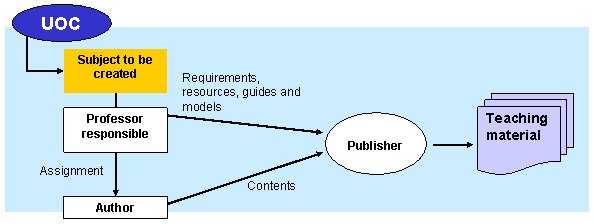
At the UOC, the elaboration
of didactic material is carried out in the way
described in the following diagram:
The UOC needs to create material
for a subject. The professor responsible defines
what type of materials they want and what characteristics
they have to have. They conceptualise the materials,
produce the table of contents and decide what
they should be like.
Certain requirements and guides
arise from this (the style guide for teaching
materials, the technological design guide for
teaching materials, etc.). Subsequently, where
appropriate, the necessary resources are produced
to make the materials work (such as browser, search
engine or glossary resources, elements that allow
video and sound to be watched and heard); likewise,
where necessary, a model is produced that includes
all these resources.
The publisher is in charge of collating
the contents from the authors, carrying out the
various reviews and producing the teaching materials
from the guides, contents and model (if there
is one).
The professor responsible has to
find the authors and coordinate the work of all
of them to produce the final format.
|
Types
of Materials |
Whether on paper or as digital
media, the teaching materials are based on the
knowledge of the professor responsible for the
subject.
|
| |
Materials on Paper |
The production of materials is
based on the content received from the author
and in the Scriptorium. The Scriptorium
is produced by the UOC and is a guide to the editing
of printed teaching materials and for the covers
and labels of complementary materials, such as
videos, CD-ROM, disks, etc.
Concerning paper materials, the
most noteworthy thing from the technical point
of view is that in most cases they are printed
digitally (directly from Postscript). This makes
it possible to produce the content with greater
flexibility and speed.
|
| |
Multimedia
Materials |
The production of materials
is based on a technological design guide for multimedia
teaching materials. The following requirements have
to be met:
|