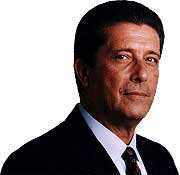
Federico Mayor Zaragoza:
Education, the cornerstone of democracy

|
Federico Mayor Zaragoza: |
|
|
|
|
|
|
First and foremost, we need to ask what democracy actually is. The term democracy is of Greek origin and means ‘the people’. It is the people who rule, the voice of the people is interpreted by the authorities in order to carry out the people’s will, not their authority. This is the difference between democracy, autocracy, plutocracy, oligarchy, bureaucracy, technocracy. It is really all the people, the citizens, who rule. And for a democracy to be truly genuine, all the citizens must have the right to express themselves, to participate. |
|
If we do not participate, we are not citizens; we are counted, but do not count. |
Descartes said, “I think, therefore I am”. If I think, it means that I am, and if I do not think, I am not, I am not a human being, who has an enormous capacity to create, invent, imagine, something which no other living being has. But we are also capable of feeling, and of reflecting on these feelings. We can also say “I participate, I am a citizen”. If we do not participate, we are not citizens; we are counted, but do not count. We are taken into account when the elections come round, when they hold opinion polls, but when we count is when we are real citizens. |
| We have to educate ourselves to be really able to act as fully-fledged citizens... |
We have to educate ourselves to be really able to act as fully-fledged citizens, to participate, to dissent, to denounce, to applaud, but not because we are told to do so, not because someone gives us instructions as if we were mere puppets. “I do so because I want to, because I have thought about it, I have deliberated”. |
| We are told that we are living in the society of knowledge, but it is not true. We are in the information society. |
We live in a time in which
we are normally spectators, receivers of information. We are told that we
are living in the society of knowledge, but it is not true. We are in the
information society. There are some privileged citizens and we have some
fantastic information media, but they are information media, not knowledge
media, and there is a big difference there. |
| Knowledge
is that which is produced as a result of reflection, thought, and becomes
a personal response. ...we must teach to know, to be. |
Knowledge is that which is produced as a result of reflection, thought, and becomes a personal response. Having these personal responses, having this personal position, this personal sovereignty, doing what I want to do and not what I am told to do, acting in accordance with my knowledge and not what I might be told, is fundamental for this citizen’s participation to be able to exist, for citizens to be able to be agents and factors of an authentic, genuine democracy. But this must be taught from the very beginning; we must teach to know, to be. |
| ...we have to learn how to know, to make or do, to be and to live together. |
Jacques Delors, in the commission he has chaired on education for the 20th Century, said that we have to learn how to know, to make or do, to be and to live together. Living together is fundamental, because democracy is also diversity, it is plurality, it means that we are all unique, we are all different, in an absolutely extraordinary way, but at the same time we converge because we agree with certain universal principles. These universal principles are well reflected in the Declaration of Human Rights of 1948, which is something like an ethical or moral horizon of mankind. We all agree with justice, liberty, equality, intellectual and moral solidarity, as the constitution of the Unesco says. These democratic principles are like a pillar, the rafters or beams that hold up the whole building. |
| This is all possible if at the same time we are all unique and different, and have our own way of thinking and seeing things. |
This is all possible if at
the same time we are all unique and different, and have our own way of
thinking and seeing things. This diversity is our wealth, and at the same
time the fact that we are united by these great universal values is where
our strength lies. Diversity, wealth and union add up to strength. And
this is what makes democracy authentic. |
|
Normally we talk about democracy on a local scale, about democracy on a national scale. Our country has autonomous communities that mark this diversity, they have different languages, a different history, and we are all bundled together in a very nice, very plural and very strong mosaic. We are part of Europe and of the world at once. We are citizens of the world. |
|
| ...we are all part of this space where all cultures must meet and interact. |
In 1945, after that terrible war, genocide, the most abominable practices of destruction and humiliation, a meeting was held in San Francisco to draft the first charter of the United Nations, which got together because they all believed in something, they said “we, the peoples”, not “we, the states”, nor “we, the nations”, they said “we, the peoples”, because nowadays all peoples are part of this extraterritorial vision of the world, we are all part of this space where all cultures must meet and interact. |
| Nowadays, in this supranational space we do not yet have, unfortunately, a democratic framework, an ethical framework, a point of reference. |
Nowadays, in this supranational space we do not yet have, unfortunately, a democratic framework, an ethical framework, a point of reference. Many people make money in dark, shady ways, and launder the money, which is why there are calls for the creation of an international authority to stop this intolerable traffic of capital; but there is also arms traffic which adds up to two thousand million dollars a day. |
|
Can you imagine the
meaning of a world where force is more important than the environment,
than the fight against poverty and providing food and water for all? Can
you imagine how they can say that AIDS cannot be cured in poor countries
because the cost of treatment is too high, while we are spending two
thousand million dollars a day on arms? Can you imagine a world which
burns up sixty-six million barrels of petrol a day? Can you imagine a
world where two hundred and fifty–four thousand people are born every
day, which means that every four days the world’s population increases
by one million? |
|
| ..we have already had enough violence, we have already paid a very high price. |
This is the world we have
and it is here, in this global democracy, where we have to act and where
we have to educate ourselves for this democracy. Because if we do not,
there will be an increasing minority of people, as there already is, who
will accumulate wealth in the face of the immense majority who will live
in absolutely inhuman conditions, which in turn means that slowly but
surely feelings of bitterness, ill will, hate, violence and even
aggression will take root. In a nutshell, we will have great instability,
a situation of total affront to many people, the humiliation of many of
our brothers and sisters all over the world. And there will come a time
when this will give rise to another conflict, another war, another
reaction of violence. And we have already had enough violence, we have
already paid a very high price. |
|
The century that is coming
to an end has been fantastic, we have discovered a great many things:
antibiotics, the vaccination against poliomyelitis... I remember the
forties, when my mother’s face paled and she looked aghast when I told
her I had a sore knee, because at that time it could have meant
poliomyelitis. But that is all water under the bridge, and we must realise
although we have worked wonders, at the same time we have never stopped
killing each other. |
|
| ...democracy must be global and it has a name: the United Nations. |
We have had two great wars —which, let it be
said, did not start in Africa or in Asia, but in the heart of Europe—
and we have had an immense number of conflicts that led many people to
give the only thing they had to give, their own life. Therefore, democracy
must be global and it has a name: the United Nations. Recently, the more
powerful countries, including Spain, have been somewhat wary, have tended
to convert, albeit slowly, this great institution, which is a sphere, a
space of democracy and an ethical reference point, into an organization
for after the conflict, post-conflict, rather than for averting war, as
the charter says: “We, the peoples, have decided to spare our children
the horror of war”. |
|
But now it is no longer used to construct, to pre-empt conflict, serving only to act after the conflict. This is why humanitarian actions, actions for refugees, the displaced, the wounded, prisoner swapping, are developing. These are all humanitarian actions, and are all well and good, but they should be left to the Red Cross. |
|
|
...violence is incompatible with democracy Impunity is incompatible with democracy. |
The society of nations,
the United Nations, should prevent war, build peace, otherwise when there
is war, there is no democracy, when there is violence, the latter takes
hold of everything. Let nobody be misled: violence is incompatible with
democracy. And when those who resort to violence are not made to pay for
it – if it goes unpunished — what better worldwide example than the
Pinochet affair — then there is no democracy. Impunity is incompatible
with democracy. |
|
We therefore have an interactive circle, which could also be a triangle, where each one of the angles can interact continually with us. Peace, long may it last, must have a fair development, a fair distribution. This is only conceivable if there is a system of democracy, that is to say, the voice of the people, who protest when things go wrong. |
|
| No authoritarian system ever had fair laws. |
Peace is the fruit of justice, as is often said. I believe that this is true, and if the law is to be just, then it needs the voice of the people. No authoritarian system ever had fair laws. Why? Because there is only silence. The people does not exist; only those who rule call the tune. This is justified by saying that it is the empire of the law. But was there not law in the Weimar Republic when Hitler was there, or in Russia, in the Soviet Union, when Stalin was there? What we must do is transform legality into justice, and do so via the intervention, by the participation of people when there is a democratic system. |
|
The interaction between peace, democracy and development is the way to understanding why democracy is our hope, why it is so relevant nowadays from all points of view. |
|
| ...I am concerned about capacity of expression, why one may be free to express oneself but not have the capacity to do so because one has not been properly educated. |
I have talked about freedom of expression as a basic human right, but I am concerned about capacity of expression, why one may be free to express oneself but not have the capacity to do so because one has not been properly educated. This made me admire my mother and father greatly, who had nothing but a very short primary education; thanks to their work and their personal formation they eventually developed their personality and creative and participative capacity. |
| Tolerance is not indulgence, tolerance means putting ourselves in other people’s shoes |
This is something that we must bring into education at all levels. We must realise that we have to be citizens of the world, we must know history, we must think about what may happen, and above all we must know that there are values that are fundamental to teach ourselves, and others, democracy, tolerance. Tolerance is not indulgence, tolerance means putting ourselves in other people’s shoes, tolerance is acting as if we were actually the person we are thinking about or who is our reference. In a word, otherness is fundamental for this democracy to be genuine, strong, consolidated. |
|
Thus, it is education that gives us this capacity to act by ourselves, but we need time to think, we need time to dissent, we need time to stop being tame. |
|
|
I often quote the poems of the Llibre d’hores [Book of Hours] by Jesús Massip, which delighted me. The other day I told him that it is great to think about tameness as time goes by. In his book he says that the hours will return and will find us all grown up and tame. |
|
|
Thus, what democracy needs — and ditto education for democracy— is for the hours to find us always untamed when they come back. This was one of the great lessons I learnt from my father, the permanent posture of dissent as an ethical demand, i.e., I cannot say I agree if I do not agree; but without violence, never violence, violence breeds violence. But firmly, perseveringly, we must say “no, I don’t agree with that”. Because that is the only way we can change things. |
|
| Things must never be accepted the way they are, because otherwise we shall never have a fair democratic system |
I will tell you an anecdote from some seven or eight years ago, when I was in the United Nations. One day my father asked me how things were going in the Unesco, and I answered that things were looking up; he replied by asking if things really were looking up or if I was just becoming tamer. That is what we must think about every day: are things really looking up or are we just letting ourselves be led, dragged on and on, saying that there is nothing we can do and that we must accept things the way they are. Not on your life! Things must never be accepted the way they are, because otherwise we shall never have a fair democratic system; if we allow ourselves to float away on the winds of uniformity, gregariousness, hegemonization, we will never be what every human being should be, imbued with this personal sovereignty, the capacity to design one’s own life. |
|
Since I have addressed this need for the existence of a supranational institution, the United Nations, which need to be helped and reinforced, and which, in actual fact, are becoming weaker, I would like to conclude by referring to the civil society, which must play a more relevant role via the non-governmental organisations. |
|
|
Recently there have been signs that point to their not being in agreement with the way most of the larger-scale actions in international cooperation, financial actions, international institutions, monetary fund, the world bank, etc. are being managed. |
|
| We need a worldwide network of the philosophy of the non-governmental organisations |
I would just like to give some brief thought to the importance of setting up a kind of network, an undertaking in which nowadays entities such as Universitat Oberta de Catalunya [Open University of Catalonia] can help us, because they have the capacity to master these computing media and establish large worldwide networks. If a worldwide network of the philosophy of the non-governmental organisations that wish to increase international cooperation is not set up, then this will not be possible, because our interlocutors are too high up, too big. We are witnessing the so-called mega-merging of companies, institutions..., and states play an increasingly lower-profile role because they can only act at national level and they also have to join together, they have to set up unions such as the European Union. Hitherto, we had only economic unions, but they could become political and strategic unions, in which case they will be more important, which means they must have other, non-monetary strands bringing them together. And as we say at home: “never lend friends money, money separates people, rather than unite them”. We are united if we think in the same way, in the same direction, if we feel the same values. That is what could unite Europe, which would be the Europe of the lights, of democracy, of inspiration, of opening. |
| Cicero deceived us, because he told us “if you want peace, get ready for war”... |
Open University, open does not mean open only to
Catalonia, but open from Catalonia outwards, open to everyone. And that is
what we must do, from Tortosa, from Catalonia, from Spain, from Europe.
Europe has been too closed. Europe has protected itself. We talk about a
free market: what free market? The European Union’s agricultural market
is one of the most captive markets in the world, one of the most protected.
We must learn more about the reality of the world from our own reality,
and in this way begin to live the so-called global village now and be able
to have a global democracy and exercise as citizens of the world, which is
the most important thing today in the education for democracy. |
| ...if we want peace, we must get ready for peace. |
I have backed the concept of the culture of peace and non-violence versus the culture of imposition, of force, which has always been present in our history. Cicero deceived us, because he told us “if you want peace, get ready for war” and it is true, we have been getting ready for war, and when you get ready for war, you make war. Now we have realised, albeit very late, that we must get ready for peace, if we want peace, we must get ready for peace. |
| We must try to finally put into practice what I said at the beginning, without violence: “We, the peoples, have decided to spare our children the horror of war”. |
So we should do away with so much imposing: I’m bigger than you, I’m stronger than you, I’m richer than you, so you must obey me; I’m the boss and you’ll do what I say. That must all stop, and we must replace it with a relationship of dialogue, understanding, dissent, discussion. We must try to finally put into practice what I said at the beginning, without violence: “We, the peoples, have decided to spare our children the horror of war”. |