
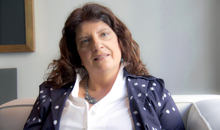
Débora Chomski
What can the media and ICT contribute to teaching? Are they essential?
They're not essential, but they are inescapable. The world today is surrounded by the media, which are another component of our culture. Children come to school with a baggage of knowledge of the information media, so school and family have to help them organise this knowledge and then relate it to the school content. School can't turn its back on this reality.
Do you have any anecdotes about the application of these media in classrooms?
There was an experience some time ago that was to do with cartoons. I recall that during playtime, there were children who spent the whole time kicking each other, like the Ninja turtles or saying "Bare Butt Boogie" and imitating Shin Chan. The teachers were a little concerned because they thought that seeing these things on TV was making them violent. In fact, over the year they realized that it was nothing more than a stylized reflection of the violence that went on in their homes.
A stylized reflection?
These children lived in environments of domestic violence and what they did in their free time at school was just another manifestation of the violence they experienced at home. Instead of doing it the way their parents did, they did it by reproducing the actions or expression of the cartoons. The cartoons acted as a mechanism for expressing their feelings and to process certain personal problems.
Why is visual culture acquiring ever greater importance in children's lives?
Children live in a multi-screen society: computer, tablets, TV, etc. The hegemonic logic is that of the image, but the question is how we complement it. It's important to open up the spectrum to a variety of experiences through other cultural consumption, such as books, "analogue" toys, go outside to socialize, experience nature, in short, be able to compare and know other working logics.
Is TV scheduling today adapted to the needs of young children?
TV3 Catalan TV scheduling is well selected and of high quality. There's a team that's in charge of selecting the cartoons and buying them from countries such as South Africa, France and Canada. These types of product from other parts of the world allow children to discover a range of cultures and realities. Latin American educational channels such as the Argentinian Pakapaka also have a very good range. By contrast, though, the commercial channels are prone to low-cost series of no quality and they operate without an expert in selecting programmes.
How does the consumption of various media at the same time or alternating them in short periods of time influence children's behaviour?
This type of consumption, known as multitasking, is very common in children. They watch TV, they listen to music and they read at the same time and, in many cases, this affects their concentration and understanding of what they're reading. For certain tasks, multitasking doesn't have any effect, for example drawing or painting while they're listening to music or watching TV or doing a task where they don't have to respond to a command or concentrate on the content of what they're reading.
There was recently a case of a four-year-old girl hospitalized for iPad addiction. What do you think of this type of case?
In the book, I write of a similar case, which was, in fact, one of the driving forces behind my writing it. It was if a four-year-old boy hooked on his gadget, a portable gaming console. He had a problem of adapting to reality and of social and school integration in the sense that he couldn't follow a school pace or the rules set out in a context. He was used to "you say", to "you set your own rules", which is what happens in many video games. What was important here was to help him and his family control the time of exposure and to be with them.
What does being with them consist of?
It's not just a question of knowing what our child is watching, but also of asking them what they understood of what they saw. We have to offer the chance of this type of conversation so that they can express their feelings and so we can help them process the information. At school, we can ask questions about what they've seen and relate it to the academic content. This way, children are educated in constructing opinion and the systematization of information. In short, we cannot take the reality they see in the media away from them, but we can regulate the times of exposure, have control over the content of what they're seeing and enter into dialogue with them at school, at family meals or at shared leisure times.
Doesn't such early access to these media displace children's devotion to reading?
The media can act as a starting point for teachers or parents to tell them of things relating to the history, geography or cultures of other parts of the world. Watching cartoons about a book or mentioning a work in cartoons can incentivize reading among young children. In the Simpsons, for example, they often refer to great books, such as "Where the Wild Things Are" by Maurice Sendak, and it leads to them going to look for it. Besides this, internet and tablets offer enriched reading of books, where they can listen to the text or see the characters in the story and even corporealize them through augmented reality. The media make reading more attractive by using other codes and media.
In what other way can the media and ICT complement teaching?
In language learning, for example. Cartoons, children's scheduling in general and even many video games can help in this sense. They're an extraordinary resource as they offer a lot of everyday expressions and situations that are often not covered in language classes as these focus on grammatical aspects or language accuracy.
In light of a growing use of new technologies in the school and family spheres, what childhood do you imagine in the future?
We are seeing a generation of digital natives, children who have been born in a multi-screen environment, in which they move with a great deal of plasticity. It would be interesting to see school and family helping them become critical and creative consumers. That is guiding them so that they can choose their images from the net and their programmes using their own judgement, so that they can give their opinion of what they see and are able to create their own "media", such as blogs, digital books and even video games. On this path, they will naturally demand TV scheduling and games of a higher quality and it will lead to more intelligent feedback between the media and the youngest consumers.
Press contact
-
Editorial department