
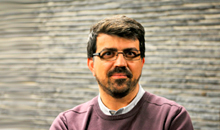
Genís Roca
You've said that it is not enough to have a corporate website. That more is needed. How? What strategies are required?
The internet is multi-channel. You can have different editorial lines for your website or blog. You can have three different Twitter accounts, a LinkedIn account for your company's staff and a Tuenti account for their children. This is a multi-channel environment. It is hard then, from one internet site, to cover the full range of aims. We believe that the internet has enough resources to be able to cover each specific aim with a specific proposal. It is a questionable belief to think that you can handle all your aims with just one website. That said, in terms of the aims of some companies, they don't need to use all these resources and would indeed have enough with a website.
A recent study said that Gallina Blanca was the Spanish brand that best used Twitter, followed by the International University of Catalonia and Banc de Sabadell. Which companies are now leading the way in terms of the use of social networks for brand rollout?
I don't trust these kinds of studies and rankings at all because they fail to take into account the aims that companies are targeting. I know an airline that monitors Twitter, and whenever they find a client who has lost their luggage, they contact them and try to sort out the problem – but they don't have a Twitter account. They're making great use of Twitter, but you won't find them in these kinds of studies because they are not present on this network. What is vital, then, is the company's aim. People value internet metrics highly, whereas they should value the business metrics. The number of followers isn't everything.
Many companies are averse to using social networks, and even prohibit their employees from using them. What do you say to these companies?
In short, there will be a director who feels that they do not lead to improved results and if we don't show them an improvement, they will never authorise their use. It's a question of results, not management styles. In many cases, I feel bad about the situation but can't demonstrate how they can improve things. Though, I do have other examples, some of the worst offices in terms of product sales rates at a well-known bank started collaborating over the internet and went on to lead the region in sales of mortgages. No more need be said.
If, as you've said on occasions, community managers are just a placebo for companies, how would you redesign their role to make them more effective?
The main error lies in the fact that you shouldn't try define their role, instead their functions – and see where these functions, whether all of them or some of them, can be incorporated. Whereas, what has happened is that a new professional profile has developed quickly without revising that which went before. And this is a serious error. When you analyse all that which is required of a community manager at a functional level – which I have nothing against –, you can see that these have to be carried out by different departments within the company. Have you heard the joke about community managers? Two community managers meet and one asks the other: And what do you do exactly?
Are there as many digital divides as generations using technology?
Yes, although the meaning of digital divide used today by many people does not reflect its true meaning. It's an expression coming from a protectionist discourse, referring to the 'underprivileged' who lack resources or culture and who cannot access digital society. Once this problem has been detected, policies are put in place to overcome this digital divide, but I feel that this point is debatable.
How so?
You just need to go for a walk through the Raval district of Barcelona, where you'll see women videoconferencing with their children in Guatemala, Colombia or Peru; while here, at home, there are company directors who have never videoconferenced in their lives. So, it's false to think that it's a cultural problem and false to think that it's a problem of wealth.
So, in what circumstances does this divide exist?
For cultural segments of the population who, for a range of reasons, have not needed the internet to sort out any kind of problem. This segmentation is more about the types of problems that we need to overcome with technology than about access to the technology itself. People learn how to use the internet because they want to book their holidays online, while others don't because they never travel. If a woman who had never used the internet had to communicate with her son, who had recently moved 6,000 kilometres away, she would be sure to learn how to use Skype.
Spain is one of the countries with the highest levels of use of social networks. This makes us connected, but are we better informed?
No, because social networks are a solution to one type of problem and, currently, we basically use them to organise our leisure time. Being connected and leisure go well together, whereas information and leisure don't. We are witnessing an explosion in social networks dealing with our leisure time, but not our professional careers. In my opinion, Facebook is the internet's disco. It's not a place for business, or for discussing sales and purchases.
Many people say that they are impoverishing our youth.
Not necessarily. The young do young people's things. What happens often is that the young are adept at managing their digital leisure and when they enter the labour market those contracting them mistakenly think that this can be applied to aspects of their professional lives. And that isn't always the case.
If social networks are becoming the new consumer leaders, what role is left for traditional advertising?
I'd stress that it's a certain kind of consumption. I don't think social networks can lead consumers in terms of cataract surgery. I think they are just another ingredient among the 'inputs' you receive, but the others still count. It's true that I myself have used social networks to choose my children's school, but it is also true that I've used more than just this. I also went to the school, spoke to the head and to other parents.
Are those who see internet as part of life and not as life itself wrong?
Both are true. I've always liked to say that the digital is a new layer that complements my 'me'. And thanks to this, I am more effective in my personal and professional life, and in terms of my family and education.... I communicate with friends who are faraway, when I'm ill I'm more at ease, I feel more in touch, I'm more opinionated politically. In short, without the digital, I'd be less capable.
Will there come a day when universities and knowledge transfer are exclusively online?
No, and harking back to earlier, everything digital is a layer that complements and expands my capabilities, it is not a layer that substitutes other layers. I really learn more talking to people than reading. I wouldn't want a scenario that was purely online. The format or method should never be the be all and end all.
What's left of the Genís Roca who studied archaeology?
Everything [laughs]. Archaeology has served me well because I'm still more concerned about what people do and why than about the tools they use. Archaeologists are interested in what groups of humans did, not in finding out exactly how to grind stones. Archaeologists aren't experts in making flint knives, but in understanding the changes in the dynamics in human groups from the clues available. This is exactly what I do on the internet now. I am not concerned about how to set up a blog, but about the changes in the dynamics of human groups brought on by using all these resources. I feel quite at home with this logic.
Press contact
-
Editorial department