
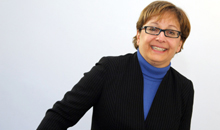
Martha Cleveland-Innes
How profitable have these days been?
Very! I have been in Europe since December 28 and visited five universities. The UOC is my last stop. My research looks at the 49 open and distance universities across the globe. There are seven in Europe and I was able to speak to people from five of those institutions: the UKs Open University, Germanys FernUniversität, the Dutch Open University, Portugals Open University and the UOC.
Have you found significant differences between the Canadian and American open and distance universities models and the European ones?
Each university has its uniqueness. At this point I dont see a particular pattern where we would say North American open and distance universities are different to European ones. There are, obviously, language and cultural differences that need to be taken into account. However, the stories Im getting about leadership issues and about open and distance education issues are very similar. For example, the leadership in all institutions is redefining relationships with traditional institutions in their milieu. Government policies affect what we do in a significant way. Because open and distance institutions have a unique educational mandate, leaders must provide continuous reminders and explanations about this uniqueness to government officials. Only in this way will the open and distance model be considered in government policy decisions.
Where would you situate the UOC among the universities you have visited?
I have not yet analysed the data, so I can only give you a very preliminary sense. European institutions are experiencing a major transformation right now due to the Bologna process, which aims to create a more seamless European Higher Education system where students can access a wide range of courses and programmes of standardised quality. The UOC is a university in transition, due to this process and internal innovations. There is a lot of change occurring at the University at this time. This University is one of the youngest and is a very vibrant institution. There is a new president and some new models in the administration, and people are very excited about whats coming up.
Who have you interviewed during these days at the UOC?
I interviewed members of the faculty, administrative staff and senior management. The interviews have all been very illuminating regarding leadership and, additionally, about issues, trends and the future in open and distance education.
In what way?
We now work and live in a global environment. Staff at all levels at the UOC are very aware of the societal changes underway. Since education touches everyone, it can have an impact that can change society. UOC staff are very aware of the technological changes affecting society broadly, how this needs to be integrated into education and what that will mean for the adjustment to broader, societal changes. The Virtual Campus is well aligned is the way I would describe it, well aligned to respond to the needs and demands of a global information society.
You were particularly interested in how we foster the research work of faculty here. What is your impression on this particular topic?
I see a serious commitment to increasing the research activity among faculty at the University. There are collaborations being created and new ideas for new collaborations implemented. Faculty and staff are also very clear about the realities and that is something I have spoken to other institutions about: in this education model where you have faculty who are managers, teachers and service providers, the integration of research is challenging in terms of time and workload. Specific policies, support structures and reward systems must be in place to ensure research activity occurs. Some of these changes are in place at the UOC and others are coming. There is definitively a significant commitment here to creating a viable research enterprise at the UOC.
What are, in your opinion, the main challenges open and distance universities will face in the forthcoming years?
After a history of marginalisation, open and distance education is being recognised by other higher education institutions as viable education models and they are beginning to emulate what we do - so we will now become part of the circle.
What circle?
The circle of academic higher education institutions. During years we were marginalised. We were seen as second-chance universities and a lower quality educational model. Now our credibility has been raised: we are credible, valuable institutions. So other institutions are now looking for collaboration, advice and engagement and their students are starting to notice us as well. We will have more collaborations and will be in competition for students.
Are there any particular challenges for the UOC?
I heard about the Catalan initiative to foster lifelong learning for those living in Catalonia. I think the UOCs challenges will be to meet the demand of all the students that are going to come to its door. The UOC is going to continue to grow very rapidly and that will be a significant challenge. However, the UOCs commitment to quality online education was very clear during my visit here. Whether I was interviewing people for my research or meeting with them about other issues in open and distance learning, the commitment to providing a quality online learner experience was part of all discussions. So this is very clearly in the UOC mandate. It is very exciting to see what is happening here!
Yesterday you gave a talk on the Online Community of Inquiry Model. Can you tell us a little bit more about this model?
The Online Community of Inquiry Model was developed by Garrison, Anderson and Archer in 2000. It is the most widely known theoretical model for e-learning of those we currently have available. If you check Google Scholar, there are now over 500 research articles published about this particular model. The model includes three central elements: social presence, cognitive presence and teaching presence, acting in concert for students in e-learning environments. A group of us are currently validating an instrument to measure all three presences and their integration, so this is a very important time for the consolidation of this model and I wanted to talk to the UOC about it. My hope is that there will be the chance to collaborate using this model.
Press contact
-
Editorial department