
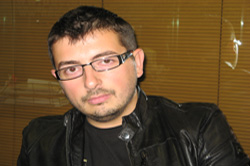
Alfonso S. Suárez
How did the idea of directing a documentary on Spanish dubbing arise?
The idea arose from the need to pay tribute to all those great actors. I have always said that for me the most important part of a film is not the actors, but the characters, and they are the voice of those characters. We have all grown up hearing their voices and it was about time that their work was highlighted and recognised.
After interviewing over forty voices, what have you found out about the world of dubbing?
That it's hard work. Work that is demanding, with scant recognition and even scorned, but despite everything, it's fascinating, almost magical work.There are a great number of myths about dubbing that are false, such as its being an invention of the Franco era, when in fact dubbing began in the early 1930s in both France and Spain, both of which were republics at the time. We also explain that up until the mid-1980s, practically all Spanish films were dubbed, even those of Paco Martínez Soria and Gracita Morales, in which they dubbed themselves. Spanish actors today don't have the same respect for the audience and not only do they not know how to dub but they even criticise dubbing.
Today, Spanish society is increasingly more familiar with English and the consumption of American films and series exceeds that of other languages. Under these circumstances, is the future of dubbing threatened by the consumption of films in the original English-language version?
Dubbing will never disappear. It was born with the talkies and if it dies, it will die with them. The new generations may be hearing films in the original English-language version, but there will always be other languages. Personally, the dangers that dubbing faces don't come from there but from the lack of care taken by some work in recent years. Now, with few exceptions, things are done more quickly, without the loving care and seriousness with which they used to be done.
Your films feature different genres. Do you have a special predilection for any particular genre? And if so, why?
I've done advertisements, fiction and videoclips, but perhaps my favourite is documentaries. From a technical point of view, you have more freedom than in a work of fiction or advertising and there's also an educational part that has always interested me. All of my documentaries deal with film characters or subjects, talking about films using film itself as a medium and that's always a challenge.
What films have influenced you? Why?
Hundreds, although rather than films, I would speak of directors. I am especially interested in Mankiewicz, although there's also Fritz Lang, Billy Wilder, and more recently Ridley Scott. They've all made films in different genres but always with great elegance and formal precision and a very intelligent look at the subjects they handle. And as for films, there's one for which I have a special affection, which is "Once Upon a Time in America" by Sergio Leone. For me, it's the complete film. Both formally and for its meaning, it's difficult for a film like that to be made again.
What is it that drives you to make films?
I would say the need to tell a story, although that answer is now rather hackneyed. I suppose that what interests me is to try to be like the directors I named earlier and to try, like them, to create my own worlds, but which are still universal.
What do you seek to convey to your audiences?
Above all, honesty in working. I believe that in any work, and even more so in artistic or intellectual work, whatever you do, you have to do it sincerely and honourably. Perhaps that's why our production company is called "Verité", because I believe that in this profession you can do many different things and projects, but always with truth. You should never try to cheat the viewer, and especially not yourself.
Can you give us a hint of your next projects?
We're completing a new documentary for the Asturias Film Library about a fundamental filmmaker for the history of Spanish cinema but whose work, the same as that of dubbing actors, has always been in the shadows, and were it not for him the history of Spanish cinema in the last 50 years would possibly be different. It will be finished in a few months and we'll "discover" who it is.
And for next year, we?re preparing a national project for a TV series, but it?s early days yet to speak about that. There?s a time for everything.
Press contact
-
Editorial department