
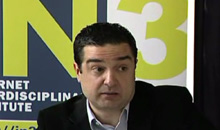
José Manuel Robles
What is the digital divide?
There is no unequivocal answer to that question. The first studies started at the end of last century, so we are still in the process of defining and compiling data to give the concept a solid foundation. But in general terms we understand the digital divide to be the difference between those citizens who access and use technologies and those who do not. Here 'technologies' mainly refers to information and communication technologies.
Basically, the internet.
Yes, that is right. The main contribution of our research group is that we consider that the essence of the digital divide does not lie in the inequalities that exist in access or use of the internet. Instead we believe that it lies in the inequalities that are caused by the way that some people use the internet and others do not.
I am not quite sure that I follow.
The first way of looking at the concept of the digital divide depended on access, that is, whether or not people had an internet connection. How is this first dimension of the divide closed?
With infrastructure, I suppose.
Exactly. Later it became clear that on its own, that was not enough. Because it is not helpful for someone to have internet in their home if they do not understand how useful this service is. And so the second dimension is use. Once these two dimensions were established, we asked ourselves: what are the implications if some people do not use certain internet services that others do use? Some people miss out on some advantages and others do not. As a consequence, there can be an increase in inequality and social exclusion.
This is what you call the third dimension of the digital divide.
Yes. It implies that inequality in a country translates into the digital domain. And because the digital domain opens up possibilities that we have never had before, this means there is a great risk involved. Tomorrow at the Universitat Oberta de Catalunya (Open University of Catalonia, UOC) we will present an article in which we analyse the profile of users of e-administration systems offered by government agencies in Spain. Broadly speaking, we have found that the two variables that most influence use are level of studies and income. This is paradoxical because if anyone needs the financial assistance that is offered by public institutions, it is precisely the people with a lower level of education and more limited financial resources.
It is a vicious circle.
This is a paradigmatic example of the third dimension of the digital divide: the support offered by the state is more easily accessible to those with higher levels of education and income, when in reality the exact opposite should be true.
Could you give another example?
It is more and more common for members of parliament to have blogs so that citizens can interact with them, thus creating a closer relationship between the representative and the citizens they represent. This implies greater democracy, greater freedom, and so on, but it is limited to those who access the blog. Another example is positions vacant. Some jobs are now only advertised on the internet, which means that people who do not access these advertisements are less likely to find work.
What is the formula for tackling this challenge?
It is not an easy task. What our study suggests is that the third dimension of the digital divide will not close unless we eliminate social inequality first. And sociologists know that inequality is a constant in all societies; societies without inequality are unknown. Therefore, we must concern ourselves with alleviating the effects of inequality so that the internet does not polarise social differences. This in turn brings another challenge, because we now entering the ideological domain.
What are you referring to?
If our intention is that people use the most advantageous features of the internet, the first thing we will have to do is decide exactly which are the most socially relevant uses. And later give them incentives, protect them and convince people to use them.
To put it another way: tell people that it is good to use the internet to do certain things.
And of course, who has the power to define what is good and what is not? If we cannot apply principles that are as objective as those in the first and second dimensions (infrastructure and training), it will be difficult to resolve the third dimension. For example, if we go back to the blogs, some people will believe that it is a good idea to have a close relationship with their democratically elected representatives, whereas others will see this as less relevant for ideological reasons.
Press contact
-
Editorial department