
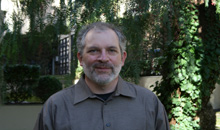
François Bar
Why use cell phones instead of computers?
Cell phones are a good way to lower the barrier for VozMob users to express themselves. They usually don't have computers whereas the phone is immediate and intuitive. And they always have one with them.
How does VozMob work exactly?
We've set up a system that lets people take pictures, record a narration for them (three or four minutes of audio) and then pack it into a slideshow to send it by MMS to the blog where it shows up. You can also add keywords if you type them on your phone.
What is inspiring immigrant workers to share their stories?
It's a long-term goal, but one of their real heartfelt desires is to explain how they live and how they contribute to society. But the project also has other benefits. One group we work with used to write a newsletter "by day laborers for day laborers" and they were having many problems getting stories for it. Now they publish three different issues of the newsletter with stories that come from the cell phones. Another benefit is that users that send pictures usually want to see them published, so they go to a computer and browse the VozMob site. Many have then started to edit the text and the pictures or to rearrange the way the story was presented. So it is also a way to draw people into the information age.
What are the stories in VozMob usually about?
They report things happening: workshops they organize, demonstrations they participate in, actions like cleaning the street around their labor centers...
Do they also use it to report abuse?
Initially, I had this same thought: that VozMob would be a good tool for reporting abuse. And that certainly is true, but that's not the main interest, since most of the stories are positive. I continue to be amazed how people wanted to do this: in the last two or three days we've got dozens of posts sent by people that have other important things to do like finding work or being with their family. VozMob seems to fill a need for expression.
Most of the posts are in Spanish. Isn?t that a barrier to attract an audience?
Yes, language is a big challenge and we're looking at different ways to deal with it. We?ve started translating some posts and the system allows any registered user to translate content, so if you see an interesting story and you think it should get broader exposure you can translate it. I've also talked to an English class at the university and there may be an interest in using that as an exercise for their students. And, in some cases, even the Spanish-speaking people can write a bit in English and they like to do that, and then we may help them to correct the grammar or the spelling. The other thing we are trying to do is to put subtitles on the videos.
Do you think VozMob can be repeated in other countries?
Yes. We would like to see other groups using the same platform in other countries and in other contexts. I'm interested in that from more a theoretical viewpoint because I think that users have a very important role in innovation, and we've seen that in our projects. VozMob is not a system that we've designed and then taught people to use. We've designed it with them. So the users have had a very big impact on what it looks like today.
Another interesting thing is that, when you talk about innovation, you usually think about rich users with pricey gadgets. This is not the case.
This is innovation at the bottom, with people that have a lot of constraints. My theory is that we'll get all different kinds of innovation if we get different kinds of users. So the more diverse users I get, the happier I'll be. We've already offered this system to other groups and they are starting to use it and change it in their own way. One of them is working with homeless people in Los Angeles, another one with kids... I've also started to talk with a bicycle association that wants to use it to report problems with bicycle paths. The more contexts we see working, the better.
This is your first seminar as visiting professor at the IN3. What made you join the UOC?
I've worked with some UOC researchers like Mireia Fernández from a long time. In October I met Adela Ros, who is also working with immigrants, and I told her about my project. So what?s driving me here is not just to give a seminar but to build collaboration. In fact, I'm really hoping that the people coming to the seminar will be interested in this research project and that we can use the next sessions to discuss it.
Your most recent research focuses on the impact of information technology for development in places like Africa and Latin America. How can IT accelerate the pace of development in those countries?
In many ways. There are all kinds of different forms of IT that may useful. One of the most important ways is, again, cell phones. They are cheap, easy to use and widely available, so most people have them and some use them to support and advertise their business or even to relay market information, to know what's for sale or what the demand is or what price people are going to pay. The economist Robert Jensen has done a nice study looking at the price of fish in Kerala on the southwest coast of India.
How have cell phones changed the way those fishermen work?
The way they usually work is they go out in boats and then, at the end of the day, they just head for the beach, where people come and buy their fish. Before they had cell phones they'd just guess where to land. Sometimes there would be other boats there, so the price would be low and maybe not all the fish would be sold. Now they have cell phones, they just call a friend who's on the beach and ask him where people are willing to buy fish and where the best price is, so they pick a spot that makes more sense. This economist has done a study looking at the price of fish and the amount of waste before and after cell phones. What he found is that the price was very erratic and there was a lot of waste. Now they have cell phones, they are able to distribute themselves on the beach in a much more efficient way, so prices have converged and the amount of waste has been reduced.
Press contact
-
Editorial department