
Rectors of UfM universities commit to fostering student and researcher mobility
At the conference, held today in the Historical Complex of the Hospital Sant Pau, in Barcelona, managers of higher education centres from the 43 Union for the Mediterranean countries (UfM) have agreed to provide greater facilities to students to recognise credits approved at universities and to make student and teaching staff exchanges more flexible than at present.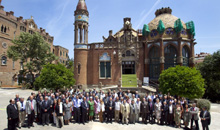
- The universities and more than 100 experts who met today have agreed on a declaration containing 7 proposals, which include asking the European Commission for greater investment to modernise the universities in Mediterranean member countries and to favour their competitiveness. The conclusions will be sent to the Euromed Ministers for Higher Education, Research and Innovation, who will be meeting this autumn in Slovenia.
- With a view to advancing the construction of the Euromediterranean Higher Education Area, proposals were also put forward regarding the creation of a council that includes the universities in the Euromediterranean zone (Euromed), the establishment of a higher education and research observatory and the opening of a UfM university online portal through which knowledge can be shared and exchanged among lecturers, researchers and students.
- The get-together was organised by the EuroMed Permanent University Forum (EPUF), an international network of organisations from the field of higher education, with the collaboration of the Rovira i Virgili University (URV), the Universitat Oberta de Catalunya (UOC), the Agence Universitaire de la Francophonie (AUF), the Sant Pau Private Foundation, and European Institute of the Mediterranean (IEMed). Participating at the rectors’ conference were Josep Huguet, Catalan Minister for Innovation, Universities and Enterprise; Lluís Arola, EPUF chairman, and José Manuel Martínez Sierra, General Manager for International Relations at the Spanish Ministry of Education.
The Union for the Mediterranean (UfM) rectors’ conference has today agreed on a declaration containing 7 proposals which will be presented to the Euromed Minsters for Higher Education and Research, who will be meeting this autumn in Slovenia. The meeting held today in Barcelona, which was attended by presidents and experts from the field of higher education, has been a significant step forwards in the construction of the Euromediterranean (Euromed) Higher Education Zone, an objective that was made public in what is known as the Cairo Process and which is subsequently being promoted through the EPUF international network of universities and institutions of higher education. At today’s conference, the universities specifically agreed to establish more flexible systems for exchanges between students and teaching staff, while at the same time undertaking to develop student and researcher mobility in the EuroMed Zone and make it easier for students to have credits approved at one of the universities in the 43 UfM countries recognised. This means a quicker and more streamlined process for accrediting credits between Euromediterranean zone universities and that students who decide to study subjects at any of the EuroMed universities can accredit the credits that they have completed when they return to their university. There are currently 43 countries in the UfM and around 2,000 universities, with 27 million students. The specific measures for the construction of the EuroMed Higher Education Zone also include the creation of an interuniversity council, an online portal through which knowledge can be shared and exchanged among all the members of the university community, and a higher education and research observatory.
More investment
During the conference, presidents and experts called for greater investment from the European Commission for countries in the UfM and FEMIP (Facility for Euro-Mediterranean Investment and Partnership), with a view to modernising the zone and favouring its competitiveness.
Since the creation of the Union for the Mediterranean on 13 July 2008, the universities from the member countries, in particular those who are not part of the European Higher Education Area (EHEA), have viewed the new institution as a beacon for the construction of the new Euromediterranean Higher Education Area. However, since the EuroMed ministers’ conference in 2007, there has been extremely little progress towards the creation of the EuroMed Higher Education Area.
During the meeting, the participants made clear the concern for the growing interest of science and university policies towards a single research-based approach and have said that a balance needs to be found between research and the main task of the university, i.e. people’s higher education.
At the conference, the idea was also brought to the table that in order to progress towards a comparison model between all university institutions, subsequently accountability is essential, but to achieve this we need governments and supranational authorities, such as the UfM and European Community, to provide universities and their research centres with adequate funding.
The conference also highlighted the certainty that commitment by the UfM with the assurance of quality in research and teaching is the best guarantee for achieving the fair and balanced progress of society and at the same time is the main driving force for fostering mobility that leads to a guaranteed return.
UfM proposals
The 7 proposals for the 43 states and the institutions included in the UfM to come out of the conference are:
1. The creation of the UfM Interuniversity Council, comprising all the universities of the 43 member countries, whose main mission will be to promote the EuroMed Higher Education Area and work on resolving problems between the different national legislations.
2. To establish the UfM Research and Higher Education Observatory, which will help disseminate scientific research as a guarantee of quality and which will also be an instrument for liaison between new graduates and the creators of public and private jobs.
3. To establish the UfM UNIVERSITIES portal, which will be a source of information and dissemination for the programmes and calls likely to be used by the university community.
4. To set up the assessment and quality logic in the Euromediterranean area so that it favours coordination between the different national authorities and agencies. The appropriate bodies will be created that come under the remit of the UfM and the coordination of the Interuniversity Council.
5. To encourage mobility among the university community and the scientific community and request national authorities to activate the economic and regulatory means to do this, especially to guarantee the recognition of credits on the student’s return.
6. To ask UfM member states to make the necessary investment to enable the universities to carry out the social task assigned to them: to stimulate innovation, excellence and involvement with the society around them. In this sense, a clear commitment is called for from the UfM and the FEMIP (BEI) to fund the necessary structural reforms to ensure that all UfM students receive quality teaching.
7. To establish the subsequent control culture and increase university autonomy as a focus point for the new dynamics of the UfM university and research policy and of its member states.
These measures come in response to the need to create a Euromediterranean Higher Education and Research Area, the aim of which is to promote quality higher education, and consequently the economic and social development of the zone.
Participating in the opening ceremony were Lluís Arola, EPUF chairman; Gemma Sendra, Director of the Historical Complex of Hospital Sant Pau; Senén Florensa, IEMed director; Imma Tubella, UOC President; Bernard Cerquiglini, President of the Agence Universitaire de la Francophonie, and Joan Majó, Catalan Commissioner for Universities and Research.
The inaugural speech was given by Georges Haddad, Director of the UNESCO Division of Higher Education, and Enric Olivé, EPUF executive secretary, presented the report into the situation regarding the Cairo Process 2008-2010.
Taking part in the subsequent debate were Francesc Xavier Grau, URV President; Francisco Michavila, Director of the UNESCO Chair in University Policy Management at the Polytechnic University of Madrid and honorary president of Castelló’s Jaume I University; Mohamed Zaher Benabdallah, President of Moulay Ismaïl - Meknès University; Jean Marcou, Director of IFEA-OVIPOT and Director of Grenoble’s Centre d’Études Politiques, and Joseph Mifsud, President of EMUNI University in Portoroz.
Press contact
-
Editorial department