
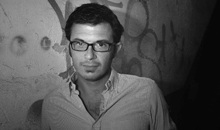
Alberto Arce
You went to Misrata just when many journalists were heading for home, after covering the first weeks of revolution that followed in the wake of popular uprisings in Tunisia and Egypt, during the so-called Arab Spring. Did you mean to arrive late, swimming against the media current?
I always swim against the media current. I don't let anyone take my decisions for me. As a freelance journalist, I am not in anyone's orders or pay, so I make my own travel plans, both when and where. Misrata is where a large part of the Libyan war is being settled, with brutal levels of violence and the worst fighting. The moment the journalists suddenly left Misrata gave me the ideal opportunity to enter. When you're a freelancer, you should always try to sell your work and one of the most obvious solution is to be where no other journalists are. In any case, Spanish media editors do not follow information according to its relevance or quality, but by the places where they can cover it. There is no room for freelancers, so the strategy of travelling to a place where there is no press presence and trying to create a niche for information tends not to work because, in this country, information is the last thing that matters.
Once at the front, how do you assess the media coverage of the conflict? Do you feel that Europeans, particularly the Spanish, understand what is happening in Libya?
Those who want to know, know, because the multiplication of internet news channels gives you all the information there is. It's out there and easy to find. The institutionalised media has been dead for some time and focuses on sensational journalism, trash television and political gossip, particularly in terms of international conflicts. In short, the public, taken to be a group of people who watch the official television, read the official press and listen to the official radio stations, don't understand a thing because the media don't tell them anything. They're being dumbed down every day. It's much easier to find out the wheels Fernando Alonso used during a Formula 1 training session than watch a report of more than two minutes about Libya. What can you expect from this news context?
As an observer of the Libya conflict during the NATO intervention and given the suppression of protests in Syria and Yemen, how do you think the international community will act in these countries?
As always, with much hypocrisy. It intervened in Libya, but not in Bahrain or Syria. It will act in accordance with business interests, prior alliances and the whims of egomaniac leaders. In any case, never according to a real desire to protect human rights or make progress towards democracy. Young people in Arab countries who rebel can only count on themselves. Nobody is fooled in the trenches. If it was left to the West, the Misrata rebels would all be dead. NATO has been bombing Libya for over two months and has not been able to crush the Misrata siege. You either play the fool or see that they are not bombing effectively and making it look like they're helping the rebels. There only partly helping them. Has nobody asked how Gaddafi's army can withstand these bombing raids for months without leaving their posts?
In terms of the so-called Arab Spring, what can we expect from the social movements and regime changes in Tunisia and Egypt?
I don't know. Perhaps the situation will improve, perhaps there will just be cosmetic changes without any real implications for the wellbeing of the population. I'm more inclined to go with the second option. Changing four faces does not constitute regime or political change, simply selecting four well-known crooks and removing them from power and consequently calming the protesters, because the heart of the state structure continues to beat as it did a year ago. Regime change involves a Constitution, new parties, an electoral system, new leaders, political culture, democratisation, etc. Do not think that the fall of a dictator constitutes regime change on its own. Much more is needed, much more in-depth analysis and more time to reach conclusions.
During the many weeks you spent in Misrata, what was your daily life as a freelancer on the ground like?
Daily life meant leaving home as early as possible and spending as many hours at the front as possible, accompanied by a good translator. Over time, you learn to read the situation, the soldiers get to know you and trust you, they start supplying you with information and allowing you access with them to the front and the battles. Information is time and patience. Money buys time and patience comes from the luck of not having someone back in Spain asking for stupid headlines, continuous exclusives or stories that are invented from a desk in Madrid.
How did you get close to sources and interact with people involved in the conflict?
You get close to sources by showing humility and millions of questions, winning their trust, listening to them and observing them with all your powers of understanding. For example, if the soldiers decide to attack, you move with them to the most advanced position. If nothing happens to you, these soldiers will respect you and on the second day they will inform you if anything happens because they respect you. As a reporter, the main difficulty is money. No money means no satellite phone or time for good coverage.
On your blog, you recall the emblematic punk slogan, Do It Yourself, to define your activity within international journalism, specialising in conflicts. How can you apply DIY philosophy to war reporting and also meet the new high levels of demand and quality?
There's just one formula: you either do it yourself or you don't. If I had to wait for someone to help me work, I'd still be waiting. The formula is: I want to be a journalist. Nobody has hired me as a journalist. Well I am, I'm self-employed, I do my job and demonstrate that I can do it well. Nobody has hired me yet. I'm still a journalist. Nobody has hired me yet. I have discovered that we live in a country where there is no direct relationship between work quality and quantity and professional undertakings. I am frustrated because I see that we live in a country where it is increasingly who you know and friendships that have a bearing on work and that instead of time spent studying journalism, I should have spent time making friends or networking. And because I didn't do this, I get more frustrated. And I'm not going to throw in the towel. I carry on working and in the end discover myself by working for the foreign media who prefer me to produce information in Spanish which is then translated into French and English and published all over the world. In Spain, nobody buys my work, but they do in France. That's nothing new. Over there, they go by your work, here it's who you know. The only solution is the one adopted: emigration. In Barcelona, the problem was translating work into Catalan. In France, I wrote in Spanish and they translate it for worldwide distribution. It's how you approach life. My Do it Yourself approach means that my pieces appear in Sidney, Paris and Jakarta, but not in the city or the country where I always wanted to live.
Your career as a reporter includes experiences in some of the most violent and dangerous of today's post-war periods, such as Iraq and Afghanistan. I suppose that this professional condition gives you greater freedom, but it also puts you in a vulnerable situation that becomes worse by the lack of safety of the terrain. How do you get your project off the ground given these determining factors?
Money stopped being important to me a long time ago. I don't need much to live. I have no plans, but I have a passion and desire to work. What can I say? I either get sponsorship or I don't work. Which is why I always say I don't understand how I'm not given any space. The more awards I win (abroad), the tighter the door closes. The ICIP has sponsored two of my trips. I have been immensely lucky with this institution, but it must not become a content producer, that's not its purpose. The problem lies with the media. However, vulnerability is at the same time strength. I'm 34. I'm part of a generation that will never have the working conditions the previous generation had and have. Sooner or later, your work speaks for itself. Persistence, persistence and persistence.
You work in conflict research and analysis as a tutor on the UOC Masters in Conflictology run by the UOC's School of Cooperation Postgraduate Department. Bearing in mind the complexity of current crises, does providing news coverage of a war or post-war period require journalists to have prior training in conflictology?
I believe that if I have tackled conflictology-related issues, it has been through experience on the ground and not vice versa. In any case, this approach seems more logical to me. In my opinion, the news coverage of a war, if it comes from the battlefield, requires good thinking, and not so much in the way of university degrees or academic manuals. War is a special situation and you need to know how to adapt to it, to fear, tiredness and the addiction to adrenaline. You need to know how to choose your sources, choose a good translator, separate the truth from the lies as much as possible, not play the hero more than strictly necessary, learn about combat dynamics as quickly as possible (times, places and weapons used), read as much as you can and learn to surround yourself with good advisers. Almost everything you'll need to be on the front-line can only be learnt once you're there. Being shot at is a personal and non-transferable experience for which there are no theories, it is difficult to get used to and however much you think you have overcome it, it'll still take you by surprise every time it happens. Dealing with people requires psychology, but that's what happens in a conflict and in daily life. In the end, it's a case of witnessing a lot of human suffering that has to be processed correctly so that it does not cause excessive harm.
You're about to leave for Guatemala to take on another project. What will it consist of?
If I'm honest, I still don't know what I'm going to be doing in Guatemala. I'm going to be there for six months doing something related to the state of urban violence in the capital to compare the violence created during the war with the violence of the post-war, which stems from the abundance of weapons and the lack of resources for the former combatants. In any case, I prefer the truth to surprise me and change my ideas rather than for me to design it on paper at home.
Press contact
-
Editorial department