
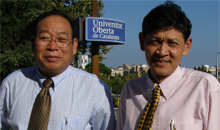
Fanxi Meng and Bei-Zhong Han
If you had to explain to someone who has never been to China about the current agricultural situation in your country, what would you say?
Fanxi Meng. I would say that today we have important key crop productions, such as rice and wheat, and whereas thirty years ago we were growing cereals to feed ourselves, we now use them to feed our animals. We also have all kinds of fruit, vegetables, fish - be it wild or farmed - and meat, as well as large-scale cotton growing. As well as this, every region has winter and summer schools and agricultural universities and the young farmers are well versed in modern technology.
China only has 7% of cultivable land to feed 21% of the world's population, which is still growing. Despite this, you firmly state that you are able to feed yourselves. But when?
Bei-Zhong Han. China is a vast country, with regions that differ widely from one another and with big cities, but despite this, I reckon that in five or ten years we could be completely agriculturally self-sufficient.
Isn't it possible to extend the cultivable land?
Bei-Zhong Han. Unfortunately, only a small part of the land can be cultivated. Added to this, we also have to consider that economic development also means that the cities will grow and need land to build homes and facilities. But now the government wants to control this and limit it to keep the cultivable land as such.
Apart from the limited amount of cultivable land, what other problems do you face?
Bei-Zhong Han. We have many challenges and problems. For example, we use too many fertilisers and herbicides. And you have to add droughts to that. How can you combat that? This is where genetically modified crops come into play. The government is fostering research in this area and I personally support this practice as I believe that transgenics are the best solution.
Is it the ideal solution for China?
Bei-Zhong Han. I don't know if it's the solution for China, but it may be for the developed countries as transgenics need much less water. For example, in the case of rice, we don't need the huge amount of water that's normally used with traditional cultivation. And as crops that use a lot of water are easily infected by insects, and herbicides have to be used that have an impact on the environment, these become unnecessary with transgenics. Therefore, it's a good option for the developed countries.
What was the effect of China's joining the World Trade Organisation (WTO) in 2001 on the evolution of your agricultural sector?
Fanxi Meng. I think it's been good for us as we're in international markets. But thinking of China today, of our people, what we have to look at is how to feed them. Because, even today, with everything we have, this is the question we always have to ask. And the answer is that we don't have any problems. Because if you look at the Chinese population, you'll see no one's hungry.Bei-Zhong Han. Today, even the poor people have food. It might be very basic food, but they don't want for anything to eat, even though at a nutritional level, they're undernourished as we need to produce many more animal proteins such as meat, eggs or milk so that they have more nutrients.
In terms of nutrition, has the evolution also been so significant?
Bei-Zhong Han. Nutrition is a very important issue that we learned both from Europe and the United States once China opened up to the world. So, for us, it's a very young tradition. Unfortunately, though, the new generations only want to follow the North American lifestyle and they eat lots of hamburgers, chips, etc., which means that in the cities we're seeing more and more overweight and obese children. And that's not good.
So how do you tackle this problem? Education, awareness campaigns?
Bei-Zhong Han. The problem is that if you speak of malnutrition in China, most people will tell you that they're poor and they eat what they've got. While, on the other hand, we're seeing rich families who are eating too much. Therefore, we have to teach them to eat correctly, because it's not just a question of eating meat, and that's a problem for Asians. We Chinese eat a lot of protein, and we get a large part of that from a very healthy plant such as soya, but the new generations prefer animal proteins from meat and milk. And at a nutritional level, it would be best to consume more plant proteins that animal proteins. What is evident is that we have to teach people in the sense that they need to eat well with the most suitable food.
You are members of a delegation that has visited the UOC in both Madrid and Barcelona. What role does cooperation play in this evolution?
Bei-Zhong Han. Following China's opening up, thirty years ago, we've encouraged and supported our students in going to foreign universities and studying a great many things. Most of them have been supported by the government and have come back to China to apply their knowledge. Therefore, China has benefited from this cooperation as before we did not have the modern technology that we do now. Today, though, since we have a lot of people who have been educated abroad, we also have very good universities where we educate our own students and we can also teach things to other countries.
In this cooperation, has the experience of major agricultural powers such as the United States been more useful, or have you also been able to benefit from the experience of very different countries such as Luxembourg, for example?
Bei-Zhong Han. We haven't just benefited from the United States but also from universities in different countries. You gave the example of a country such as Luxembourg, but I studied in the Netherlands and, despite its being a small country, they have very good agriculture - especially in the wine industry - and nutrition. They also produce a lot of beer and cheese, a product that we don't have. We've learned a lot from Western countries at the technological level. Wine, for example, is now a very popular product in China. Likewise, we now consume 40 billion litres of beer a year. These are examples of what we've learned from the West, knowledge that benefits Chinese consumers. While at the same time, I'm certain that the West has also learned things from us, such as soya. We consume a lot of it, it's a healthy and highly nutritious foodstuff that has very few calories. That's why we're slimmer than Westerners!
Even with all these evident improvements, what is the great challenge today facing Chinese agriculture in the coming decade?
Fanxi Meng. We work on five-year plans, and this year the most important aspect, the number one priority in Chinese agriculture, is water management. It's our main cause for concern, as can be seen in government documents.Bei-Zhong Han. But what's very important is to have stable politics over the years. We don't have any political upheavals like in Egypt or Libya, but we always move in the same direction. Another important aspect to take into account is technology. While the third is education, both of farmers and of the people at a nutritional level. If we achieve all this, Chinese agriculture can make a great change.
Press contact
-
Editorial department