
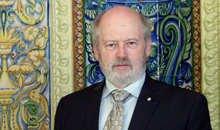
Patrick J. McGrath
What are the main aspects of your current task at the IWK Health Centre?
I have two jobs at the IWK which is a specialist children's and women's hospital in our region of Canada. I'm the Vice President of Research and my job is to promote and oversee research. The research conducted at the IWK includes many different types of research. Some of these are looking at the development of new drugs using chemistry, investigating vaccines and prevention of diseases, and working on autism, pain and many other aspects of mental and physical health. On the other hand, my job as a researcher is focused on two areas. One is pain in children and the other is the use of technology to help children in many different ways, not only dealing with pain, but also in mental health problems, and in some physical ones as well. We do studies looking at different issues. One of the issues that we work on in several projects is the issue of how to treat mental health problems in children at a distance. Many children with mental health problems do not get any specialist care, and some patients have to wait for a long time to get treatment. Moreover, many times it's very costly for the patients –even though the therapy is free–, because people need to drive from a distance, take time off work, buy meals, pay for parking... All these expenses are quite high. In addition, many people feel embarrassed about having a mental health problem.
It's hard for children but also for their parents.
Yes. The stigma against mental health patients is very important. We have developed a programme to overcome these difficulties, in which we deliver care at a distance, using telephones or internet and a coach. This coach is a highly trained non-professional who talks to parents or children, depending on the problem, and helps them through the programme. We are now offering it as a service within Nova Scotia and elsewhere in Canada, where we have a contract with the health system to deliver service to their patients. We take patients with disruptive behaviors or anxiety in particular, and we treat them without ever seeing them. The person who talks to them is not a psychologist or other professional, but he or she has been very well trained. Among the advantages, it's less expensive for the health system and as a result, we can see more patients. The families don't have to wait, to travel or to take time off work. We schedule appointments at times that are more convenient for them. They don't feel embarrassed because they are at home and nobody knows anything about their mental health problems. We have other programmes for stress, anxiety and depression in young adults and in young mothers. The whole idea is to bring health home to those that need it. The programme is called Strongest Families.
Strongest Families consists of distance and web based interventions. Could you explain further details about it?
We do a lot of work with children and young adults with anxiety. With them, we use both the telephone and Internet systems. The major way to overcome anxiety is to face it, but quite often you need skills to do that and ICT are really helpful. In this sense, the work of Cristina Botella (Jaume I University) is amazing. She is a world leader in this area, the best, so it's very interesting to work with her. The other thing is that the use of ICT can create a community. The fact that people can talk to each other is very important.
What results are you achieving?
We have achieved excellent results. The intervention is about three times better than the control condition which is usual care. It's pretty effective. The other positive thing is that families like it, and they don't drop out of treatment. Many times in the clinic families drop out, so that is a big problem. We have dropout rates of about 10%, whereas many times in a clinic it's about 40 to 60%. If the child gets a little bit better, the parents leave, and of course, the problem comes back. But if we can teach them all of the skills then they will be much better off. If we don't cure the child, we teach the family how to work together so the child doesn't have the problem anymore.
You said before that you don't use psychologists. So, what's the profile of the coach like?
The coach can be any age over 20 years old. Perhaps there are a few more females than males. They tend to be people with experiences working with children. They must have an undergraduate degree, maybe in Psychology but maybe in Chemistry or History. They have to be very good at talking on the phone, and they have to be very good at solving problems. We chose positive people who are good at these skills and then we train them very intensively for three or four weeks. After this, we monitor them when they are talking on the phone and we can give them feedback in order to help them improve. At the beginning every call is monitored, but later we just do random monitoring. We also control the outcomes, if the family is getting better. The outcome is always assessed by somebody else, not by the person who does the treatment.
Is this programme to be launched outside Canada?
For now it's only being held in several areas in Canada. We hope in the future to collaborate with other countries, including Spain. We are also working on a very big project in Finland. There, we are looking at how we can prevent mental health problems in children. We are screening all of the four-year olds in one area of this country and choosing the 15% who are most aggressive and difficult. We are offering the programme to their parents. Prevention is better than fixing later on.
Concerning this collaboration with more countries, the IWK Health Centre has made an agreement with UOC in order to work together with the PSiNET research group. Which are the main issues you are implementing?
We are very pleased to be working with UOC and we are hoping to work on some protocols on abdominal pain. Rubén Nieto is heading this programme and Anna Huguet, who works with UOC as well, is also working in Halifax. We are working on a project for headaches using smartphones and teaching people with them. The projects with UOC are very exciting for us and we are hoping to continue them until they are completely underway. There are many very talented young researchers here who have done most of the work. It's very delightful to come to Spain, Catalonia and Barcelona, because people are so friendly and hardworking.
The main part of the research developed by UOC has to do with ICT. Do you think that technology could help in some way to democratise health care and make it more affordable?
Yes, it could if we do it right. The use of ICT doesn't guarantee democratisation of health care, but it could make it much easier to accomplish. In different ways: one is that ICT increases access, so the people who can't travel, who live in rural areas or who are shy can still get into treatment. Many times those people are poor, so it helps them to get therapy. One of the problems is that sometimes poor people don't have communication devices so we have to be careful to make sure that we don't exclude the poor by using fancy gadgets. For instance, many poor people don't have iPhones. ICTs do have the potential for making access easier. They also have the potential for reducing costs to the system. I think it can be more efficient, especially if you combine the use of technologies with some things that are automatic and some things that can be done by people with less education. For example, our coaches are not paid as much as psychologists. We can do that because we can carefully monitor what is happening, to make sure they are doing the job the right way. There are a lot of advantages to ICT but this is not the only solution: we have to have face to face treatments as well.
So the virtual treatments can't replace the face to face ones.
I don't think they will replace the traditional ones. One approach is better for one thing and the other is better for something else. You may like face to face contact; I may like Internet contact... We should respect patients' needs and wishes. Obviously, there's more than enough work for everybody to do, but I don't worry about face to face being replaced.
How will health care based on ICT evolve in the future?
Hopefully, it will increase access to care and it will help to control costs. In addition, it will also increase patients' feeling of being at the centre of the health system. They will see themselves as the most important part of it. It can be a very democratising tool. I think ICT can really make a difference.
And the issues of your research?
We are always looking for ways to do things better and more efficiently. We are using more social networking in our new projects. I will like to do something with Twitter and SMS in order to encourage and support people. We will see what works best. It doesn't matter to me if it's high tech or low tech: we have to think of the right technology for that problem, for that patient. That's going to be the key. We need a wide range of possibilities for people to use.
In the case of Canada, is the population ready to assume this challenge?
Absolutely, like all Western societies. It's the professionals and the bureaucrats who are having difficulties with ICTs. There are issues concerning security and privacy that we have to solve. There's no problem of acceptance among patients. They want help and they want help in any way that they can get it. We have done work even with automated telephone assistance, so you don't need a human. There's no limit. Not everybody wants to use it but we have to make things available for everybody. That's what we have to think about. Until now, you had to go to your doctor's office at times that were convenient for them. From now on, we need more options.
Press contact
-
Editorial department