
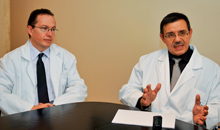
Irving Waxman and Marc Giovannini
The use of endoscopy has come a long way since it first appeared in the mid-nineteenth century, especially when at the start of the 1980s endoscopic ultrasonography arrived, a technology that combines ecography and endoscopy and which replaced the limitations of the two techniques. What did this mean for the speciality?
Marc Giovannini: Since the appearance of endoscopic ultrasonography, there have been two distinct periods. During the first period, from the start of the 1980s until 2000, this new technique was used to obtain a diagnostic image, whereas during the second period, which includes the last decade, it is widely recognised as having a much more therapeutic function. And this has meant a great step forward. Endoscopic ultrasonography is currently more widely indicated for a less invasive, much more quality and accurate type of biopsy.
And has this evolution followed different paths in the United States and Europe?
Irving Waxman: I feel that they have run extremely parallel to one another.M. G.: As regards endoscopic ultrasonography, right from the start doctors in Europe and the United States have worked very closely on it. There's no competitive feel to it, but one where we're working together to improve the quality of this technique.
And how has it evolved on other continents, Asia for example?
I. W.: In fact, endoscopic ultrasonography appeared in Japan some thirty years ago, a country where they were more conservative in their approach to the technique and technology, although they have started getting up to speed with it and now use the latest technology in less invasive techniques. However, with regard to other countries, it's very difficult to compare the needs and level of medicine in India, for example, with that of other countries, such as the United States or Spain and imagine these less developed countries using endoscopic ultrasonography for therapeutic purposes, as it's a technique, which, in some aspects, is extremely expensive.
The internet has popularised practices such as video-conferencing and means that we have and can exchange amounts of information that would have been unimaginable in the past. Which areas of medical care have improved most thanks to digital tools and up to what point has your speciality benefited from these improvements?
M. G.: It is true that we now have new tools, such the possibility of accessing image banks, which means that there is greater accuracy in endoscopic examinations. But having images is not enough, as in our speciality, before we can reach a final diagnosis, we need to know the clinical history, see the patient, etc. It's not the same if the patient is elderly, young, if they have AIDS, or have been treated for lymphoma. Therefore, one image isn't enough, which in all these cases could be the same, but we do need to know the history and, if possible, have personal contact with the patient.I. W.: In endoscopy, it's very difficult to interpret it just with isolated images. It's easier when it's a scanner, because what you see is always the same, so telemedicine is great for specialities, such as radioscopy or radiology, but in endoscopic ultrasonography it's very difficult, as it's a dynamic test that is highly dependent on the examiner.
M. G.: I use video-conferencing to talk to other colleagues. It's a perfect system, a huge advantage and highly practice, but it's different for endoscopy, because sending an image is not enough. While the scanner is always in the same position, in endoscopy, as my colleague said, the image is much more dynamic and you're constantly modifying it on screen.
I. W.: It's like Messi. It's not the same looking at a photo of him as seeing him play.<
Earlier, you touched on the different ways in which the speciality is implemented in more and less developed countries, but that could also happen within the same country. Doctor Waxman, how do you see this difference in the United States, where there are huge debates into health reform?
I. W.: Research at universities in the United States is extremely powerful. We have the best medical care and the best health technology possible, but unfortunately not all this is available to everyone, as 30% of Americans do not have health insurance. And that, in my opinion, is unacceptable in a country that is supposedly one of the world's most developed. In Spain, as in the rest of Europe, they have a better medical system, as everyone has access to it. This is not the case in the United States, where if you don't have private insurance, you can't access the best possible medical care. This is an extremely dramatic imbalance, although it probably won't be around for very much longer.
Are you sure?
I. W.: I believe that this imbalance will disappear, because people are now acutely aware of this problem. In fact, if nothing is done, it'll be very expensive to cure everyone who doesn't have insurance. Those opposed to universal healthcare believe that their taxes do not go to pay for medical care for those without insurance, but they are in fact paying for it indirectly because these people then have to be treated for much more serious illnesses. And in the United States, we also need some sort of universal health system to tackle the problem of obesity. There are fifteen-year-olds who have a whole number of health problems caused by obesity.
It never ceases to be a paradox that when a society has a high standard of living it ends up suffering health problems, such as obesity.
I. W.: Yes, however obesity in the United States has nothing to do with your social class or financial situation. It's based on bad habits, incorrect information about what's good and what's not, etc. But it's not a problem of fifty-year-olds, as it's occurring among ten-year-olds. These kids take no exercise and often they're not fed correctly at school. All in all, it's a huge problem, certainly now that we're living longer. In the United States, insurance policies now include a clause which makes it easier to access this type of private medical cover if a person exercises or takes certain steps to avoid becoming obese.
In any event, while in the United States there is an emphasis on the need to follow the European model, in certain European countries the need to pay for certain services which until now were free is being suggested.
M. G.: The French system is very good, but we're now getting to a limit due to the economic recession which has, for example, seen the government commit much more than previously to generic medicine, which is cheaper. However, despite this, all patients have access to the latest technology and treatment since 80% of the population has relatively cheap medical insurance, between ? 100 and ? 300 a month, which gives you cover for you whole family. And for those on low incomes ? less than ? 800 a month ? the State pays for the care they need. Anyhow, as I said, in just a few years' time we'll be facing problems as there will be a gradually smaller active population and more patients who do not work, mainly because a lot are unemployed. So, if we reduce unemployment we will solve the problem of the health system.
What other suggestions do you have to reduce health spending?
M. G.: One of the great unresolved issues in terms of the future, especially in our speciality, is selecting and reducing the number of examinations before deciding on treatment. People believe that because they pay their taxes they can demand a whole series of tests that are very expensive even though they aren't always necessary. Consequently, in the future, when it comes to universal access to medical care, if there are two options for the same thing and people want the more expensive one, the patient will have to pay the difference.
Cost apart, some experts say that it is in healthcare where the most important progress is being made, thanks to new technology.
I. W.: There's a whole range of very expensive new technology available, such as the latest innovations in radiotherapy or robotic surgery. The problem is that people mistakenly believe that because it's more modern, it gives better results than conventional methods.M. G.: I agree with that. People now want to be operated on with the most modern technological means, such as the Da Vinci robot, a recent innovation in medical technology. However, all these new machines are much more expensive and there are no studies that say that their results are better than those of conventional methods.
I. W.: We live in a consumerist world where people know that Blu-ray is better than DVD, and that this is better than a CD, etc., so everyone wants to have the latest technology. It might be that in the examples I've given it is better, but this isn't necessarily the case with medicine.
When talking about technological progress, the media often cites genomics and biotechnology as the fields leading the medical revolution. Are the changes in these highly media-friendly specialities as important as they say they are?
M. G.: The benefits of these medical innovations are still not part of our daily lives. At the oncology centre where I work, we have different studies into genomics, but we have yet to observe the benefits of this research.I. W.: I agree. Although I should stress that we're not questioning the fact that over the next fifteen or twenty years we expect to see a lot more improvements in the field of genomics and proteomics, as occurred with the test for detecting colon cancer using DNA, for example. It's ridiculous to think today that you can screen the entire population with colonoscopy to detect possible colon cancer. Protocol dictates that all over-50s should have a colonoscopy, but if everyone over 50 did, there wouldn't be enough staff and the health system couldn't cope.
M. G.: Changes will come in the long term. With good screening, probably in ten or twenty years we'll reduce the rate of advanced cancers. The problem is a financial one, as cancer screening programmes are often more expensive than treatment with chemotherapy for those who are already ill. Fifteen years ago, when the colon cancer screening programme began in France, the government said we could go ahead with it because the drugs for advanced cancer were more expensive than the screening programme. That's the reality.
People now have greater access to medical information thanks to the internet. Have you noticed a change in patients' attitudes due to the appearance of the web?
I. W.: It's better now. The internet helps a great deal in terms of curing patients, as they are better informed and, as such, can take better decisions.M. G.: I agree with that. It's much easier for doctors to explain things to patients because they now know what we're talking about. The internet has changed patients' attitudes once and for all.
Press contact
-
Editorial department