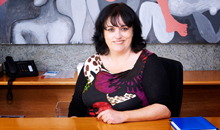
Eugènia Serra
How would you define a library?
A library is a cultural facility where people exchange knowledge and professional staff ensure that information is available and accessible to everyone, while at the same time facilitating learning and dissemination. That is what it is today in the 21st century and what it has always been. The concept of a library has hardly changed since I was a little girl.
And a national library?
National libraries, in addition to having the same traits as any other library, also take into account the concept of heritage. National libraries collect and conserve a people's heritage. They keep it safe for people to discover and enjoy.
You joined the National Library in 1983 as a clerk. You'd previously done your work placement there. Now that you are the director, would you say the institution is any different?
Over the last 20 years, the model for libraries has changed. Today's library is more open. The National Library used to focus primarily on conservation and preservation, whereas now it concentrates on ensuring universal accessibility. The key to the success of a library such as ours is to strike a judicious balance between these different tasks. Monitoring and conservation are still essential, if we wish to pass on our heritage to our great grandchildren and future generations.
What hidden treasures does our library hold?
We have three million documents in our collections, including books, scrolls, musical scores, audio and sound recordings, journals, etc. It is hard to pick just a few. I suppose if I had to choose, I might point to certain classic works, such as the deed of consecration of the church at the castle in Tona (Osona), from 889 AD, the oldest document in the collection, or the Organyà Homilies, the oldest literary text in Catalan. Or how about the wax cylinders that were the first system for recording and reproducing sound or the flat discs pressed for Berliner's gramophone?
No doubt these gems need to be protected, but from what?
We mustn't just protect the oldest documents! We need to ensure that all documents are kept under proper conditions. For example, we have to monitor the humidity level and temperature, for rare books, obviously, but also for books in the general collection. And not only do we need to store them in optimum conditions, we need to prevent any abrupt changes in those conditions, too.
How did we come to have millions of documents?
The National Library was founded in 1907 as the library for the Institute of Catalan Studies. In 1914, it was opened to the public. Originally, its collection consisted of donations from prominent figures. Over the first few years, the collection was rounded out through the acquisition of new documents: the institution had its own budget for this, and certain individuals also purchased documents directly to be donated. For the last year, under the Catalan Legal Deposit Act, we have received copies of items published in Catalonia or in Catalan in the rest of Spain. This way, we stay up to date on current publications. Separately, we also have a large number of donors. We're given items by musicians, writers, graphic designers, collectors... sometimes even originals! At the same time, we continue to make our own acquisitions, albeit less often than we used to: items for our old book collection, purchased from rare book dealers, and items for the modern collection. We also have a Catalan collection: works published in Catalan here in Catalonia, works published by Catalan authors elsewhere in the world, and works about Catalonia published abroad. We are moreover a leading centre in the field of humanities, so we continue to enlarge that collection, too.
Each year, you get...
We receive an average of about 120,000 new documents a year.
Who makes it possible for us to have a national library like the one we do?
Our staff is more than 160 people strong. We are specialists in a variety of fields: conservation, restoration, book binding, catalogues, graphic materials, regulations, patron service, etc.
This autumn you announced your objectives for 2016. One was to become a leading cultural centre specialized in promotion and dissemination, to which end you will be holding several major exhibitions.
We have always held exhibitions, but, with the cut-backs, they had become smaller. However, since we have a large room at street level, we decided to open it and use it to hold four major exhibitions a year to draw the public. We need, want and believe it is good for people to think of the National Library as their own.
What kind of library would you like to leave when your term is over?
I would like to leave a library with enough space to be visible, with a physical presence, but also a library with a social presence: in addition to the people who already know and use it, I would like to reach the average person on the street. I would like it to have a strong presence in society at large. Separately, I am also interested in the digital world. Right now we need to be laying down the foundations and creating the infrastructure we will need to capitalize on the opportunities it offers. We are working on this, but it's not easy. For example, we are beginning to realize the fleeting nature of much of the content in the digital world. We need to sort out what needs to be done and where we are headed and be able to constantly evolve. We need to make sure that we can properly conserve this digital world. Of courses, in addition to these challenges, there are other new issues, too. Until recently, people wrote letters and we held the originals. Now people write e-mails. How do we archive them?
You have always been interested in new technologies. It's nothing new. For years, you have overseen the projects in this area at the National Library. Why? What do you think they have to offer?
I'm curious. At first, I was drawn to technology because of the instant access it afforded to different information tools: CD-ROMs, databases, etc. It opened up hitherto unknown possibilities for users. Additionally, it made it possible to track down works we had previously been unable to get. It has since evolved considerably. Above and beyond my own field, I think technology offers immense possibilities for work in general and to society at large. It is a democratizing force and, as such, it has pros and cons.
Two role models...
Two libraries that immediately come to mind are the Library of Congress in Washington and the British Library. As for libraries more similar to our own in scope and size, I would have to cite the Danish National Library. Any one of those libraries would make an excellent yardstick.
In the 1980s, you studied library science. Today, you teach it. Has the field changed?
When I was studying, it was a virtually unknown field in academia. From the start, you worked at libraries and saw how everything worked in real life. I studied at a non-university school with a personal, homespun feel. There were 12 students to a group. Today that has all changed, just as the content has. Why? Because society has changed, user demands have changed, the characteristics of the documents we handle have changed...
In the late 1990s, you went back to school.
I had always wanted to earn a university degree. I told myself I would wait for there to be one in documentation. I enrolled as soon as the programme was created. That was in 1999. I finished it in two years. I preferred to do it all at once.
What made you choose the UOC?
Its educational model was ideal for me. In terms of scheduling, independent learning and the ability to combine my studies with my family life, it was very convenient. Besides, I wasn't new to the field. I'd been working at the library for 20 years and had accumulated experience and know-how. At the UOC, that was an advantage. No doubt my interest in technology also played a part in my decision. I remember the forums. I loved participating in them! Looking for that little red flag...
In addition to your degree, what else has our university given you?
I've talked about this with classmates often: it helped us consolidate practical skills and knowledge that we already had but needed to reflect on and put in order. On the job, we were doing many things intuitively. The programme helped us discover which things we were doing well and which could be improved.
You joined the National Library in 1983. You've worked in nearly every area!
I feel at home here. Everyone should. With its public funding, this library belongs to all of us. For me, as an employee, it has allowed me to enjoy a rich and varied job full of diversity.
What can it offer to the average citizen?
The National Library has something surprising for everyone. Perhaps you are familiar with 16th-century authors but have never seen the cylinders. Knowledge is discovery. We have such singular collections! We are trying to use social networks to raise people's awareness of the singularity of the collections the library offers, of their own rich heritage. It is good to pique people's curiosity, and the National Library can help us do it.
Press contact
-
Editorial department