
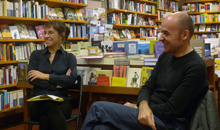
Marià Marín and Teresa Iribarren
How is the unstoppable process of digitisation affecting bookshops' content?
Marià Marín: Bookshops sell books, more and more of which are e-books. Beyond the boundaries of what we currently consider a book to be, bookshops will sell living, digital content. Such content is clamouring to be part of their business.Teresa Iribarren: First of all, this centuries-old business is pushing for presence on the internet, and to market and promote works on the Web itself. Readers increasingly read from screens, a new habit for which bookshops must cater. They have to sell e-books too, both online and on their premises.
What measures are being taken to adapt to the new situation?
M.M.: Firstly, there's training and information. Secondly, there's the adaptation of everyday trade to the new types of books. Thirdly, there's involvement in the e-book business, within bookshops and via the Liberdrac portal. Fourthly, there's the use of digital marketing.T.I.: The initiatives that the guild is undertaking show that book marketing experts in Catalonia have realised that the leap to digitisation needs to be orchestrated in a coordinated fashion. I think it's essential that bookshops join forces.
If e-books tend to be cheaper than paper books and demand for digital content is rising, will selling e-books in bookshops be sustainable? Might paper books vanish?
M.M.: Paper books will continue to exist. They're the best form of hand-eye-brain connection there is. If they didn't exist, we'd invent them again. So, the business is undergoing diversification, enrichment. The e-book's sustainability will depend on its economies of scale; the greater they are, the more sustainable it will be. It's the marginal nature of sales (3%) which makes investment unfeasible.T.I.: Humans are fetishists and, let's be honest, books are objects that seduce us. The book is a phenomenal invention, that's why it has endured for centuries. I'd say that the option of reading certain content from a digital file in no way prevents us from enjoying contact with a beautiful, tangible object, such as an art book containing a host of images or a well produced facsimile. Paper books will be around for many years yet. History has shown us that one technology doesn't necessarily replace another.
Is printing on demand in bookshops a viable option?
M.M.: Its viability depends on the parameters of any business, i.e. technical scope, binding, supply and demand, economic sustainability, etc. If printing on demand has a future, it must have a future in bookshops too, whether as a pooled service or an ad hoc service.T.I.: At present, going back to the bookseller-printer model of past centuries isn't sustainable (the Espresso Book Machine is really expensive). In any case, the publisher could print a requested book and deliver it to the customer's chosen point of sale. The production and distribution system would need to function very smoothly though.
With the emergence of new technologies and the concept of bookshops undergoing redefinition, what new business models are being applied? Could you give examples?
M.M.: Business models are changing in each sector and bookshops are part of that, the final part. It's in that altered value chain that the new models will be determined. The bookseller's profession will change. Pooling services and selling online already constitute new forms of business. Booksellers are guides, a role they'll also play in relation to e-books and, probably, to merchandising associated with technologies and hardware.T.I.: The booksellers who've given most thought to the matter have already realised that both their virtual and traditional shop windows need to be very well presented, and that making a purchase, whether in a shop or online, has to be a quick, easy experience. Business models? There are some really surprising ones, such as Libros Libres, where they give all their books away! Let's see if that proves to be sustainable.
What does a bookshop have to offer as far as online sales platforms are concerned?
M.M.: Tangible and intangible aspects that the economy is once again coming to appreciate, as they give something back to society and contribute to a company's profitability. They include proximity, product knowledge, empathy with customers and guidance. Additionally, there's local trade, taxation that benefits the community, added value and economic play in the industrial and creative fabric.T.I.: A bookseller must be your personal guide, someone who has time to listen to your needs and interests, and can advise you not only on content but also on technology. I think booksellers can offer a fundamental service, that of helping readers develop their digital library, guiding them in their more technology-related decisions.
In a sector in which piracy is on the increase, what can be done to combat illegal downloads?
M.M.: Content quantity and quality need to be greater, and titles should be put into circulation immediately, so that piracy isn't worthwhile. That ought to be accompanied by legislation that's not so much geared to penalising offenders as to stimulating creativity, and by appreciation of culture's critical value in industry and schools.T.I.: The first step, an extremely urgent one, is to apply the same rate of VAT to paper books and e-books. How can VAT be 21% on e-books and 4% on paper books? Secondly, we need to do away with DRM, the encryption of content to prevent its distribution. DRM often causes problems with reading on some devices. Furthermore, it imposes restrictions that infringe readers' rights (see what Richard Stallman has to say on the subject, for example).
What impact has the emergence of e-books had on readers' habits?
M.M.: Very little in terms of numbers. A greater one in terms of people's fascination with technology and its spread throughout society. A huge one in terms of digital natives. In the immediate future, the more common e-books become, the faster readers' habits will change.T.I.: I think it would be more accurate to talk about digital textual content and online access to it. Are there many people who still routinely use paper encyclopaedias or dictionaries? As far as habits are concerned, there are studies according to which fragmented reading is becoming more common and immersive reading less so.
What will the bookshops and readers of the future be like?
M.M.: The future isn't written, but I imagine bookshops having an even greater role in terms of guidance, with spaces shared by shelves and screens, where we'll leaf through paper documents and turn electronic pages, and which we'll leave with five books, three in paper format and two in the form of downloads. Unless schools and the sector take measures, readers will be less adept at sequential reading and more prone to fragmented reading.T.I.: I don't have a crystal ball, but I'd say that bookshops will become social places with online extensions. As for readers, they'll only be interested in gratifying experiences, as has been the case ever since writing was invented. Readers aren't fools.
Press contact
-
Editorial department