
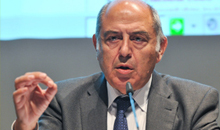
José Antonio Marina
It's said that there are multiple intelligences. How are they related to talent?
Talent comprises all the intellectual, affective and executive resources that allow us to tackle very different tasks and problems. Howard Garner's concept of multiple intelligences, the popularity of which is waning a little, refers to people being more adept at some tasks than others. Intelligences start out as interests that are fuelled by achieving positive results. For example, a child who enjoys running and wins a championship will concentrate on developing their "physical intelligence".
Why's that of particular interest in terms of education?
It's of interest, educationally speaking, because it highlights something that everyone knew but which had been forgotten due to a quite ridiculous kind of educational egalitarianism, namely that children are neither all born equal nor all have the same skills, and attention has to be paid to the things that make each child different if we want to do a good job of educating them. There's a more general idea underlying all the abilities we're talking about. Teaching people to reason or anticipate consequences is relevant to all intelligences. Saying that making an effort is important in order to reach a goal goes for all intelligences. Talent is common to all intelligences.
You make a distinction between personal and social talent.
Yes, and both have to be cultivated. Each of us has our own intelligence, but it develops in a social environment that nurtures or restricts it. To put it another way, Einstein wouldn't have been Einstein if he'd been born in Zimbabwe, despite many Zimbabwean children theoretically having the potential to be as clever as him. There's a relationship between individual intelligence and collective intelligence, which, in turn, reinforces individual intelligence. It's a kind of vicious circle that leads to more talent appearing in certain societies and at certain times than others, and that's connected to how people are educated, how pressure is applied to them, how they're rewarded and encouraged. That's why we need to live in intelligent environments.
Is that why you think it's important to manage talent?
Of course, because it's an element of nations' wealth. Education has two pathways. One goes directly to individual talent and the other goes to social talent, which, in turn, runs through individuals. The difference between formal and informal education is that in the former we go to the student and in the latter it's society that does so.
Would more talent and education have reduced the impact of the economic crisis in Spain?
It could have been less severe. It's very clear who's to blame for the current crisis, it's inept politicians making one mistake after another. The lack of rigour, monitoring and regulation politicians have applied to financial systems has caused those systems to crash. Crises occur when something has failed. There's an education-related factor in that our critical attitude to politicians has failed, and very clearly so in Spain.
So, there's still a lot of work to be done here.
Yes, because education will determine our level of sustainable economic growth. Any solid economic development has to be based on a solid level of education, for various reasons. If the level of the economy rises without the level of education doing likewise, there'll be an economic bubble, and sooner or later it'll burst, which is what has happened to us. Stable growth can only be maintained if education develops alongside the economy, which is what has happened in countries such as Germany and Sweden.
What role should schools and families play in nurturing talent?
Families can't educate without schools, and schools can't educate without parents. We can't provide a full solution without working together. Schools don't just have to teach, they're society's awareness of education. They therefore have to know and explain what needs to be done, and they have to teach that to parents, which is what I try to. We ought to forge closer bonds with parents instead of driving them away. Parents must come to schools, and schools have to encourage them to do so.
What's the Universidad de Padres and what does it aim to achieve?
It's an attempt to help parents who want to do things the right way but don't know how to. We assist them in the process of educating their children, covering a period spanning the three months before the child is actually born and their 16th birthday. The work involved depends on the stage the child is at. We provide resources and look at the problems most common to each age group and how to solve them.
And how's it going?
Very well, but we can only do so much. We have 2,500 parents registered with us because that's as many as we can handle. We make them feel that they have support and are very useful, as opposed to very alone, which is how parents generally feel. They have a tutor, they can share their experiences and they're part of an educational tribe.
You're carrying out research into the process involved. What results are you getting?
All we can see so far is the level of acceptance among parents, which is very good. We've revamped some of the programmes, which have been finished last year. We've also included a kind of test for parents, before the start of the academic year, covering situations and the issues that are important to their children, with a view to comparing their ideas to those they have at the end of the year. We're currently drawing on external research. All the processes we've incorporated have been validated.
Your research has generated a collection of educational books.
Yes, three have already been published. The collection covers the most scientific basis of all the programmes. It's specifically intended for parents and teachers, the idea being that they should read a few of the same books, so that they have the same sources of information and know why we say what we say and do what we do, among other things.
You've hypothesised about genetics opening up a range of possibilities that education is defining. What's the importance of genetics?
Genetics has its trends. This is going to be the century of epigenetics. A person's different genes may or may not be expressed. The interesting thing is which ones are expressed. There's a series of regulating mechanisms that cause their development. Social and educational aspects are part of the epigenetic regulating mechanism that causes the expression of some genes and the non-expression of others. Absolutely purely genetically speaking, it's now being acknowledged that we're a mixture of genetics and culture, and that the two are inseparable, as culture acts genetically, expressing certain genes and not others.
Press contact
-
Editorial department