
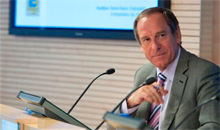
Ramon Rovira
You were involved in the IGI Conference Talent, an Engine of Growth. Specifically, you moderated the roundtable on professional experiences of talented people who have shone in different fields. What conclusions did you come to?
That we still have a long way to go and a lot of work to do if we want to bring university education and the needs of companies closer together. This is one of the main problems companies encounter when they are looking for new staff - they are faced with professionals who are technically well-training and have an abundance of knowledge but find it difficult to put their training into practice.To give you an example, one of the head-hunters who took part in the conference, Ester Casademont, explained that in some cases a company looking to recruit new staff might ask for a high level of English, but that when she has asked where the new employee will be working, she has been told, "the county of Bages" in central Catalonia. So why would they want someone with such a high level of English? They should be looking for other, more useful qualities, such as the ability to deal with clients, empathy...
And how can we prevent this type of situation?
By trying to get companies and universities to work together. Companies could use part of their revenues to support the right kind of education at universities, which would pay dividends by providing a means for the brightest students or those with the most suitable profiles to go straight into a job with the company that has helped to train them.This would be a positive thing, as a lot of people would leave university with a job already secured, which is very difficult to achieve in the current climate; they would have a practical knowledge of the standard work routine and understand from day one exactly what the company expects of them. Finally, it would encourage universities to move away from their highly theoretical and, at times, slightly elitist model to focus on more pragmatic, day-to-day concerns.
How do you make the transition from traditional journalism to more institutional communication in a company like Banc de Sabadell?
After years in a public company like TV3 I wanted to work in a private firm to see what the internal operations are like, how work flows are managed... Above all, I was very interested in the project offered by a great company like Sabadell.
And you weren't interested in working for a private television channel?
I have always worked in Catalonia, expect for a couple of years at TVE in Madrid, and I wasn't looking to go and work for a Spanish channel. Also, five years ago when I was looking for a change, I didn't receive offers from other channels here in Catalonia.
How do you respond to the challenge of directing communication at a financial institution like Banc de Sabadell at a time of considerable economic hardship?
With a lot of effort, a lot of patience, as much imagination as we can muster and the technical skills and experience we have acquired over the years.This is obviously a very difficult time, and there is a stigma over the banking sector that makes it difficult to communicate, but at Banc de Sabadell we have decided that, rather than hide our heads in the sand, we should do just the opposite. We believe that now, more than ever, there is a challenge, a possibility and an opportunity to communicate, and the campaigns we are running have been designed with that in mind: to try and reach our public, to explain to them what our bank is, to show that we are no worse and no better than anyone else. We are a bank that does things its own way.
We believe that honesty, ethics, and a close relationship with customers remain at the core of our existence, and this is what we try to transmit through our campaigns. It is the goal we have set in my department, and for now things are going well.
Getting Pep Guardiola to lend his image to the campaign must have helped...
Yes, Guardiola was the icon from which everything else stemmed. Instead of producing strictly commercial campaigns we decided to place more of a focus on values and on what a financial organisation can bring to society, looking beyond the potential financial benefits or the services it offers. And these values were taken directly from the personality that Pep transmits.This is the central idea we aim to convey: the world of values, whether we are talking about friendship, long-term relationships, common sense... It is all about thinking that there are ways of doing things well in the banking sector.
And do these advertising campaigns produce a return?
Yes, an excellent one. They also win awards - including the last Ondas Prize - year after year. Much of the credit must go to the publicist Toni Segarra and his team, exceptional creative professionals who struck gold from the start and have been able to manage it intelligently. Things are going very well, and we are proud of that.
What memories do you have of your time in Washington as correspondent for TV3?
The best memories. I was there for six years and it was a fantastic time. My family and I are huge fans of the United States. It's a country we know well, we had been there before and love the North-American lifestyle. I was also fortunate enough to be there during a very profitable period. The economy was on a high, the country was working, there was barely any unemployment and no one knew what the crisis was. And professionally, the management at TV3 put a lot of trust in me. I can never thank them enough for the six years I spent in Washington, which have been the best years of my career so far.
As a journalism and communication professional with many years of experience, what advice would you give to recent graduates in the discipline?
The situation is so complicated that it is very difficult to give advice... What I would recommend is that they start to work as early as possible, even if they earn next to nothing, simply for the chance to be around a news team.No one leaves their studies and goes straight into a job as Washington correspondent, as a news-reader or as editor-in-chief of La Vanguardia. This is a trade like any other and you learn on the job, just as a carpenter would, so you have to do your time as an apprentice before you can become a master craftsman.
This is a profession in which you have to build every day. You need a lot of patience, and it is the most resilient people that out on top. If you don't have the energy you're simply not cut out for this job, and would be better off looking for another career.
Another important consideration, in addition to the quality of a person's writing, is that a journalist should have an innate sense for what is newsworthy and what isn't. You need a nose for the job, and that's something you either have or you don't - although you do improve as you get older.
What would you say is the principal revolution that ICTs have brought about in journalism and communication?
I am a staunch defender of social networks. They strike me as an extraordinary tool, although I am very critical of the uses that people sometimes make of them.
In what sense?
In the sense of ruining credibility, people's good name - attacking, insulting and manipulating in total anonymity, or simply lying to harm someone. This is why I appeal to people to use social networks with at least some concern for ethics and common sense.
Are you referring to any case in particular?
There are so many. I have been a victim myself. At the time I was offered the job of taking over TV3, there were certain people who, out of cowardice and to serve their own miserable purposes, devoted their time to spreading lies about me. And the most painful thing is that falling into the trap of responding simply makes things worse, because you end up magnifying the effect.
Your decision to turn down the TV3 job surprised many people.
I'm not terribly keen to discuss this because I've already spoken about it many times. A series of circumstances meant that I didn't feel it was the right time to take the job. It's true that we had held talks, and that negotiations had reached a fairly advanced stage, but certain aspects inside and outside the organisation made me decide that it wasn't the right moment.
The Internet and ICTs have had an impact on all aspects of our lives, not just the media. Do we need to constantly training and educating ourselves to adapt to this changing context?
Absolutely. When we spoke about new technologies at the conference we agreed that they are a formidable tool and that the UOC is an excellent example of how they can be put to good use: it uses ICTs to foster equitable and global distribution of knowledge and information. People who would never have been able to get a degree through on-site learning can now get one through the UOC.The UOC is an extraordinary university led by a fantastic President, who, with the help of her team, has set extremely high standards. In my humble opinion, universities in the future will be more like the UOC than other universities.
The UOC will go on to be recognised as one of the positive things the Catalan government has achieved.
Where would you like to end your career?
I have always liked the idea of setting up a company that provides services linked to the world of communication. But I'm very happy at Banc de Sabadell and have a lot left to do.
Press contact
-
Editorial department