
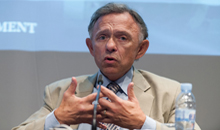
Robert Kozma
Dr. Kozma, you've travelled the world advising communities and governments on education issues. Given the number of pupils who fail to successfully complete compulsory secondary education in Catalonia and Spain, which countries should we look to as an example?
There have been significant changes in Asia in the last 30 years due to conscious, major investment in education. There are Asian countries that have gone from being practically underdeveloped to having great economic growth and better quality of life for their citizens. South Korea and Singapore are currently world leaders in education.
In contrast, western countries like ours are failing...
Because they've reduced their investment in education. There are studies showing that a society's investment in education and its level of equality are directly related. The more a society invests, the more egalitarian it is and the better its citizens' quality of life."Society has changed, but our education system is the same as it was at the beginning of the 20th century"
To what else would you attribute the high rates of such failure in our schools?
Here and in most countries, the problem is that, despite the far-reaching changes that new technologies have brought about in societies, education hasn't changed. Our education system is the same as it was at the beginning of the 20th century. Students are still being educated in classes where a teacher gives a lesson and they have to answer questions, and little use is made of technology. Despite the transformation that society has undergone, the teaching model, assessment, curriculums and so on haven't changed.Students aren't interested in that old model of education and they drop out before they've received sufficient training. We need to offer them an education that interests and motivates them, and which they see as something useful.
What should such a new model of education be like?
The current model needs to be drastically transformed. Businesses and organisations have adapted to a society dominated by ICTs, but educational institutions haven't. Education has to meet the needs of society and the new, IT-based economic system.A system that revolves around memorising knowledge is inadequate in today's world. Computers now perform many of the functions that people used to carry out. We have to train students to acquire skills that are out of computers' reach, such as critical thought, motivation and people management.
Wouldn't it be a mistake to base people's education solely on skills for the job market?
In the past, there were two types of education, one that prepared you for a given job and one that trained you for personal development. The new model of education combines both those things. We prepare students to contribute to the economy and to give the best of themselves as people. Today's economy needs people with as much creative and personal potential as possible.
Despite everything, new technologies have been introduced to schools in recent times. There are interactive whiteboards, computers...
Yes, but they're used within an outdated model of education, and education won't work in those circumstances. We all too often introduce technologies without changing policies. There needs to be change throughout the model of education. We won't achieve anything by putting a few more computers in classrooms. Initiatives such as 'One Laptop per Child' are an example of that kind of poor planning.
Who should lead the change in the model of education?
Changes are necessary at different levels: in the education that teachers receive, in curriculums, in schools' physical structures, in timetables, which could be more flexible... ICTs should be used to change education structures, to boost students' critical thought and communicative skills. Assessment models need to be changed too. Students have to be assessed, but so do teachers, to improve their activity.
In a society as changeable as today's, should training be a lifelong process?
Yes, exactly. Change is part of our society. Students have to train constantly and be prepared to learn new skills. They must be trained on the learning process, how to assess themselves, how to set themselves targets...
You work with both public bodies and large multinationals (Cisco, Microsoft, the Ford Foundation, etc.). What role do big businesses have in education?
The companies I work with take their corporate social responsibility very seriously. They have an interest in developing people's potential, because they see it as a significant driving force behind economic growth. It's to their benefit too, basically.
In this new scenario, does education no longer only depend on governments?
Governments don't have enough resources to transform the education system. Different actors need to be involved. Transforming education is one of the key challenges of our time.
Press contact
-
Editorial department