
Jaume Pagès: "The current demand for knowledge is putting an unprecedented strain on higher education"
Jaume Pagès i Fita, CEO of Universia and former president of the UPC, gave the UOC's Inaugural Lecture for the academic year 2013/2014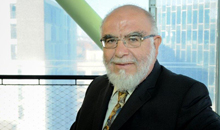
The UOC presented today, Monday, 21 October, the inaugural lecture for the academic year 2013/2014, given by Universia CEO, Jaume Pagès i Fita, in conversation with Jordi Planella, Director of the UOC's Psychology and Education Sciences Department. This year's lecture will be published as a video so that the whole of the UOC community (faculty, students, administrative staff and alumni) can hear the speaker analyse the current educational system and the most pressing challenges for the future. The format aims to encourage participation and dialogue on social media.
According to Pagès, one of the most important challenges facing the educational system in the information and knowledge society is to meet the increasingly demanding learning needs of a growing population. "The educational systems together are under an unprecedented strain, as they are designed to produce and disseminate knowledge, and knowledge and information are becoming increasingly important."
"This represents an extraordinary challenge for higher education institutions – institutions that have a great amount of inertia and that have a hard time changing," Pagès added. In his opinion, if traditional universities cannot come through, then they run the risk of being superseded by "corporate universities". These are already in existence and experimenting alongside the traditional system with "the aim of taking up a position, because they don't believe the others are up to it or that they are responding to the needs that have to be covered".
Likewise, Pagès sees mass access to university education as the challenge of having to choose between a university model that wants to train society's elites (its traditional role) and the university of the masses that aims to train society as a whole. "In emerging countries, like China or India, with large populations and demands for education, traditional systems just can't stand up. In this context, distance education is, without doubt, a solution," he said. Thus, he sees the UOC as a "successful experiment that has accumulated know-how – its capital – over many years".
When it comes to the panorama in Spain, Pagès sees the current educational system as extraordinarily complex and needing improvement. To do so, however, requires cooperation from the system's agents (university faculty, schools and teachers, etc.), which is something that is not always seen in Spain. Without this, reforms are doomed to fail. In turn, he believes that, on occasions, the poor showing of Spanish universities in international rankings is due to an excessively negative interpretation of the studies. "In the Shanghai ranking by field, Spain is sixth in terms of recognized universities," said Pagès. Likewise, he counters the criticism of the excessive variety in the university system's current offer: "there is too much university legislation and too little freedom of choice [...]. Universities should be able to decide what courses they offer, as is the case in many countries."
Pagès also believes the current crisis, the levels of unemployment and the brain drain abroad are not indicative of a failing in the education system. "The fact that people are leaving and that they can leave is good. What isn't good is that people have to leave because they cannot develop and generate added value here when they can abroad. The upsetting fact is that there are no companies here able to use this talent and the training accumulated by these people to generate added value for our society."
Press contact
-
Editorial department