
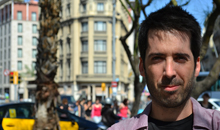
Jordi Duran
What can we expect from this year's festival?
We've been working hard all year to make the festival possible, and that involves many stages. In September, the whole process and all our work will culminate in a four-day celebration of the performing arts; basically street shows, the latest trends and a major section devoted to invited acts.
There's no escape from the economic crisis. How has it affected your sector?
There are many ways of combating the economic crisis. Everyone does what they can. In our case, as a public service, our commitment is greater than ever. We're eager to work closely with the sector and very mindful of encouraging street arts. We approach the discipline from 360 degrees all year long. We provide training. We work on creation. We're hosting 12 resident companies who develop, rehearse and share their act and, once it's ready, present it to the public and take the opportunity to start selling it.
So the festival is just the tip of an iceberg that develops throughout the year...
The festival is completely different now to the way it was years ago. It's a complete, cross-cutting, wide-ranging project. It used to be a show at which street theatre companies could give the sector a taste of what they had to offer, in a very specific context, at what had become a popular celebration and one of the main events on the Catalan calendar. The market really worked in such an intimate setting. Planners coming to meet people get all the material in a very human manner, which doesn't happen with showcases. More needed to be done in terms of relations with companies and artists, particularly in a discipline like street arts, which is fairly chaotic. Elsewhere in Europe, in the UK for instance, there have been extremely clear cultural policies thanks to which it's now an absolutely thriving discipline with fantastic productions. We have to try to make creators powerful, to make them professional, to ensure that they receive training. That's why we're involved with the UOC's master's degree. Our residency programmes help artists find their feet in the market, which, with all its complications, is an environment you need to understand very well.
If the UK is the example to follow, what has gone wrong here?
It's not a case of something going wrong, but of different ways of working. We exist, we've got public money and a strategy, we're an institution and we operate as a public service. 70% of our funding comes from institutions and we come up with the rest ourselves. What we've seen elsewhere is that there have been comprehensive plans and strategies to make the whole thing work. In the UK, that has happened because the Olympic Games prompted a cultural Olympiad beforehand, with a great deal of money and enthusiasm. It happened here as well before 1992, although the situation subsequently ended up as it is today.
What are street arts' most notable values?
Street arts are a means of democratizing and guaranteeing access to culture, of levelling the playing field in that respect, of seducing. There's a lot of scope in terms of working with other institutions too, practices that are established in London but not here as yet. In London, the National Theatre, the Royal Opera House and the Tate have all ended up working with street arts in one way or another, even involving month-long activities. We're still waiting for all that to happen here.
Could that be because street arts are mainly associated with popular celebrations?
There are many municipal theatres that we're working with. In Viladecans, for example, work on street theatre has been going on for 25 years, and they've got plenty of energy, money, enthusiasm and, most importantly, ideas. That's vital. You might have money, but you won't get anywhere without a good concept. At the festival we become the kings of the unconventional, of experiences, of a type of theatre to engage with, to feel; theatre that enters your mind and really gives you a jolt, that flows in through your skin and makes your heart pound, which is what it's all about, feeling alive and connected. For example, the programme for this year's festival is very socially committed, not because we've decided it should be, but because we've received many more proposals full of discourse, and we're delighted about that. In recent years there has been too much entertainment and empty discourse, too much cheery stuff.
And this year there'll be a mood of protest?
We've got critical, political theatre, because there's a connection between street arts and the current state of affairs. This year, more than ever, the festival will be a forum for debate, with artists dramatizing the things that happen to us in our day-to-day lives. People have many ways of getting through life. Some opt for escapism, others prefer to take the bull by the horns, and others take a more passive, reflexive approach. We're looking for that connection in relation to technology as well as content though. Street arts thrive on everything that's happening in the technology arena. There'll be new developments in that regard too this year.
Is that kind of critical spirit compatible with your public funding, which is linked to politicians?
Democracy hasn't been abolished yet. It'll be a sad day when we start censoring what we do. The artists have fears and concerns, just like the rest of us. I think the people at the top, those we've voted for and who are trying to organize the society we're living in, have got their work cut out. The criticism we'll be witnessing won't be like the protests of the 1970s. It'll be different, more sophisticated. The festival is a catalogue for understanding reality.Commercial venues are more inclined to opt for escapism in response to the current depression...
The box office calls the shots nowadays and the range of shows on offer is very conservative. That's not a criticism, we've all got to earn a living. We need to look for balances.
Going back to the festival, what are the main aspects of managing the project?
In the Artistic Department, our job is to establish the direction of the artistic philosophy, select companies, travel and present material. We have to look after all the participating companies and provide support for creation. We play the role of advisors and psychologists, so that all parts of an act come together at just the right time. We also work and have a symbiotic relationship with other departments, such as the Management Department, which is responsible for human resources and safety issues.
Mexico is this year's guest country. What can we learn from Latin America?
Latin America is characterized by the courage to keep going, a capacity to react, to deal with problems, for renewal, which we need here. Latin American societies always look ahead. They know that they have to make a fresh start every so often because one crisis follows another. In that context, they're always prepared for whatever might happen. It's hard to credit that there are professionals in a state of shock and projects on hold here because we don't know how to react.
People may have begun working with fewer resources and more modest project designs, but what needs to be done to get things moving again?
I'm a believer in good production designs. A good idea, one you believe in; that's what we're looking for. Ideas that are feasible, that are logistically and economically viable, and which the market is ready for. Something dangerous is happening in Barcelona, we're shooting ourselves in the foot with a kind of "re-amateurization" of the sector. There's so much enthusiasm to do things, it's like going to the toilet, you either go or you'll burst. Micro theatre, for example, is a shambles. Those experiences are fine as a complement, but as productions in their own right... we need to be careful, that's not the way to go. We have to show our worth and work however we can, I understand that in relation to the up-and-coming generations, it has always been the case. We must find the right way to go about it though, or we'll end up back where we were 40 years ago, working all day to pay the bills and developing our acts at night.
Press contact
-
Editorial department