
UOC engages with social stakeholders to drive solutions to local challenges
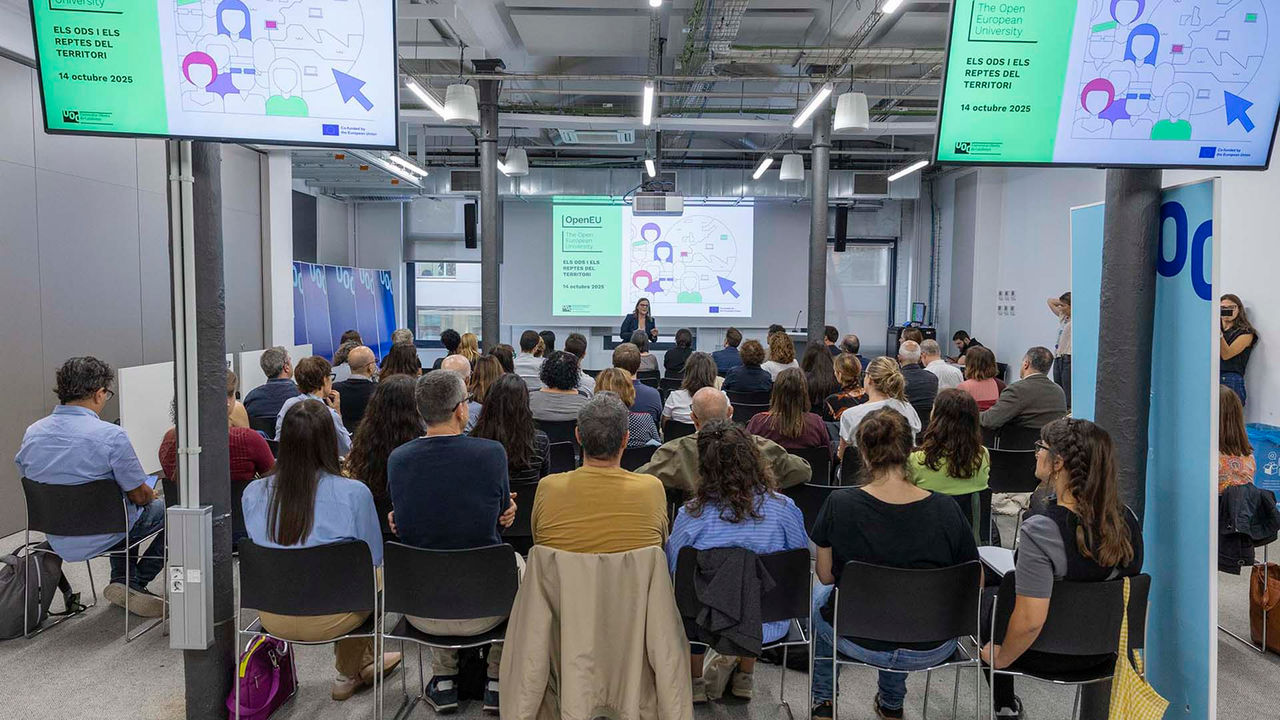
Identifying and prioritizing the challenges facing Catalonia, promoting dialogue and connecting the university with local agents, and exploring new forms of collaboration with industry and the wider community were the aims of The SDGs and Local Challenges event, which took place at the UOC on 14 October.
“Public policies must pursue the objective of having knowledge as a transformative engine, both economic and social, and, therefore, universities and the territory must go hand in hand.”
It focused on addressing the United Nations Sustainable Development Goals and the challenges identified by the Research and Innovation Strategy for the Smart Specialization of Catalonia (RIS3CAT) 2030, which is committed to shared agendas, and transformative and responsible research and innovation as a driving force for Catalonia. It was attended by some 70 people, including teaching, research and administrative staff from the UOC, and representatives from government agencies, including ACCIÓ (the Catalan Agency for Business Competitiveness), international institutions, such as the Union for the Mediterranean, the business world, including PIMEC, and the charitable sector, such as the ONCE Foundation and the Red Cross.
During the opening of the event, Javier Selva, the Government of Catalonia's Director General for Knowledge Exchange and Society, said that "the objective of public policies must be to make knowledge a transformative engine, in both economic and social terms, which means that universities and local partners must work together".
Key priorities and collaboration with local partners
The attendees reflected on the main challenges facing Catalonia and highlighted possible areas of action to improve the cooperation between the university and other social agents. "Science and research often fall within the world of ideas and methods, which is entirely necessary and essential, but at the same time we need an approach to real-life problems in order to have a more tangible impact," said Xavier Vilajosana, UOC Vice Rector for Research, Knowledge Transfer and Entrepreneurship.
Against this backdrop, the event defined key priorities for moving towards a fairer, more digital and sustainable society. In the field of quality education, these included the need to improve access to university and enhance teaching with more training and recognition. In the field of digital transformation, the event discussed the importance of incorporating digital training from childhood, and bringing together culture and technology to foster a more democratic use of the latter. Promoting sustainable farming models, recovering traditional knowledge and a cultural change in the relationship between consumption, the territory and production were prioritized when addressing climate action. The need to listen to and empower young people, fostering models of university governance that include their voice, provided the focus for democracy and European values. Finally, the importance of promoting new models of collaboration that take into account the role of open universities and their potential for transforming the territory to foster alliances was stressed.
During the event, the speakers highlighted the need to create shared agendas between the various social stakeholders in order to jointly address local challenges and foster the co-creation of policies and strategies for an educational model which is more strongly committed to sustainability, democracy and digitization. Manel Jiménez-Morales, the Vice Rector for Alliances, Community and Culture, pointed out that "the UOC is working on a map of alliances to find the institutions, companies, public bodies and associations it can work with to overcome specific issues and meet the challenges facing society".
The event emphasized the importance of obtaining the perspectives of all stakeholders in order to address social challenges effectively within this framework of cooperation. This vision is shared by institutions including the ONCE Foundation: "Not only is it important to create these spaces – it's also essential to take the perspective of the different parties involved into account [...] and, at the same time, to find complementary alliances to work together and obtain the impact we're seeking," said Dolors García.
A European alliance for social innovation
The event is among the research and innovation activities organized by OpenEU, the alliance of European universities coordinated by the UOC, in order to promote higher education that is more committed to local and global challenges.
"OpenEU wants to take this chance to pool all the knowledge of the 10 universities in the consortium and its other members to grow knowledge collectively and improve how we address global challenges, while also thinking locally," said Pastora Martínez Samper, the UOC's Commissioner for International Action and Coordinator of OpenEU.
This session is part of the alliance's line of work focusing on research and innovation in digital education. Its purpose is to create an open and collaborative lab that connects university, society, and industry to drive new tech-based educational solutions, with a direct impact on the SDGs linked to climate, democracy, digital transformation, and quality education.
The event, led by Lourdes Guàrdia, Associate Dean for Teaching at the UOC's Faculty of Psychology and Education Sciences, and Marcelo Maina, director of the UOC's University Master's Degree in Education and ICT (E-learning) programme, is the result of collaboration between the OpenEU Office at the UOC, the Knowledge Transfer, Entrepreneurship and Open Science department, and the Alliances, Community and Equity department. It marked the start of an ongoing, collective workspace where participants can share knowledge, identify challenges, and create joint, long-lasting solutions.
This session is one of the first activities organized by OpenLab, the UOC's transformative social innovation laboratory. These labs are being promoted by the Government of Catalonia to foster innovation and transformation within government bodies in partnership with universities.
Find more pictures from the event here.
This project has received funding from the European Union (EUROPEAN EDUCATION AND CULTURE EXECUTIVE AGENCY - EACEA) under grant agreement No 101177241.
Funded by the European Union. Views and opinions expressed are however those of the author(s) only and do not necessarily reflect those of the European Union or the European Education and Culture Executive Agency (EACEA). Neither the European Union nor EACEA can be held responsible for them.
Press contact
-
Editorial department