
OpenEU meets in Lisbon to conclude the alliance's first year and set priorities for 2026
The Rectors’ Council and the Executive Board of the alliance met at the Universidade Aberta in Portugal on 5 and 6 FebruaryThe coordination meeting reviewed the first year of OpenEU, the alliance of European universities coordinated by the UOC, and set out the priorities for its second year of work
The meeting focused on the role of open and distance universities in meeting the challenges facing European higher education
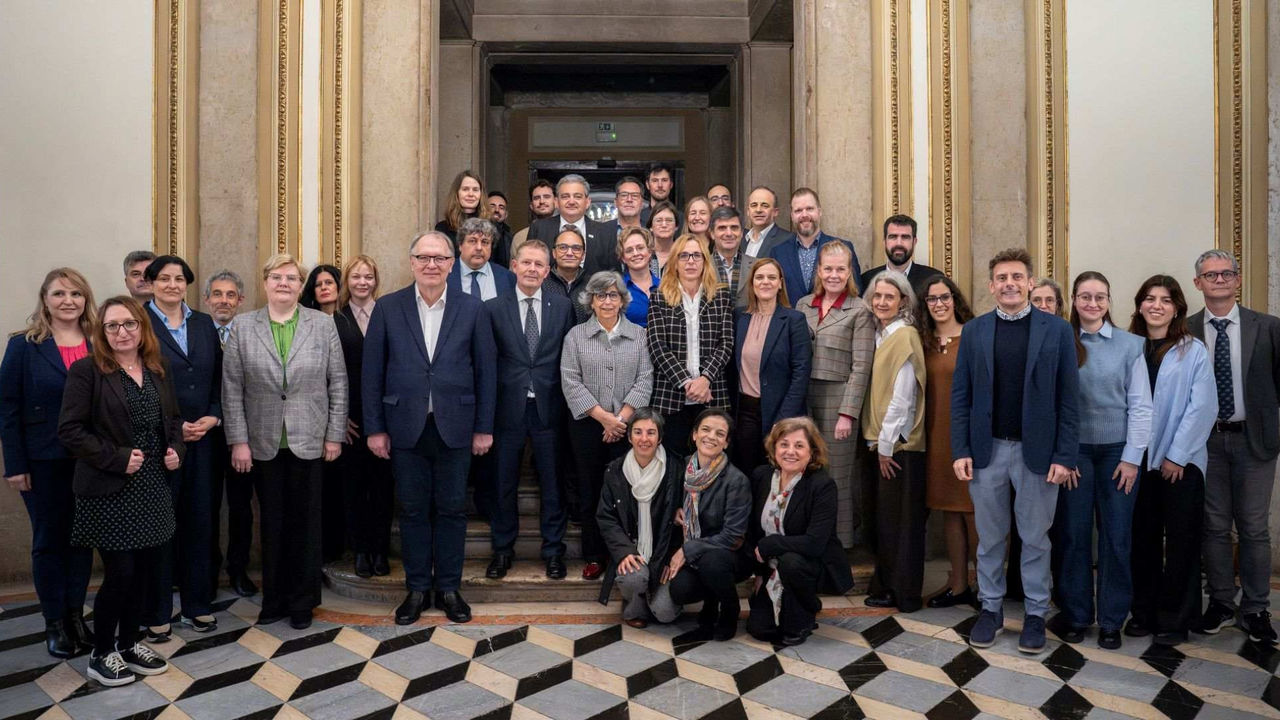
The Universitat Oberta de Catalunya (UOC), as coordinator of the OpenEU alliance of European universities, took part in the coordination meeting hosted by Portugal's Universidade Aberta in Lisbon on 5 and 6 February. The meeting concluded the alliance's first year and defined the priorities for 2026 in its move towards a pan-European open university.
Over two days, the ten OpenEU member universities approved the work plan for the alliance's second year and focused on the role of open and distance universities in the European Higher Education Area, in the context of demand for flexible learning pathways, lifelong learning and continuous reskilling.
"This first year of OpenEU reaffirms the commitment of Europe's open universities to helping make the European Higher Education Area more inclusive, digital and ecological," explained Àngels Fitó, the rector of the UOC and the president of OpenEU. "We have the responsibility and the opportunity to lead the digital transformation of higher education, breaking down geographical, cultural and social barriers to provide answers to the challenges of a constantly evolving Europe," she added.
She was accompanied at the meeting by the Vice Rector for Alliances, Community and Culture, Manel Jiménez; the Commissioner for International Action and Alliance Coordinator, Pastora Martínez Samper; and the acting Director of the OpenEU Office at the UOC, Sílvia Puigbó.
A first year consolidating the alliance
In its first year, OpenEU established shared mechanisms for governance and coordination and undertook several pilot initiatives, laying the foundations for large-scale implementation in its second year.
Its key achievements include joint research workshops and the delivery of eleven shared doctoral degree courses, with more than 80 enrolled students. Also there was the first OpenEU Winter School, in Athens, which brought together almost a hundred doctoral and early-stage researchers, strengthening collaboration and ties within the European research and doctoral training community.
The alliance also approved its governance framework and various policies shared by the alliance's member universities. These are aimed at rolling out initiatives organized by OpenEU in the future, and include progress towards joint degrees and the design of strategic initiatives such as GPS Professional tool and lifelong learning portfolios.
As highlighted by Angels Fitó, the alliance's ambition is a response to a clear social need: "ensuring access to high-quality, flexible and equitable higher education for learners at all stages of life."
“After a first year of work, OpenEU is entering a new phase aimed at turning European cooperation into tangible opportunities for students, university staff and society.”
Lisbon sets the course for the second year
The priorities established for 2026 include enhanced mobility schemes, stronger links between skills development, employability and microcredentials; increased collaboration between academic communities; and the exploration of new shared initiatives, such as a course created in partnership with Eurocities and the alliance's first joint bachelor's degree programme, coordinated by the UOC with the participation of the Open Universiteit Nederlands and the UNED.
Collaboration within the alliance will be further strengthened by the five Staff Weeks scheduled for 2026, which will take place at various OpenEU member universities with the aim of promoting staff mobility, peer learning and institutional cooperation.
Experts UOC
Press contact
-
Leyre Artiz