
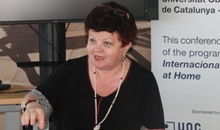
Sarah Guri-Rosenblit
What's the situation of e-learning in your country, Israel?
We must distinguish between e-learning and distance education. Nowadays, most higher education institutions offer online courses or multimedia materials (ie, e-learning), but the first distance education organization in Israel was the one I represent, The Open University of Israel, founded in 1974.
How was it founded?
It happened in an era in which the British Open University led a revolution in distance education. Until then, institutions involved in distance education had a very bad reputation for providing low levels of quality. The Open University of Israel was founded following the British example and, as in the case of most universities in the 1970s, it was a public decision. Nonetheless, our minister of education back then received philanthropic funding from the Rothschild family. Even now, the government only provides a small amount of the University's budget, about 20%. The rest comes from student tuition and other sources.
What's the focus of your current research?
I'm very interested in e-teaching. The lines between access to information and knowledge construction are extremely blurred. New digital technologies give you access to oceans of information, but in order to construct meaningful knowledge, you need experts and teachers to guide you through. Teachers' role in the learning process is by no means incidental, they're very much at the heart of it. What's more, while it's normally taken for granted that they have online competences and skills, some of them are reluctant to embrace digital environments. Those are some of the incorrect assumptions I've identified in relation to e-learning nowadays.
Do you mean that teachers aren't adapting properly or quickly enough to the new digital scenario?
First of all, I'd say that a huge change in the last century where students are concerned is that so many people now gain access to higher education. In 1940, there were only a million students all over the world! Now we have nearly 200 million students. So, the university arena has to adapt and it does so in heterogeneous ways. Consider, for instance, community colleges in the USA. We can't talk generically about university nowadays because there are so many kinds of universities. And in the e-learning era, I think teachers should help students construct knowledge, and there's still not enough being said or done with regard to how to adapt.
What's the main challenge facing e-learning at present?
I think the biggest one is that technology is often taken as an answer without knowing what the questions are. It's not entirely obvious why teachers or many other professionals should use technology. It has become part of every aspect of our lives. Even in all the activities associated with universities, such as libraries, registration and management, new technologies have replaced older ones, but the core process of teaching and learning hasn't changed dramatically.
Have expectations been too high?
In my last book, I analysed people's sweeping expectations for digital technologies in higher education and the actual reality, and there was a huge gap between the two. That happens with all kinds of technologies though. When a new one emerges, there are sweeping expectations and then a disappointment phase. In the long run, technologies are going to change our way of life dramatically; they're already doing so, in fact. In the case of the learning and teaching process though, it'll take longer for them to do so. In 1997, Peter Drucker predicted that all campus universities will become dinosaurs and die out, but I don't believe that'll ever happen, because social interaction between young students is very important, and not only in terms of knowledge construction.
What's your opinion on massive open online courses (MOOCs)?
They might be wonderful resources for both teachers and students. In some cases, it'll be possible for them to replace certain courses, but I don't believe they could substitute a whole academic programme. Even now, more than 80% of the students who sign up for MOOCs drop out; they just want to see what they're like. And who are the people who take MOOCs? Professionals, graduate students, professors, etc. They all want to get a look at a good course from a prestigious institution like Stanford, Berkeley or MIT, and then maybe use it as a resource in their own classroom. Without clear guidance though, especially for undergraduate students, there's no way MOOCs can substitute a programme.
Press contact
-
Editorial department