
"Servitude, bureaucracy and automation run through contemporary cultural production"
Ingrid Guardiola, cultural researcher, lecturer at the University of Girona and speaker at the Culture or barbarism seminar at the UOC
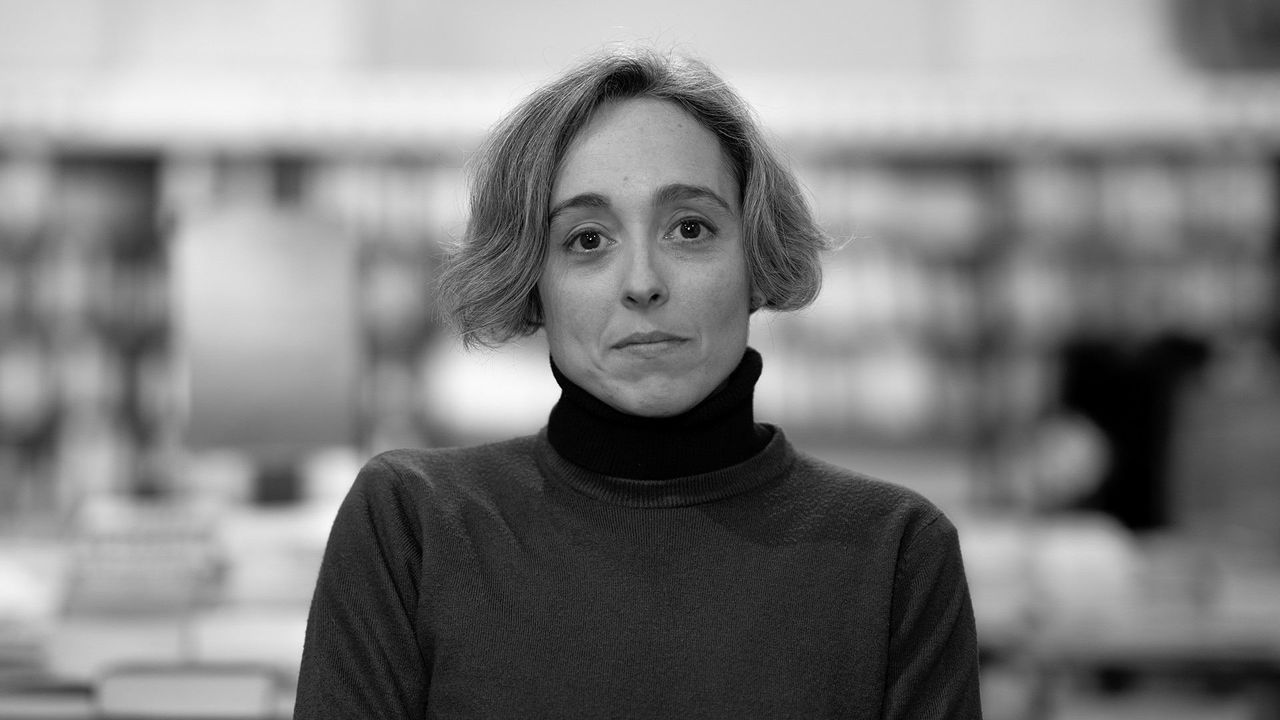
Another form of digitalization is possible, far removed from the shop window culture, disinformation and unbridled capitalism of the platforms controlled by the tech giants. The essayist, audiovisual producer and cultural researcher Ingrid Guardiola, PhD in Humanities from Pompeu Fabra University and lecturer at the University of Girona, has focused her work on the critical analysis of visual culture, social inequalities and technopolitics. A few days ago, she took part in the Culture or barbarism. Tensions surrounding culture in the 21st century seminar, organized by the UOC-TRÀNSIC research centre's GAME group at the Universitat Oberta de Catalunya (UOC), where she talked about the conditions that sustain platform capitalism, and techno-bureaucratic protocols.
Do you think that new technologies have brought more tensions than ever to culture? Are they changing how we define it? If so, how are they transforming it?
Connected digital technology has changed our relationship with ourselves, with others and with the physical realm (the planet) and the ontological realm (the world) on all possible levels. Today, artificial intelligence applied to planetary digital infrastructures and a data-driven economy has enabled real-time monitoring of all our behaviours, including those that the machines themselves organize (trading). This increases entropy, expands bureaucracy and hinders socialization by creating a landscape for public opinion that favours commercialism, polarized discourses, an absence of context, hatred of others, disconnection from oneself, anxiety... The medium is not to blame for this, although Norbert Wiener warned us about the relationship between communication and control arising from technological protocols back in the 1940s. Instead, the responsibility lies with the people who have the monopoly on infrastructures, hardware and software, and the contracts that our governments make with them. In other words, the blame lies with the interests of the ruling classes, the tech corporations and their network of partners (companies which extract raw materials, insurance companies and investors).
What did you discuss in your talk on work, culture and the bureaucratic and digital labyrinth?
The thoughts I addressed are related to my book La servitud dels protocols (2025), in which I examine the implications of the technosocial and information technology protocols that sustain platform capitalism, and techno-bureaucratic protocols. It's not so much a question of understanding infrastructure from a technological point of view, but from a humanistic point of view, which is why I focus on the myths that these protocols create: efficiency and control (Prometheus), the myth of abundance, the casting culture (Narcissus), self-performance and presentation (Pygmalion and Orpheus), digital neoplatonism or the performativeness of identity, rivalry and polarization, competition (Romulus and Remus), predestination, lifelong learning and updating, discipline and self-control, the cancel culture and online shaming, the technological and bureaucratic labyrinth, dehumanization and desire.
“Hegemonic culture, based on social networks and the media, has become the main space for symbolic production and social cohesion.”
How do techno-social protocols influence how we construct our identity and social relationships?
At various points in the book, I refer to Prometheus, who according to Peter Sloterdijk is the architect of the cold fire of efficiency. Prometheus embodies Napoleonic restlessness and the techno-industrial epic, the "superhuman". It is Prometheus who uses technology to transform his environment. In my book, this is reflected in the quantified self, in the individual who seeks efficiency in all aspects of their life. This person complies with constant competitions and permanent training, militarization and discipline. Another of the myths that I consider is that of Narcissus, who wastes away and dies so that his image can be considered a beautiful form, or a work of art, as expressed by Boris Groys. This brings us to what I call "casting culture", which is related to the organization of life based on a never-ending series of tests, challenges and fuzzy audits.
Wherever we are in our lives, we seem to be evaluated, rated and judged unreasonably. This not only makes us insecure, but also anxious and powerless, and leads us to think of other people as rivals. In order to overcome this, we have Pygmalion and Orpheus, the two faces of the artist, the sculptor of the perfect work and the person who personifies the same work, or in other words, the idea that identity is performed by means of a series of categories and actions which are organized for other people to see. Finally, I talk about the myth of abundance (the mistaken idea that social platforms have everything, like a primordial Eden), the idea of the technological and bureaucratic labyrinth, and the end of desire as practically everything becomes automated.
Is it impossible to escape from a hyperconnected and digital world, in the cultural, economic and social spheres?
It's impossible to escape from a hyperconnected world because bureaucratic protocols, or in other words, our status as citizens, are associated with our digital identity, by law. Social platforms are the subject of considerable mistrust in the cultural and social spheres. You can not only choose not to be on them, but you can also choose which ones you want to be on, and there are more and more alternatives to the Silicon Valley monopolies. It's different with education, because if the Ministry has a contract with Google and installs it in all schools, then we're at their mercy. It's a disaster. We must demand digital sovereignty. That's why I don't see the point of setting the online world and the offline world against each other, as they're part of the same ecosystem, they're connected. We can't detach ourselves, or ignore the tangle of cables that pass under our feet, or the digital trail that we leave behind with each step we take. What we can do, as Svetlana Boym pointed out, is disregard the enforced image of the "global brain". We need alternative media based on humanist platforms for knowledge and experience, which are beyond the control of corporations, their alarmism, their somnolence and their disinformation. We live in a technosphere that covers the entire planet (as discussed by Achille Mbembe and philosophers including Yuk Hui, Peter Sloterdijk and Dipesh Chakrabarty) and we cannot separate our ways of life from infrastructures, their ruins and everything that forms a part of our relational ecosystems. We need to restore the concept of planetarism, and make it politically relevant again.
Can we have a powerful economy without digitalization?
No, digitalization isn't a bad thing, but we have to start from the question of who benefits from it. And if the benefit is social and democratic, we will have to administer the tools so that this is actually the case. Digitalization can be an opportunity to manage a society which has complex demographic groups. There are various initiatives working to ensure technological sovereignty in Barcelona: the Canòdrom think tank; Sobtec (the technological sovereignty congress which will take place on 28 February) in the areas most strongly associated with the open software tradition; the 4D conferences organized by Xnet and Accent obert; Alba Cervera and her team researching quantum computing at the Barcelona Supercomputing Center, and a very rich creative sector working in a wide range of ways (Monica Rikic, Núria Nia, Playmodes, the Domestic Data Streamers, Azahara Cerezo, Taller Estampa, Mario Santamaría, Joana Moll, Alba G. Corral, Anna Carreras...). You can choose from all this and more, or the Mobile World Congress, shop window culture, unbridled luxury tourism and more platform capitalism. They are opposite ways of thinking about technology.
"TikTok is a vending machine for images aiming to influence on a precognitive level"
As an audiovisual filmmaker and essayist, how do you see the role of the image in today's culture, and why has it acquired so much power and influence?
The image that currently concerns me the most is the mental image, which is why in my book I talk about Walter Lippmann and his obsession with controlling the "pictures in our heads" – the images of things that people create, because he understands that this will be precisely what they will end up doing. He wanted to reach swift political consensuses. Nowadays, we could say that we live in neurocultures (in Chile there is even a law to protect neurorights) that leave not a single part of our body intact, especially if we talk about our brains. TikTok is a vending machine for images aiming to influence on a precognitive level – images that trigger an autonomous sensory meridian response, images that anaesthetize us. Then we have Netflix and its narrative formulas (most of the content is cultural fast food), Instagram and its celebrities, statements by politicians that are a narrative genre and a global upheaval... But iconophilia and cinephilia have their niches.
What form do cultural spaces currently take, and who in your opinion is inside them, and who is outside?
The mainstream – hegemonic culture, the cultural industry, the cultural products seeking commercial success – has become the primary forum for symbolic production and social cohesion; the case of Rosalía is a prime example of this. I discussed this issue in an article in the Ara newspaper this week. The process of cultural alchemy – the ability to transform ordinary matter into gold – also takes place while taking into account a business model based on the analysis of data and tastes in real time. The media, and even the public media, feed off each other, and should not be based on business considerations such as how famous somebody is, clickbait or the current hot topic. Umberto Eco explained this when he talked about "neotelevision" – television that only talks about itself, and no longer looks at the world. The place of culture in the media has become increasingly residual, and that can't be a good thing. I'd like to think that public television is an oasis of culture, now that it has fewer and fewer viewers.
But the fact that there is no cultural communication of a cultural event does not mean that there aren't many cultural initiatives and experiences that we will never see advertised in any medium or network. Public cultural institutions ensure that this is the case. And beyond these institutions, cultural initiatives are also abundant.
What do you think cultural and educational institutions need to do to address the tensions that are running through contemporary culture?
Make management more flexible, practice what they preach (apply theory to practice – transparency, horizontality, permeability, professional ethics...), seek partnerships, work based on trust and high standards, and work on the ground. I tried to do this as the director of Bòlit, the contemporary art centre in Girona (2021-2025).
What are you working on at the moment? What are your upcoming projects?
I'm a lecturer in Cultural Communication at the University of Girona. Next week, at the FIL in Guadalajara International Book Fair in Mexico, we're inaugurating the exhibition "Vendrán las mujeres: 150 años de luchas en las calles de Barcelona" [Women will come: 150 years of struggle on the streets of Barcelona]. I'm still travelling everywhere to promote my books (especially the latest one, La servitud dels protocols). I'm in a discussion with a group of European philosophers with a view to contributing to a production of knowledge and social relations that is less English-language focused, based on their cultural and political peripheries, among other things. I have been a member of the Girona-Cinema Truffaut film critics collective since 2005. I have a son and a shared kitchen garden, and I am in the parents' association of a high-need school in Salt, a great town.
Transformative, impactful research
At the UOC, we see research as a strategic tool to advance towards a future society that is more critical, responsible and nonconformist. With this vision, we conduct applied research that's interdisciplinary and linked to the most important social, technological and educational challenges.
The UOC’s over 500 researchers and more than 50 research groups are working in five research units focusing on five missions: lifelong learning; ethical and human-centred technology; digital transition and sustainability; culture for a critical society, and digital health and planetary well-being.
The university's Hubbik platform fosters knowledge transfer and entrepreneurship in the UOC community.
More information: www.uoc.edu/en/research
Press contact
-
Núria Bigas Formatjé