
"Critical design can help generate commitment to social values"
Irma Marco, artist and researcher at UOC
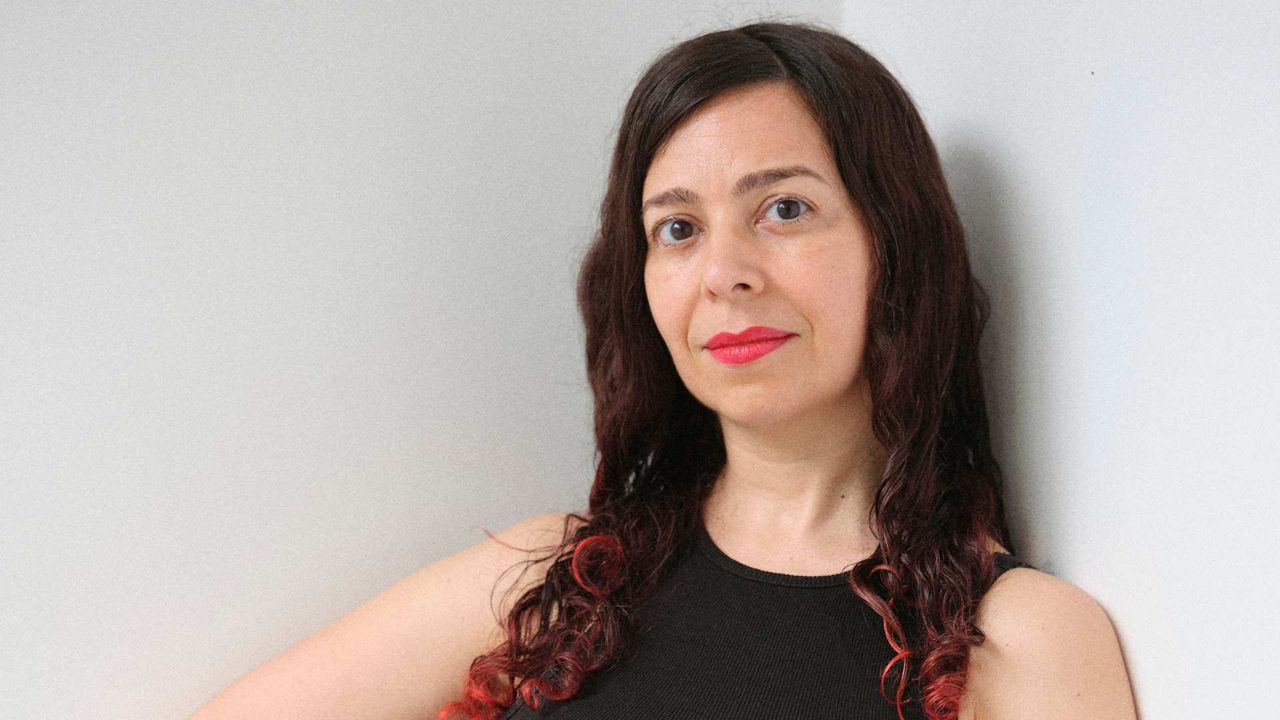
We live in an "onlife" world, where "real" life and digital life are no longer separable. The consequences of this digitization of our daily lives are critically analyzed by artist and designer Irma Marco, lecturer in the Studies of Information and Communication Sciences at the Universitat Oberta de Catalunya (UOC). One of Marco's most prominent artistic projects, researcher of the Mediaccions group at the UOC-TRÀNSIC research center, is the Contraflag Toolkit, part of her doctoral thesis, which facilitates citizens, through workshops, the design of flags with slogans about the digital world, stimulating debate and critical thinking. On her Instagram account, we can observe the works she produces.
What does it mean to live in an "onlife" society, and how does it affect our daily lives?
Following the ideas of Italian philosopher Luciano Floridi, it has long been meaningless to differentiate offline life or off-line life and online life — digitally connected — as separate entities; this is why he coined the concept of "onlife" (2015), a reality of constant digital connectivity that permeates our physical existence. Other key figures in the field, such as Geert Lovink, agree on this totally hybrid notion of contemporary life. Digital technologies are an inseparable part of our environment. This reality implies transformations in the intimate and social spheres, as well as the challenges we must address to move towards a way of life that allows for the analysis and reflection of this new everyday life.
What inspired you to create the Contraflag Toolkit project?
Contraflag Toolkit is the result of a doctoral research based on artistic practice that I presented in 2024. Previously, I had started a project of fabric banners —flags—, with hand-painted activist messages, which I installed in public spaces. My intention was to promote debate and critical thinking regarding digital communication, and the project opened up to public participation. For this, I designed a resource accessible to people with different levels of manual skill, allowing them to compose their own activist messages in collective creation workshops.
What motivates you to do research in art and digital design?
From the Mediaccions research group (UOC), we believe in experimental and participatory methods to promote critical digital culture and the conscious use of technologies in daily life; addressing it from design and creation is one of our established lines of work.
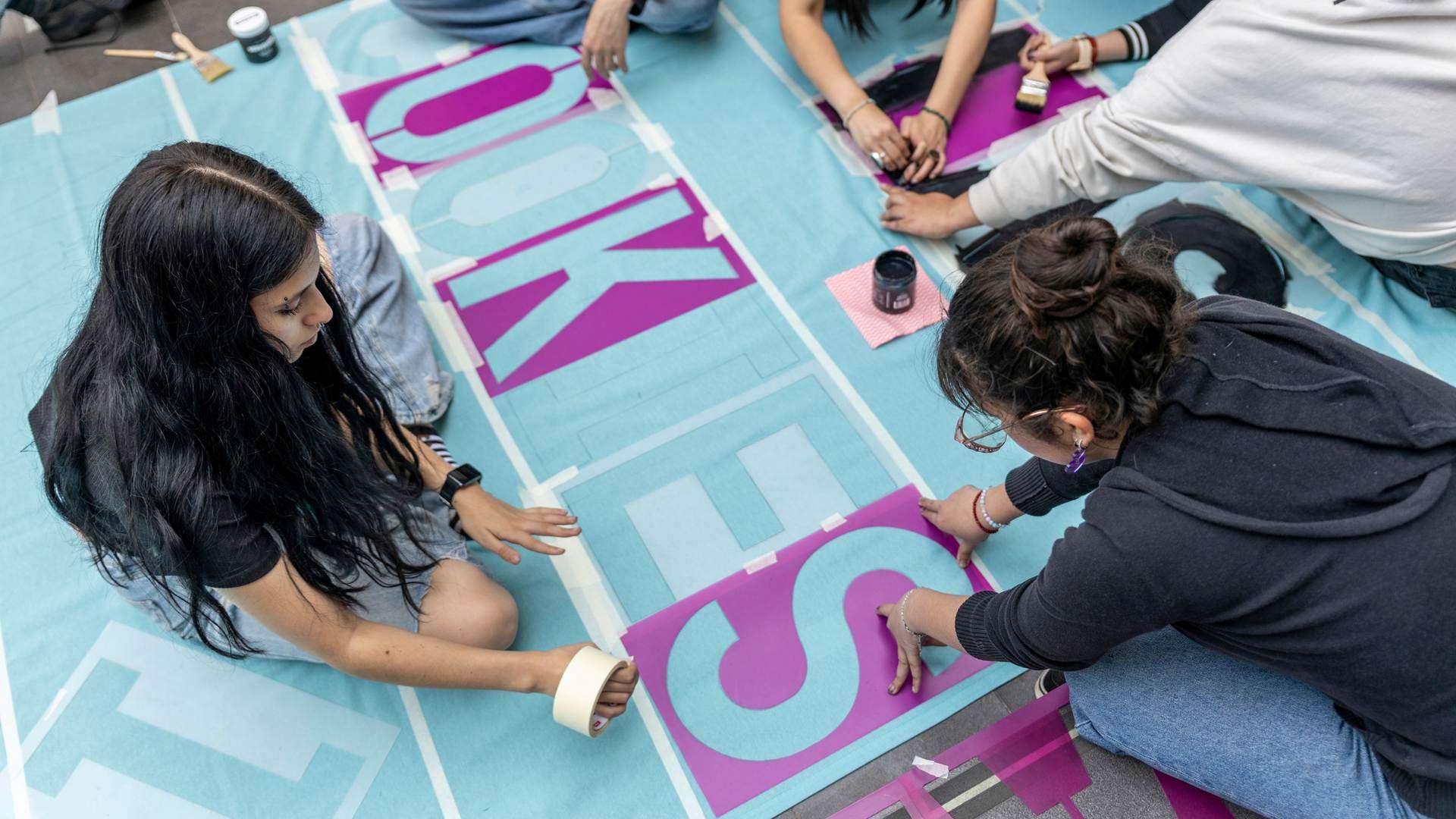
Taller amb alumnat de la Universidad de las Américas (UDLA) al Centro Cultural de España en Santiago, Xile (2025). Foto: Matías Pinto.
One of your main critiques is about the internet and digital media. What criticism do you make and why?
It is important to emphasize that this is not just a critique of digital media. In fact, I started researching the subject motivated by my fascination with post-internet aesthetics, technological communication formats, and their impact on society's daily life over time. The critical aspect of the project does not call for digital disconnection but for an awareness of the medium. In today's world, the emancipatory utopia of the internet from the 1990s seems distant, large tech companies profit from the control exerted over our digital data, and ethical and environmental debates on the use of tools like AI are multiplying. Understanding how these factors operate allows us to be conscious of the digital environment we live in and engage actively with it.
How do the participants in the workshops react to the Contraflag Toolkit?
The workshops begin with a contextualization of ethical, environmental, and social issues linked to the use of digital technologies. It serves participants as a springboard to talk about their personal experiences and debate the topic. They are pleasantly surprised by how easily activist slogans emerge from the shared conversation, which is a very beautiful moment of the process. When they create the flags, the manual processes of art and design we apply open new ways to connect with ideas and also with the group. Finally, the fact that the works are later exhibited generates identification, commitment, and a desire to stay connected with the project.
“The project does not call for digital disconnection, but for awareness of the medium.”
Can you give examples of messages that have inspired or surprised you?
The project is gaining momentum, and there are many interesting slogans. From the most recent, I highlight “Las cookies are eating you” created with design students from the Universidad de las Américas (UDLA) and “Usa tu cabeza, no + dependenc[IA]” with the Universidad Católica de Temuco (UCT), both universities from Chile with which I collaborated thanks to a research stay this year.
In the Digital Arts Cycle of Vic (2024), messages closely linked to the Catalan territory emerged, such as “Les dades seran sempre nostres” or “Lo decreixement és vida”. From the collaboration with the exhibition AI: Artificial Intelligence at CCCB (2023), I highlight “Humans que entrenen IA’s, IA’s que actúan como humanos” and “No te escucho, pero estoy aquí para ti.” I continue to be surprised by the ability of humor and language twists to generate reflection and debate.
What problems or concerns about digital life come up most frequently in the workshops?
In front of rapid access to information, task resolution, and immediate communication, recurring problematic issues arise, such as dependency on mobile devices, misinformation and information overload, reduced attention span, online harassment, harmful effects on self-esteem, mental health and sleep patterns, and the distortion of the concept of reality, among others.
Can you give examples of messages that have inspired or surprised you?
The project is gaining momentum, and there are many interesting slogans. From the most recent, I highlight “Las cookies are eating you” created with design students from the Universidad de las Américas (UDLA) and “Usa tu cabeza, no + dependenc[IA]” with the Universidad Católica de Temuco (UCT), both universities from Chile with which I collaborated thanks to a research stay this year.
In the Digital Arts Cycle of Vic (2024), messages closely linked to the Catalan territory emerged, such as “Les dades seran sempre nostres” or “Lo decreixement és vida”. From the collaboration with the exhibition AI: Artificial Intelligence at CCCB (2023), I highlight “Humans que entrenen IA’s, IA’s que actúan como humanos” and “No te escucho, pero estoy aquí para ti.” I continue to be surprised by the ability of humor and language twists to generate reflection and debate.
What problems or concerns about digital life come up most frequently in the workshops?
In front of rapid access to information, task resolution, and immediate communication, recurring problematic issues arise, such as dependency on mobile devices, misinformation and information overload, reduced attention span, online harassment, harmful effects on self-esteem, mental health and sleep patterns, and the distortion of the concept of reality, among others.
Why is it important that anyone —and not just artists— can create activist objects?
The focus of the project is to foster the public debate on the transformation of daily life due to digital life. To do this, it is necessary to facilitate the construction of text-based activist artifacts for a broad group of people, whether or not they have artistic or design interests. When designing the Contraflag Toolkit, it seemed particularly important to me to ensure that the resource would not be attractive only to a specific sector but could persuade anyone with the will to express something publicly. I consider this broad scope a necessary condition for obtaining a public space for conversation that contributes to gradual transformation.
“ In each workshop, critical thinking is fostered, debate is promoted, and collective creation happens.”
How can design help address the major social challenges of the present?
Design is a key element in interacting with the world, it is everywhere: on the street, in domestic spaces, and also in our digital devices. It tends to be associated with functionalities that depend on the market, but as Anthony Dunne pointed out in 1999, there is a critical side of design that can help generate commitment to social values and promote ethical debate.
The Contraflag font is specifically designed to create messages with high visual impact. It is presented in uppercase letters and is composed of geometric modules to ensure optimal legibility. It is ideal for the project works, as they need to be visually striking and legible from afar since they are usually installed on balconies, windows, and building facades.
Do you imagine a commercial or mass distribution kit so people can create from home?
The kit first appeared in the printed version of my doctoral thesis (2024), as a prototype for expanded editorial distribution. The idea was to make a limited run to encourage autonomous creation of flags "from home," with a series of usage tips. Since then, the kit has always been activated in collective creation workshops, and the editorial version has not been promoted. I believe that workshops are a good method for developing the project because they allow the consolidation of its key aspects: through the shared experiences in each workshop, critical thinking is fostered, debate is promoted, collective creation happens, a community of people linked to the conceptual foundations of the proposal is formed, and the works are shown and distributed in different parts of the world.
What has your research stay at the Universidad Católica de Temuco (UCT) and the Universidad de las Américas (UDLA) brought you?
I have been able to contribute my teaching, artistic, and research experience in a new, though similar, context. And above all, I have learned a lot, both from the students at UCT and UDLA, the main creators of the works in the workshops, and from the professors from the universities who accompanied and supported us at all times, as well as from the collaborating entities in this international exchange: a cobert, UOC (Barcelona-Spain), the FAAD UCT, Casa Varas, and the Centro Cultural de España in Santiago (Chile). It has been an enriching experience that demonstrates how methodologies based on artistic practice can contribute to academic research and the dissemination of scientific knowledge. Currently, some of the works created in the workshops continue to be exhibited in Chile, and the students remain linked to them.
What stage is the Contraflag project at and what are your next projects?
The activation of the Contraflag Toolkit in collective creation workshops is ongoing, and new collaborating entities will soon join. In addition to my usual artistic production, I am preparing a retrospective exhibition of the project for 2026, where a selection of the most representative pieces from its inception in 2020 to 2025 will be shown, including mediation and participation processes.
Within the activity of our Mediaccions research group, we are carrying out the project "Abrir el Futuro: Imaginarios Emergentes de Naturaleza ante la Crisis Climática y Medioambiental. FuturNAT" (which is supported by the Ministry), and with Lluc Massaguer and Elena Bartomeu, we are in the internationalization phase of our project "Material Agency in Design" (Accelerator). We will also soon publish the call for papers for our biennial design congress "Expanding the Margins" (UOC).
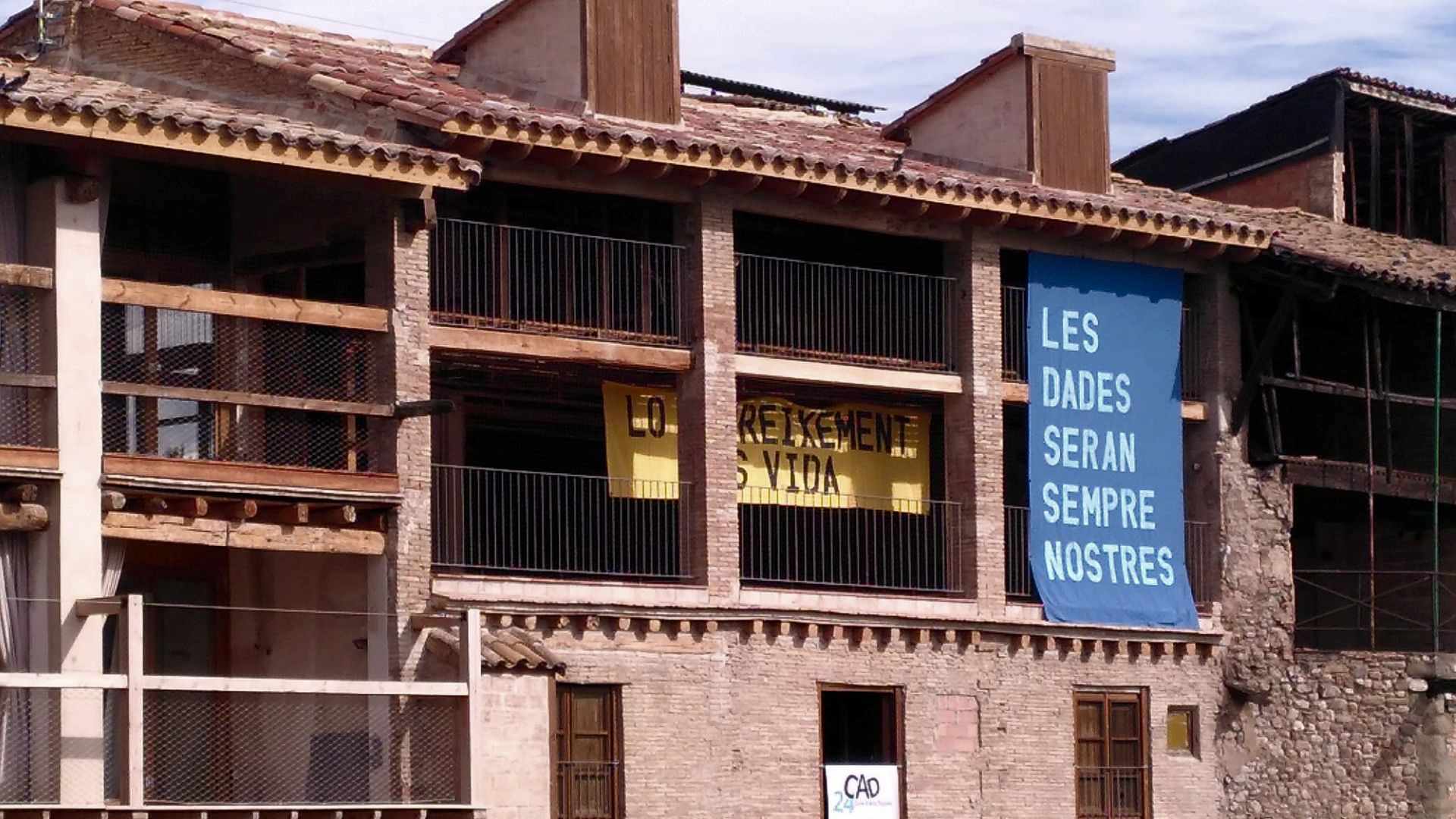
Banderes creades durant el Cicle d'Arts Digitals de Vic, exposades a les Adoberies (2024). Foto:Joan Soler-Adillon.
Press contact
-
Núria Bigas Formatjé