
Data and technology experts from around the world come together at the UOC for a more connected European higher education system
New avenues for collaboration between institutions and technology companies to increase interoperability and connections between university systems were explored during the conference, which was held jointly with 1EdTech and the DXtera Institute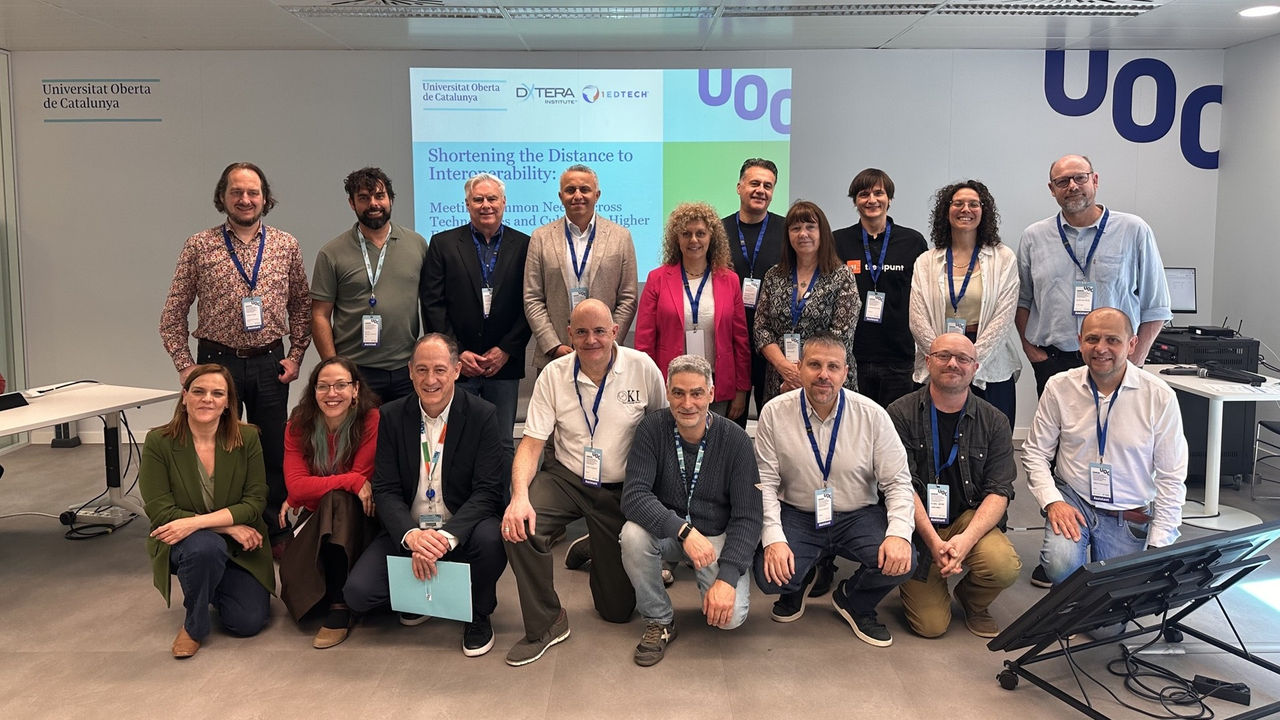
On 4 and 5 May, the Universitat Oberta de Catalunya (UOC) hosted an international conference with data experts, technology specialists, public officials and higher education professionals from all over the world to discuss how to create a more connected and interoperable student-centred university ecosystem. The event, titled "Shortening the Distance to Interoperability", focused on different universities', systems' and platforms' abilities to seamlessly connect with each other, share information and work together. Despite the advances seen in recent years, this remains one of the main challenges facing European higher education in an increasingly global, digital and international context.
The conference, which was held in partnership with 1EdTech – a global non-profit organization that promotes open standards for interoperability in education – and the DXtera Institute – a US non-profit consortium specializing in technological solutions to bring education systems closer together – provided an opportunity to share knowledge and experiences and explore innovative solutions. Against this backdrop, participants explored ways to strengthen the links between universities and education systems, reduce fragmentation in the sector and increase international collaboration.
"The UOC, a pioneer in the field of online education, has been designing digital learning models for many years. Bringing people, institutions and systems closer together has always been at the heart of what we do," said Ricard Gómez, Deputy General Manager for Talent, Transformation and Organization at the UOC. Participants were also able to share experiences and identify opportunities to strengthen connections between data, systems and institutions in the field of higher education.
.jpeg)
The conference provided an opportunity to share knowledge and experiences and explore innovative solutions..
.jpeg)
.jpeg)
.jpeg)
Jeff Merriman, CTO & Co-Founder for the DXtera Institute stressed the importance of interoperability standards to enable universities, teaching staff and students to choose the most suitable tools for each learning experience: "We imagine a digital education marketplace where institutions, instructors and learners alike can enjoy choice in the tools and agents they use to enhance the teaching and learning experience. Interoperable API standards, and related security standards, will be critical in achieving this vision."
And Gill Ferrell, Executive Director of 1EdTech Europe, underlined how important it is for technology to be at the service of learning: "Effective learning depends on digital tools that work together so the focus stays on learning, not technology. Interoperability offers the potential of data flows that stay with the learner and institutional flexibility to integrate and adapt tools without friction. This ecosystem approach is valuable whether you are creating a seamless experience for learners across a single institution or supporting student mobility across regions and borders."
In this context, emphasis was also placed on the importance of working together and creating synergies between institutions to advance towards shared standards. Case studies and real-world experience from universities and technology providers were presented to discuss how interoperability is being put into practice in different contexts. The resulting discussions showed that, far from being confined to technology matters, interoperability also covers legal, organizational and use aspects to better meet students' needs and give them a more active role in their learning pathways.
Towards a Culture of Interoperability
The importance of defining a culture of interoperability was also highlighted during the event. According to Quelic Berga Carreras, member of the Faculty of Computer Science, Multimedia and Telecommunications, "interoperability should be seen not only as a technical solution but as a cultural process involving collaboration between educational, technological and social institutions." This vision highlights the need for a shared understanding that, besides technology, also brings about change in educational and cultural dynamics.
Along the same lines, Francesc Santanach of the UOC's Data Office said that "the UOC has always encouraged collaboration in higher education. For a long time, the issue of interoperability in technology was driven mainly by American institutions, but since the pandemic Europe has taken the lead and expanded this concept beyond technology."
A commitment to the future of European higher education
The event was held at a time when various initiatives to increase interoperability between universities are being driven forward in Europe. One of them is the European Higher Education Interoperability Framework, which was created by the European Union in 2025. The aim of this framework, which brings together several European initiatives and open technologies, is to create a common standard and framework for easier data exchange between European universities and to help improve the quality of education. Rather than aiming to create new systems from scratch, this approach seeks to make existing ones compatible and better connected, using the systems already developed by institutions. This model will lead to more flexible, personalized and connected learning pathways across universities and countries.
On the road to achieving this goal, European university alliances, which include hundreds of institutions and a significant percentage of students in Europe, now play a key role in driving joint projects, strengthening cross-border collaboration and moving towards a more connected university system with a common academic language and greater capacity to work together. The event provided an opportunity to share experiences that can be applied to European university alliances aimed at increasing cross-border collaboration, such as OpenEU, the European open and distance university alliance coordinated by the UOC.
Press contact
-
Anna Torres Garrote