
"We need to foster the critical spirit to escape from knowledge silos and growing polarization"
Ignasi Beltran de Heredia, dean of the Faculty of Law and Political Science at the UOC
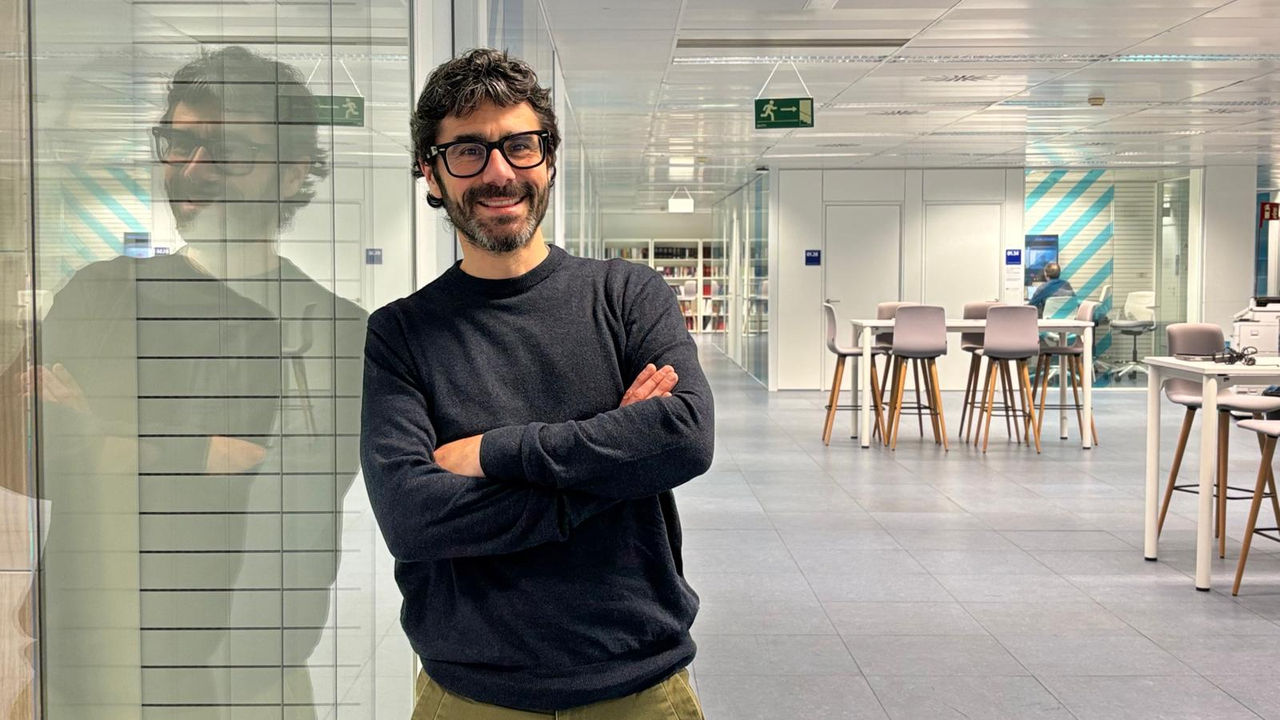
Ignasi Beltran is the dean and a professor in the Faculty of Law and Political Science at the Universitat Oberta de Catalunya (UOC), and a renowned expert in employment law – a field in which he is one of the leading authorities in Spain. His career has been defined by research (with the TAXBUSINESS research group, part of the UOC-DIGIT research center), dissemination and critical analysis, and he combines his work as dean of the Faculty with a constant focus on developments in the labour market, technology and the needs of future professionals in law and politics. We discussed the main challenges in the sector and the strategic priorities of training in legal, criminological and political science against an increasingly complex global backdrop.
The Faculty of Law and Political Science works in an environment defined by conflicts, social changes and technological challenges. What kind of professionals do we need to train to deal with this scenario?
If I had to highlight the main skills, I'd say that they must be curious, with a critical capacity and above all, respectful of diversity. Internalizing the value of humanism and intellectual humility is absolutely crucial. The same applies to accepting the finite nature of our knowledge and this humility. That's the main driving force behind curiosity; when we apply it, we begin to ask ourselves questions and that puts us in a position to question the status quo.
Critical capacity can emerge under these conditions, bringing about and nourishing a "virtuous" spiral of knowledge and personal growth and lifelong learning. If we adopt these three attitudes, the toolbox we use when looking towards the future will expand considerably.
How do the major global changes – geopolitical, climate and demographic – affect the Faculty's current priorities?
Something which is true of all the generations that have come before us is that they had to face a future with a great deal of uncertainty, and each generation probably thought that the times that they were living through were more turbulent than ever before. Our era is obviously no exception. And as Professor Daniel Innerarity said: "Not all of our problems are problems that can or should be solved; some, and perhaps the most important of them, can only be deferred, reframed or tolerated."
In this context, in which we face challenges of enormous complexity and scope, and in which the future is no longer an unknown and is becoming the present, we have to adopt a mindful, dynamic and transformative attitude to our students' changing needs.
Technology forms an interdisciplinary foundation within the Faculty. Which emerging areas require an immediate regulatory response: AI, neurotechnology, cryptocurrencies or cybercrime, or others?
All these issues basically involve possible threats to people. So, if I'm not mistaken, we must strive to put people first and prioritize protecting them over anything else.
“Universities must remain on the frontier of the unknown, taking risks and constantly adopting an investigative attitude”
How do we incorporate this technological dimension into training so that students understand the new risks and opportunities of the digital world?
That depends a great deal on each discipline, and there is a great deal of variability in this respect in our Faculty. In general terms, I'd say that as technology becomes fully integrated into our daily lives, this approach can only be interdisciplinary.
At the same time, given that changes are constant and the present is fleeting, we need to broaden our perspective and anchor our knowledge to areas that are more conceptual and abstract, which probably makes them a little more resistant to the passage of time.
The political landscape is increasingly polarized. How does the Faculty train the analysts and public policy professionals of the future to think and act in this environment?
The answer to the question is probably closely related to the first question: we need to foster the critical spirit, and accept that we don't know everything. That is the only way in which we will be able to escape from knowledge silos, echo chambers and ideological contagion. It's not an easy task, because people tend to gravitate around what they find most familiar, and what they identify with most strongly. That means it's relatively easy for us to be resistant to everything that falls outside that area of knowledge. Encouraging students to cross that boundary is crucial for awakening their civic and transformative spirit.
You've recently been appointed a member of the Council for Productivity and Economic Leadership of Catalonia. What does this appointment mean to you, and what contribution do you think you can make from the perspective of employment law?
I feel very fortunate to have been appointed, and I share this highly appreciated personal recognition with the rector, Àngels Fitó. I'm very enthusiastic about my role, which obviously inspires a great sense of responsibility. The group of experts who are members of the Council is very diverse, and their perspectives are undoubtedly very enriching and absolutely essential.
The role of law in general in this context is very important (and I would say vital), because legal norms are ultimately a very sophisticated way of doing politics, or in other words, they're an imperfect tool enabling people to achieve a specific objective.
So, against a backdrop of increasing governance by algorithms, radical transformation, extreme hypercompetitiveness, the redefinition of the paradigm of the commercial relationship between states, growing geostrategic tensions and brutal neoimperialism, lawyers can contribute to finding the formula to make things happen based on the authority of rules. The perspective of employment law obviously contributes to improving the diagnosis and undoubtedly enhances the approach and the solutions available.
What are the strategic priorities for the Faculty of Law and Political Science in the coming years?
I'd say that basically there are two. First, contributing to our students' personal growth and giving them the knowledge and skills they need to aspire to improving their civic spirit and their personal lives and their lives as members of society. And second, internally, doing everything possible to ensure that everyone in the Faculty makes as much professional progress as possible while at the same time actively contributing to meeting the challenges that the UOC faces as an institution.
What role does research, especially in the technological, labour and political spheres, play in the Faculty's mission, and how can it contribute to public debate and decision-making?
It's absolutely vital. Knowledge is central to shaping people's civic spirit and their life in society. Universities have a responsibility to work at the cutting edge in this respect. That means constantly working on the frontier of the unknown, taking risks and constantly adopting an investigative attitude. Personally, I feel very privileged to be able to lead such a committed team, which is so hard-working and which is constantly seeking to break down the wall of ignorance.
Press contact
-
Núria Bigas Formatjé