
An AI chatbot helps students with their online learning and teaching staff with their supervision
EduAIA answers learners' questions while giving the teacher data about their students, such as their frame of mind and their learning difficultiesThe project was one of the finalists in SpinUOC 2025 – the UOC's entrepreneurship programme
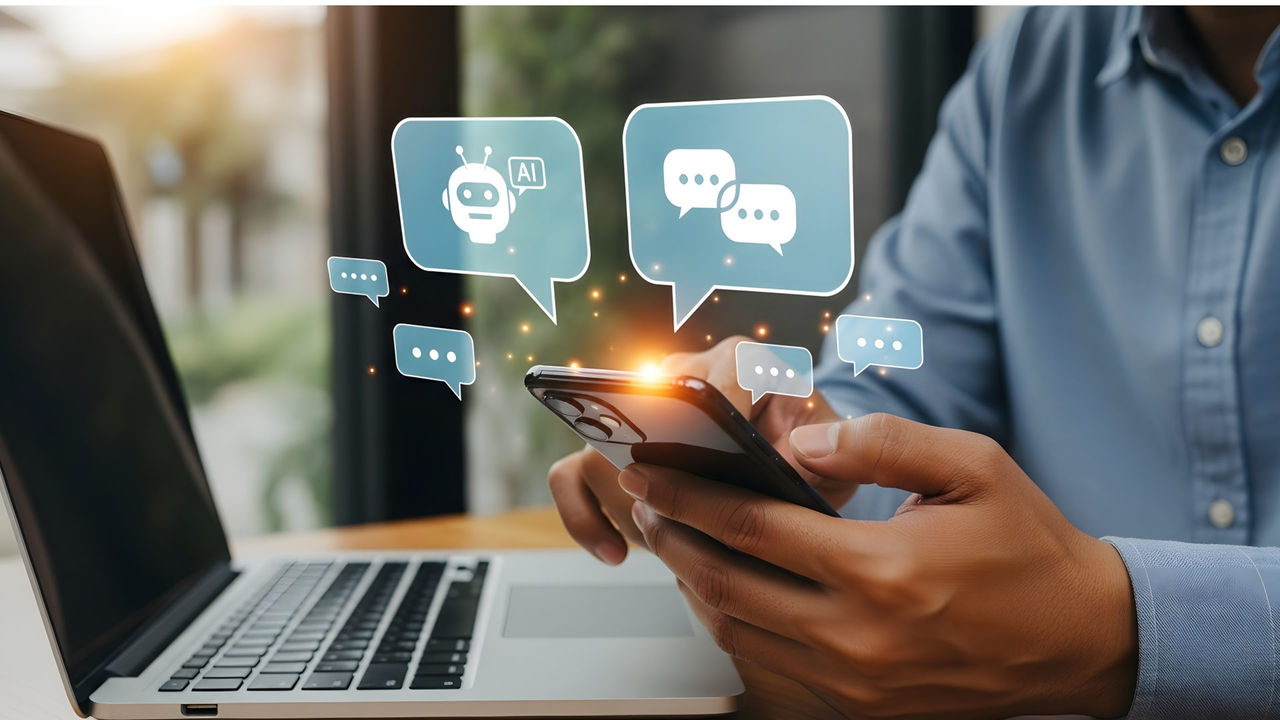
Although online learning is consolidating itself at all levels, and an increasing number of students and teaching staff are taking advantage of the flexibility and benefits of this form of study, it is not without its challenges. One of the most pressing of those challenges is to improve the channels of communication between students and teachers, and among students, so that it is more flexible, efficient, and focused on the needs of all the parties involved.
In this context, AI and in particular chatbots enter the picture as tools that could help break down whatever barriers remain when it comes to answering questions and queries or establishing a smoother relationship.
Some educational institutions are already using chatbots to deal with academic queries, but these systems still behave robotically, and overlook emotional and affective aspects. "Simply building educational chatbots isn't the best approach, because students process any information and feedback they receive in a cognitive and affective way, which means technology needs to offer them not only cognitive support, but also support in regulating their emotions." So said Elvis Ortega-Ochoa, PhD in Education and ICT (e-Learning) from the Universitat Oberta de Catalunya (UOC) and the creator of EduAIA, a project that combines technology with education, and which was one of the eight finalists of SpinUOC 2025, the university's entrepreneurship programme.
Elvis Ortega-Ochoa presenting EduAIA at the SpinUOC final on 26 June
“We need to ensure that the responses from the chatbot using generative AI are consistent with validated educational theory”
Empathetic educational chatbots
The project is "focused on improving interaction with technology", explained Elvis Ortega-Ochoa, a member of the UOC's Education and ICT research group (Edul@b), which is affiliated to the Education and E-learning Research Unit. To do this, it has a system to determine the student's frame of mind and cognitive state, which is included in the chatbot's programming, and enables it to "identify the level of prior knowledge the students have using questions about the issue they want to resolve, and it identifies the emotions which the students use when expressing themselves", he added.
Thanks to this ability to determine naturally and imperceptibly what each student is feeling, the responses that the chatbot provides are tailored to their real needs. "EduAIA focuses on educational theory to improve responses by encouraging the gradual development of skills while helping them to regulate their emotions," he emphasized. This means that the teacher does not only have a useful tool for managing their relationship with their students in online training environments, but they can also have a better understanding of the general mood within the group.
"This solution will have a significant impact on teaching staff," pointed out Elvis Ortega-Ochoa, who explained that EduAIA will provide metrics that will enable them to determine wh
Elvis Ortega-Ochoa presenting EduAIA at the SpinUOC final on 26 June
ich students need more support and follow-up, and which can resolve their queries without much difficulty using the chatbot, which will also enable students to streamline their learning process.
This will achieve the twofold objective of easing the workload of teachers working in online education, who often struggle to deal with the flow of questions and communications with their students, while helping to personalize the learning experience to make it more human and focused on each student's needs. "One of the challenges for us is to make sure that the responses of the chatbot using generative AI conform to validated educational theory," explained the instigator of this project, which does not seek to replace the work of teachers, but instead to complement it with technology adapted to the characteristics of each training programme.
A flexible solution
The developers of EduAIA suggest that the tool should be adapted to each course, within the different educational environments in which it will be implemented. Its system simply requires installation of a plug-in to synchronize the chatbot on platforms including Moodle and Blackboard. "Using the console, the teacher will be able to upload the contents of the course to personalize the chatbot, and then they will have to select the interaction model that is best suited to the student", said Elvis Ortega-Ochoa, who also pointed out that new interaction models will subsequently be added, to operate alongside the initial cognitive and affective scaffolding and fading with which EduAIA will be launched on the market.
The EduAIA project is ambitious in terms of planning its development and growth. It is now in the development phase, and the team is looking to collaborate with online higher education institutions and e-learning platforms to test the solution in different environments, while seeking public and private funding to boost EduAIA.
"The SpinUOC programme has been a space for raising the project's profile and building relationships to secure funding," acknowledged the tool's designer, who emphasized that this UOC initiative "helps this type of project to grow by enhancing our public profile".
Testing the technology
In the short term, the aim is to test EduAIA with at least 5,000 students in order to gather information to improve the tool. The prototype has tested its emotion detection facility on 196 students to date, which has provided a better understanding of the tool's potential.
The project is developing its business model, and is seeking to collaborate with online education centres wishing to take advantage of the rise of AI to improve communication and relationships between students, but with a personalized approach for each individual based on their specific circumstances.
The EduAIA project is part of the UOC's 'Lifelong learning' and 'Digital health and planetary wellbeing' research missions, and also supports the following UN Sustainable Development Goals: SDG 3 (Good Health and Well-being) and SDG 4 (Quality Education).

Research at the UOC
Specializing in the digital realm, the UOC's research contributes to the construction of future society and the transformations required to tackle global challenges.
Over 500 researchers and more than 50 research groups make up five research units, each with a mission: Culture for a critical society, Lifelong education, Digital health and planetary well-being, Ethical and human-centred technology and Digital transition and sustainability.
The university's Hubbik platform fosters the development of UOC community knowledge transfer and entrepreneurship initiatives.
The goals of the United Nations 2030 Agenda for Sustainable Development and open knowledge are strategic pillars that underpin the UOC's teaching, research and knowledge transfer activities. For more information, visit research.uoc.edu.
Experts UOC
Press contact
-
Leyre Artiz
