
Diane Coyle: "Universities must play a key role in the emerging social order"
The British economist was awarded an honorary doctorate in a ceremony at the UOC's Campus in Barcelona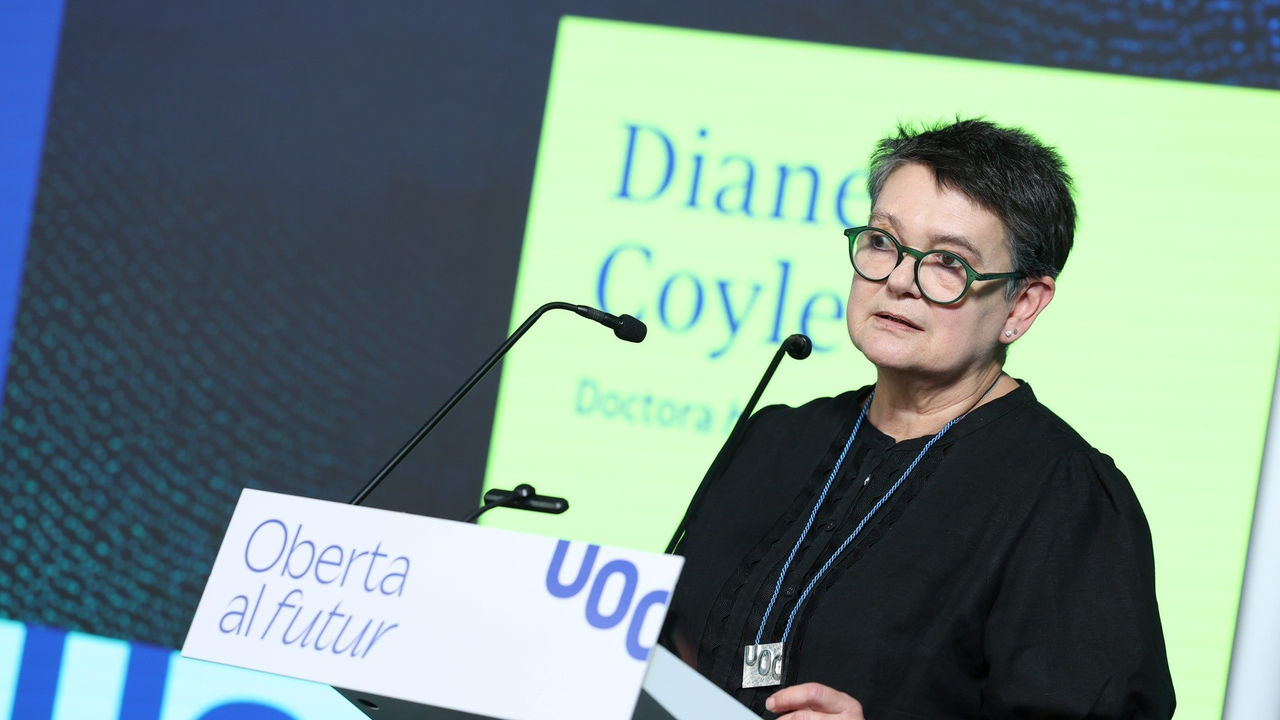
The UOC awarded an honorary doctorate to the British economist Diane Coyle, one of the most influential voices on the understanding of the digital economy in the United Kingdom, on Thursday 7 May. At a ceremony which took place on the Poblenou campus in Barcelona, Coyle championed the role of higher education in "extraordinarily turbulent times" like those the world is currently experiencing, and reiterated the need for universities to be considered "cultural and social institutions".
She warned that a gap has opened up between people who obtain a university degree and those who do not, and that this is what has made universities "a source of polarization". She called on those present to defend higher education. While she was at university, she had "a stroke of luck", as a result of which she had lecturers who motivated her: "They inspired me to see the world as endlessly interesting and to understand that learning is a lifelong occupation; the greatest gift an educator can give." This led to one of her key points: "learning means finding good questions rather than correct answers".
Coyle considers herself a person who was "transformed by education", and she expressed her concern at seeing that "one of the sharpest dividing lines in political and social views is now whether someone has a university degree or not". As an economist, she thinks that while universities "used to be seen as a ladder", today some people see them as "remote institutions divided from the rest of society". She believes that "this cultural chasm has widened, despite the economic importance of higher education institutions". She talked about the difference in university models in the United States, and in countries such as the United Kingdom and Spain, and said that "the arguments reflect an underlying pattern that people who do not have degrees are voting against people who do".
The two groups are separated by their economic prospects because "as the economy digitalizes, higher education has become a passport to better-paid jobs in cities", she warned. As a result, smaller towns and rural areas have been "left behind, with worse jobs", while "the solid, well-paid working-class jobs of the past have gone, and with them the accompanying dignity and respect". Coyle also pointed out that "there has been an unfortunate tendency to disparage people with less education, or to imply that it is somehow their fault if they have not done well in a system that is not designed for them". The UOC's latest honorary doctor expressed her concern that failing to obtain a university degree may be seen as "a personal failing" when she believes it is "a systemic one".
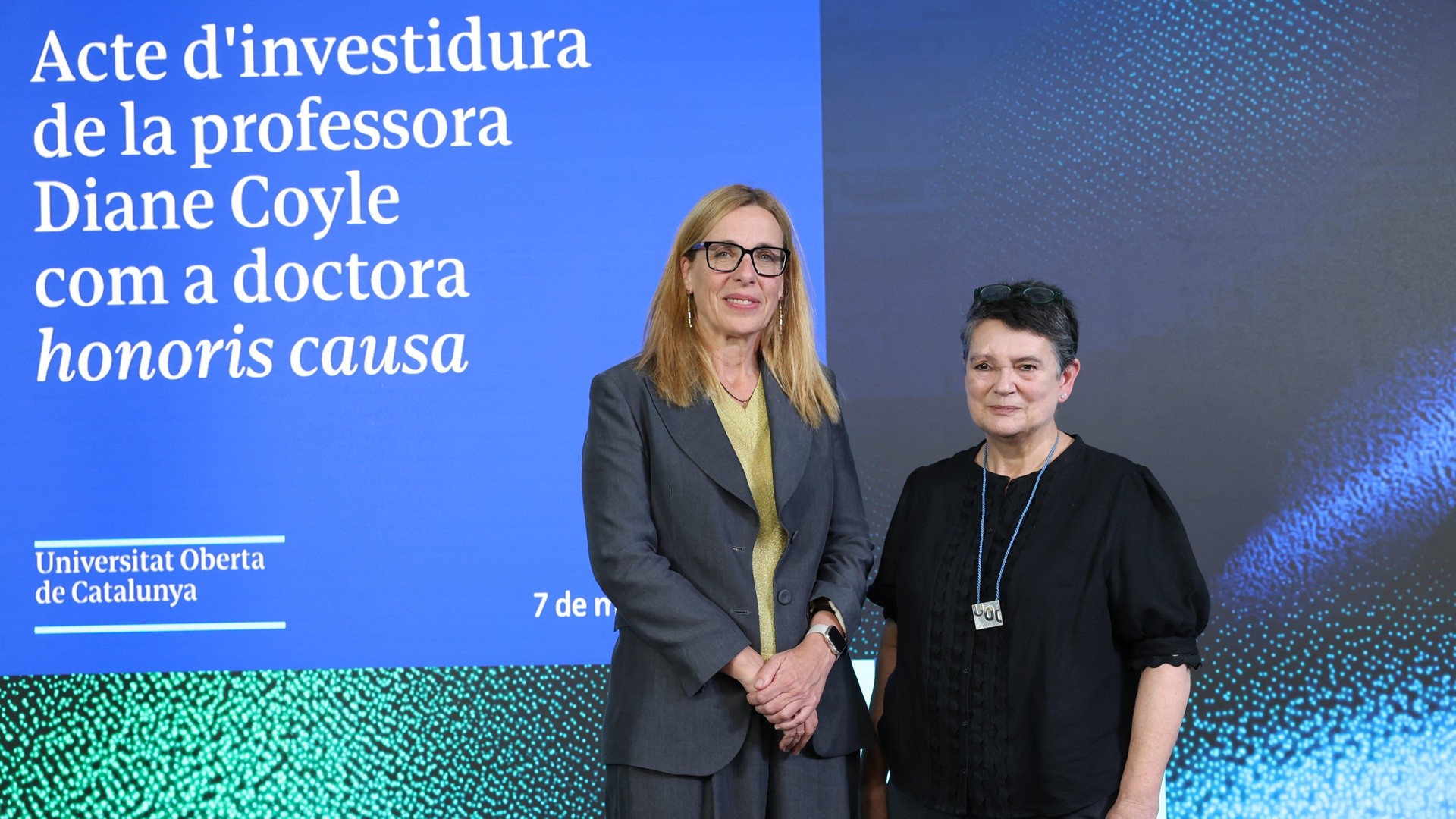

Coyle discusses the digital economy and the reasons why GDP has become obsolete.
Universities: "a source of polarization"
As a result, universities have become "a source of polarization" at a time when "modern, technologically advanced economies need highly educated people more than ever". Coyle also argued that "universities are more important than ever, and access to the intellectual horizons of an education, and the time to study and be curious, are privileges that should be available to anyone who wants them".
Given this need, Coyle said that higher education must be "loudly defended", and that this defence goes beyond focusing on its role within the economy "as a factory churning out human capital". Universities are also "cultural and social institutions" because they "provide an environment in which people can disagree constructively, can explore complexity and nuance, can learn to listen to other viewpoints, and change their minds".
Coyle also highlighted the role that research currently plays given the multiple challenges created by AI: "this is the moment to make sure that the role AI plays in our societies is understood and shaped by everyone, not just an educated elite, and certainly not by a small number of brilliant and affluent men in the tech companies". She championed the "key role" played by universities "in illuminating and engaging with this emerging social order". She believes that higher education is responsible for this and warned that "to do so effectively, in such polarized times, means having the grace to listen carefully to people who, at present, feel excluded from social progress, and respecting what they say".
She said she was excited to join the UOC community because she believes that it is aligned with the values calling for universities' increased engagement with the rest of society, and she pointed out that it is a university that "specializes in the most important questions of our time". She highlighted the interaction between new technologies and the human and social sciences, an area that her own research focuses on: "The UOC also values the kind of interdisciplinary research that is needed for universities to contribute positively to our societies, whose problems are not single-discipline problems."
“Universities are more important than ever, and access to the intellectual horizons of an education, and the time to study and be curious, are privileges that should be available to anyone who wants them”
Access to "a universal basic infrastructure"
Coyle's speech was preceded by the laudation given by Professor Joan Torrent from the UOC's Faculty of Economics and Business. He praised Coyle, saying that "she personifies the committed intellectual, who does not hide in an ivory tower and investigates, makes proposals and engages in debate" during turbulent times in order to make "the political economy useful for people and society". He defended the principles set out in Coyle's work, which is based on the assumption that "markets alone will not build a prosperous future for everyone", which is why governments "must ensure a sustainable future for all". He also talked about her recent proposal for "a universal basic infrastructure" that provides each citizen with "a minimum level of access so that they can thrive in a digital economy".
The ceremony was brought to a close by UOC Rector Àngels Fitó, who praised the choice of the new honorary doctor, saying that it is "a statement of intent for the future, which defines the university we want to be in the coming decades". She said that the UOC "is not watching the digital transformation from a distance; it is engaging with it bravely and intrepidly, and it does not separate knowledge from responsibility". As a result of these principles, the UOC is reflected in Coyle's work, which includes major contributions, such as the limits on the calculation of GDP. Fitó went on to stress that "Coyle has given us some of the clearest thoughts of our age, when she says that GDP is a distorted lens rather than a clear window into economic reality; our priorities ultimately fail to include what we do not measure correctly."
Coyle's career
Coyle has held a number of important posts during her career, including the Vice Chair of the BBC Trust and member of the United Kingdom Competition Commission. In her time as a journalist, she worked at the Investor's Chronicle and went on to be Economics Editor of The Independent, and she is a regular contributor to Project Syndicate. She is also the author of several books, including The Weightless World, a major study of the intangible economy, and The Economics of Enough, in which she reflects on how to manage resources while taking into account the well-being of future generations.
Experts UOC
Press contact
-
Anna Torres Garrote