
"Digital care platforms rely on the precarious work of immigrant women"
Cristina Barrial, a PhD student at the UOC, is studying how technology introduces new forms of precarity
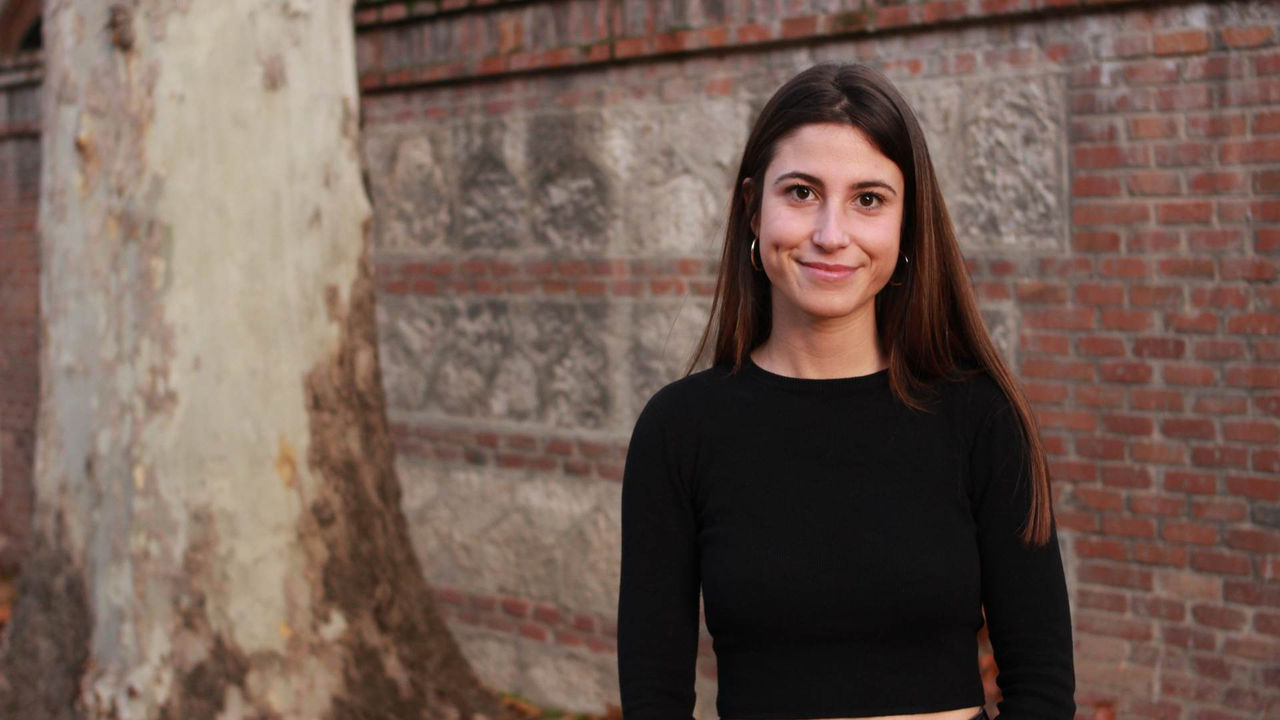
An ageing population, the entry of women into the workforce, and the crisis of the welfare state have led to a "crisis of care": there are many dependent people who need care, at the same time as a shortage of caregivers. While in southern European countries this role had traditionally been taken on by women in families, in recent years they have been replaced by migrant women who work in extremely precarious conditions, which have deteriorated even further with the emergence of digital platforms which organize these services. Cristina Barrial, a predoctoral researcher on the doctoral programme in Society, Technology and Culture at the Universitat Oberta de Catalunya (UOC) and a member of the CareNet group at the UOC-TRÀNSIC research centre, has studied these platforms and published the article Social reproduction and feminized platform labor: Care, domestic work, and migrant Agency in Madrid and Milan, which examines the rise of these platforms and the extreme gender precarity they represent.
Where does your interest in platforms for domestic work and caregiving come from?
My thesis has changed over the years, but in general terms, it focuses on the collective practices of domestic and care workers, and on how they organize themselves. I chose Madrid, as it's where I live and one of the places in Spain where associations of domestic workers have had the highest profile and public visibility.
Having said that, the article I've written with Ana Santamarina and Alina Dambrosio – Social reproduction and feminized platform labor: Care, domestic work, and migrant Agency in Madrid and Milan – looks at how digital platforms operate in different ways depending on the local circumstances. Although, as southern European cities, Madrid and Milan have some characteristics in common, such as a stratification of the labour market and high levels of privatization of care, the two cities have different histories of organization, which influences how platformization operates in each case.
Why are the digital platforms offering these services booming?
This boom cannot be understood solely in terms of a technological innovation. It is above all a response to a structural crisis of care in places like Madrid and Milan, which have been affected by the weakening of the welfare state, the ageing of the population and the outsourcing of reproductive labour to the market. Against this backdrop, the platforms present themselves as quick and flexible solutions, but instead of solving the crisis, they reorganize it along commercial lines: they position themselves as intermediaries and digitalize access to domestic work, relying on a sector that is already precarious, feminized and largely sustained by migrant women.
"Caregiving in southern European countries has historically fallen to the women in the family"
Why is this crisis of care particularly acute in southern Europe?
The data show that southern Europe has both a higher concentration of domestic and care workers and high levels of platform-based work. That is no coincidence. The predominant welfare model in the region is family-oriented: unlike in northern Europe, where the state has played a more central role in providing public services, in countries like Spain and Italy care has historically been the responsibility of families, and within families, of women.
The pressure on households intensifies when the ageing population, the massive entry of women in the labour market and the cuts to public services after the 2008 financial crisis are taken together. This is the result of the crisis in social reproduction: the need for care increases, but not the public resources or the time available to meet it.
Is this the geographical area where most platforms like this have appeared?
That's right. Southern Europe has become a particularly fertile ground for the expansion of platforms offering domestic and care work, but not because they are an exclusively Mediterranean phenomenon, but because here they have a sector which is already consolidated, which has historically been outsourced to migrant women, and is dominated by informal labour. The platforms have not created that market, but they reorganize and digitalize it, by taking advantage of its structural vulnerabilities.
Can you describe the sort of people who offer their services and work on care platforms?
Most of them are migrant women, and they have often recently arrived in the country where they are living, or their legal status is precarious. The platforms did not create this situation, but instead they are responding to the historical structure of domestic and care work. It has always been a deeply feminized and racialized sector in southern Europe. In this situation, many platforms act as genuine "arrival infrastructures": they offer quick access to employment with no need for previous networks, accredited qualifications, or formal employment processes. This makes them a key entry point for newly arrived women, but it also reinforces their presence in the most precarious areas of the labour market.
"Technology introduces new forms of precarity"
Care work has always been precarious. Your research shows that the platforms make it even more so. How do they do this?
It is true that domestic and care work was already a structurally precarious sector before the platforms arrived, with low wages, informal working conditions, little protection and high levels of dependence on the employer. However, the technology has introduced new forms of precarity that overlap with these historical inequalities. One that is quite striking is how the work has become more fragmented, as instead of a relatively stable job, many workers engage in a number of micro-services, involving dead time, unpaid travel and a constant search for new clients. And risk is outsourced to an even greater extent: the worker is responsible for finding work, maintaining a good digital reputation, and dealing with any cancellations or last-minute changes. And the rating and ranking systems create constant pressure to accept unfavourable conditions for fear of receiving bad reviews.
Is it true that workers have to pay to be on these platforms?
Not all the platforms operate in the same way. Some, and especially those that act as intermediaries, operate through subscriptions or contact fees, so the workers may have to pay to gain access to job offers, with no guarantee of getting the job. Other employment platforms do not charge the worker directly, but they make a profit in the form of commissions or types of contract that may also lead to control and flexibility for only one of the parties involved. In all cases, what we found is precarity organized along technological lines: it doesn't create it from scratch, but it intensifies it, fragments it, and manages it algorithmically.
Migrant women doing care or cleaning work have not traditionally organized themselves to fight against precarity. Why are they doing so now?
In fact, domestic and care workers have been organizing themselves for decades, although these types of organization have often been invisible . In Spain, for example, there are associations and groups with more than twenty years of experience that have fought for recognition of their labour rights, the ratification of ILO Convention 189 and the approval of the new legislation that has governed the sector since 2022. Perhaps the context is what is new. Platformization creates new conflicts and types of precarity that mean that strategies have to be rethought. And in recent years there has been a more wide-ranging feminist mobilization and public debate on care work that has given the struggles a higher profile and greater legitimacy. Additionally, the workers are also using digital tools to build networks, share information and create collective responses.
How are they organizing themselves to fight against these structures that make their employment precarious and discriminate against them?
The workers are adopting strategies at various levels, ranging from the everyday to the overtly political. First, there are widespread forms of informal organization: there are WhatsApp, Facebook and Telegram groups where they share job offers, warn each other about abusive employers, exchange legal information and provide emotional support. These networks act as genuine mutual support infrastructures which counter the fragmentation that the platforms impose.
In cities like Madrid, there are long-established associations of domestic workers that provide employment advice and organize public campaigns, performance actions, and training forums. These spaces collectively examine the platforms' practices, including illegal contracts and wages below the legal minimum level, and offer legal and political strategies to address them. Many workers often use the platform for their own ends; for example, they find clients and then establish working relationships outside it, thereby reducing dependence on the digital intermediary.
So technology can also be an ally in these cases?
Yes, technology can be a double-edged sword. It intensifies control and precarity, but it also enables the workers to create transnational networks, pass on information quickly and organize in new ways. It does not end the difficulties that collective action faces, but it does create spaces that the workers are strategically using to sustain themselves and fight for their rights.
"We need to increase public awareness about the conditions under which these women work"
As citizens, how can we fight against the platforms where these labour abuses take place?
I believe it is essential to strengthen the legislative framework and workplace inspections, defining the platforms' responsibility when they have effective control over work, and ensuring that the rights of domestic workers are fully equivalent to those in other sectors, thereby preventing technology from operating in grey areas that enable risks to be outsourced.
We must also increase public awareness: many of these applications are expanding because they offer convenience and speed, but we need to think about the conditions under which this service is provided, and to understand that care is an essential task that sustains life, and it cannot be organized with a "low cost" approach without that having any consequences. We also need to support and raise the profile of the workers' organizations, by supporting their campaigns, raising awareness of their demands, and advocating for alternative models such as cooperatives and ethical intermediaries: that is a concrete way in which the big platforms can be challenged. Ultimately, it is not simply a question of regulating technology, but of collectively rethinking how we want to organize care and the principles we want to base it on.
What social impact would you like your research to have?
I think this knowledge can help to foster public debates and more informed legislative processes, provide analytical tools for the workers' organizations, and contribute to designing policies that regulate the platforms without losing sight of the specific characteristics of the care sector. But above all, I would like it to reinforce the idea that the way we organize care is a collective and political issue, and not a private decision dealt with by an app.
Finally, what are the next projects you have in the pipeline?
Right now, my most ambitious plan is to finish my doctoral thesis and above all, for it to be useful for groups like SEDOAC and Territorio Doméstico, organizations that provide support for women who work providing care and domestic workers, who generously gave me their time, and allowed me to be a part of their daily lives.
I would like the knowledge we have produced not to remain simply within the academic sphere, but also to act as a tool for their struggles and means of organization. I am also trying to take the research to other spaces beyond the university. Pablo Martínez, Leandro Alarcón and I recently launched a video podcast called Futuros Radicales [Radical Futures], in which we take urban walks while we discuss various problems related to the city. I try to work on projects that I find interesting.
Reference: Social reproduction and feminized platform labor: Care, domestic work, and migrant Agency in Madrid and Milan, Digital Geography and Society
Barrial Berbén, C., Dambrosio Clementelli, A., & Santamarina, A. (2026). Social reproduction and feminized platform labor: Care, domestic work, and migrant agency in Madrid and Milan. Digital Geography and Society, 10, Article 100150. https://doi.org/10.1016/j.diggeo.2025.100150
Press contact
-
Núria Bigas Formatjé