
Beyond the pandemic: how coworking spaces survive in rural areas
A UOC study analyses the funding models and future viability of rural coworking spacesThey are sustainable if they serve as pillars of the community
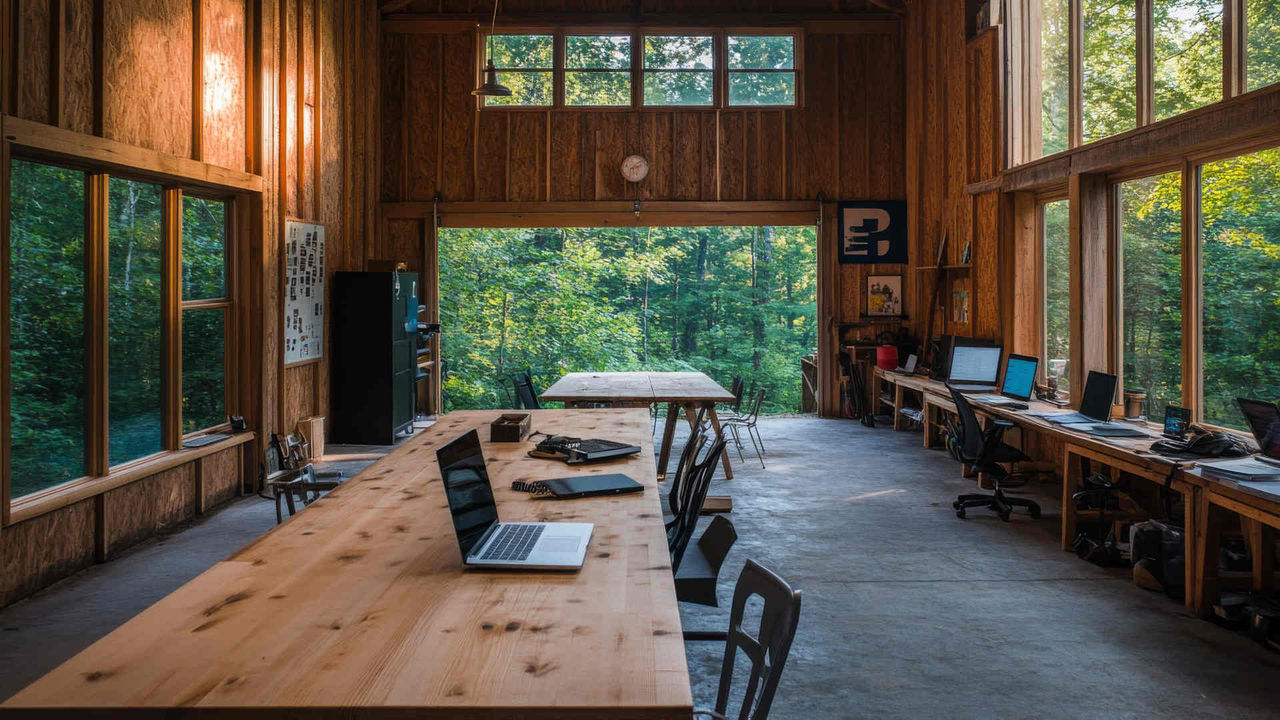
Coworking spaces have emerged as an alternative to traditional workplaces. Driven by the Covid-19 pandemic and the rise of remote working, these spaces are becoming increasingly common in cities, as well as in rural areas, where they hold promise for community engagement and local development, but also face challenges such as funding and long-term viability.
"In urban settings, coworking spaces tend to have high turnover. New users with different profiles turn up every day. This can create opportunities, but it also means that spaces become less personal, which makes it harder to build lasting relationships," explained Jorge Arturo Villarreal-Valtierra, the study's lead author and a PhD student on the interuniversity doctoral programme in Business Administration and Management at the Universitat Oberta de Catalunya (UOC).
“The key is to connect more with the community and have managers capable of adapting to the needs of the community”
In rural areas, however, the dynamic tends to be more personal, since users usually stay the same and know each other. According to Villarreal-Valtierra, this makes it easier to organize activities, collaborate and adapt the space to local needs.
To analyse how rural coworking spaces adapt to funding models, examine their sustainability strategies and explore their community embeddedness, he chose two very different regional contexts: Catalonia and Rhineland-Palatinate, a German federal state.
"When analysing these two regions, I observed a striking contrast: in Catalonia, private spaces with hybrid strategies are the predominant model, while many spaces in Rhineland-Palatinate are public and rely on subsidies. Two very distinct models, even though both regions have access to EU funding through the LEADER programme," said Villarreal-Valtierra. He is currently developing his thesis under the supervision of Julie Wilson, co-leader of the New Perspectives on Tourism and Leisure (NOUTUR) research group, and Carles Méndez from the Interdisciplinary Research Group on ICTs - Artificial Intelligence Laboratory (i2TIC-IA Lab). Both are also members of the Faculty of Economics and Business and co-authored the study.
Mixed funding sources and rural catalyst
To carry out the analysis, the research team sent questionnaires to managers of these spaces and conducted interviews with representatives of coworking associations in Spain and Germany. A total of 10 cases were included: five in Catalonia and five in Rhineland-Palatinate.
"A large start-up grant might seem like the perfect solution, but research shows that there's no single winning model," said Villarreal-Valtierra. "What actually works best is a diversified model that combines some public funding, private investment and contributions from users or in-house activities." He provided an example: a German space that began with a small grant and has survived thanks to support from local sponsors and associations.
Regarding community embeddedness, coworking in Catalonia is framed as a shared asset, cultivated through local cultural events and associations. By contrast, integration in Germany is more limited and less direct, with lower levels of local participation.
"What surprised me most was the enormous cultural difference. In Catalonia, many of these private spaces function as small communities: resources are shared, friendships emerge and business projects are even launched," he said.
Spaces with a stronger social and collaborative focus in Catalonia
Regarding long-term sustainability strategies, the research – carried out within the UOC-DIGIT centre – shows that these spaces are closely tied to funding sources in both regions. While their viability relies more on municipal support in Germany, they are more resilient in Catalonia, as they use structures such as cooperatives to access new forms of funding.
"In Rhineland-Palatinate, there is some uncertainty about their future. Some associations believe that many spaces are unsustainable and that, in a few years, the solution will be automated spaces operating without staff. This perspective contrasts sharply with that of Catalonia, where coworking spaces have a stronger relational and social character," said Villarreal-Valtierra.
In fact, most spaces in Catalonia have continued to operate after the pandemic thanks to their local ties and varied activities, including events, coliving and partnerships with associations. Meanwhile, in Rhineland-Palatinate, many spaces were established with public funding and now must operate independently. "The key is to connect more with the community and have managers capable of adapting to the needs of the community," he suggested.
The next step will involve analysing how many of these coworking spaces have remained active and what strategies have actually worked in the long term. "We also want to incorporate the perspective of policymakers, which has not yet been analysed directly," he added.
For example, in Rhineland-Palatinate, there were cases where new municipal governments opposed maintaining coworking spaces, as they were seen as an unnecessary expense that generated no direct economic benefits. "Understanding these positions is key to proposing more realistic and sustainable public policies, possibly even a specific funding line for rural coworking spaces that takes into account their social and community value, rather than just their immediate financial benefit," he concluded.
This research aligns with the UOC's Digital transition and sustainability research mission, and contributes to the following UN Sustainable Development Goals (SDGs): 8, Decent work and economic growth; 9, Industry, innovation and infrastructure; 10, Reduced inequalities; and 11, Sustainable cities and communities.


Reference article
Villarreal-Valtierra, J. A., Wilson, J., Méndez-Ortega, C. (2025). Funding sources and community embeddedness in rural collaborative spaces. Contemporary Social Science. DOI: https://doi.org/10.1080/21582041.2025.2587138
Transformative, impactful research
At the UOC, we see research as a strategic tool to advance towards a future society that is more critical, responsible and nonconformist. With this vision, we conduct applied research that's interdisciplinary and linked to the most important social, technological and educational challenges.
The UOC’s over 500 researchers and more than 50 research groups are working in five research units focusing on five missions: lifelong learning; ethical and human-centred technology; digital transition and sustainability; culture for a critical society, and digital health and planetary well-being.
The university's Hubbik platform fosters knowledge transfer and entrepreneurship in the UOC community.
More information: www.uoc.edu/en/research
Experts UOC
Press contact
-
Núria Bigas Formatjé