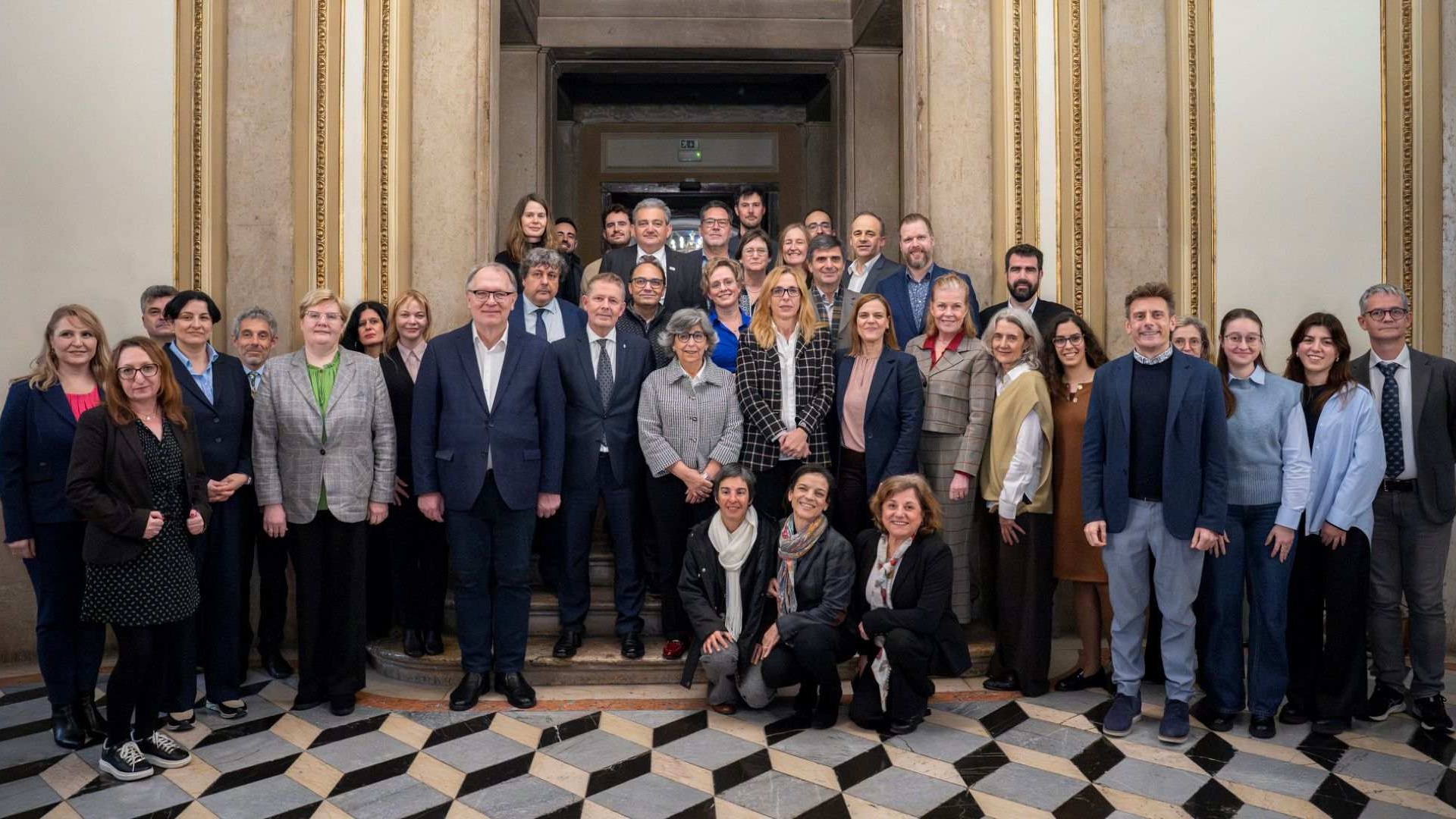
The UOC and Eurocities are training 50 members of staff from the city councils of 27 European cities
The programme, which has been developed within the OpenEU framework and created jointly with Eurocities, the largest European network of major cities, addresses the training needs identified in European municipal teamsThe initiative, which promotes the use of data and evidence in decision-making in order to make public administration more effective, sets an example for how universities can collaborate with large European institutional networks

The UOC and Eurocities, a network of over 200 major European cities that represents close to 150 million citizens, have launched a groundbreaking course to train local government staff in the design of evidence-based public policies. Its aim is to increase European local governments' ability to base decisions on data and rigorous analysis.
Amid complex urban challenges such as mobility, the energy transition or housing, the programme seeks to provide local government staff with tools to better assess the impact of their policies and make the best possible use of public resources.
The course, which has been developed within the OpenEU alliance of European universities, coordinated by the UOC, is one of several initiatives designed to promote lifelong learning and the updating of professional skills in line with the European Union's priorities, a vision shared with Eurocities.
According to Pastora Martínez Samper, the UOC's Commissioner for International Action and the OpenEU Coordinator, "Collaborating with Eurocities enables us to address the pressing training needs of local administrations. Its positive reception demonstrates the importance of collaboration between universities and public administrations in the design of lifelong learning with a purpose."
For Eurocities, this partnership is part of a wider effort to provide city officials with the skills needed to enhance policymaking and, ultimately, better deliver for their citizens. As Guillem Ramirez Chico, Coordinator of the Eurocities Academy, explains, “evidence-informed policymaking helps cities design public policies that are more effective and more responsive to the real needs of people and places. It does not replace democratic debate or political choice, but it strengthens them by ensuring that decisions are grounded in facts, data and a better understanding of reality.”
The first course has met with high demand and will teach local government staff from 12 countries
The course, taught entirely online and in English, has been jointly designed by academic teams from the UOC and experts at the Eurocities Academy. While the UOC has led its academic design, the network of European cities has helped identify local administrations' training needs and validate the course design with municipal staff from within its network. This first course confirms the high demand for and interest in this programme, with local government staff from 12 countries set to take part.
Unlike other programmes, this course emphasizes the practical application of evidence-based public policies and integrates disciplines such as behavioural economics and the study of complex systems, as well as aspects of ethics and European regulations relating to the use of artificial intelligence and big data. This interdisciplinary approach reflects current trends in public governance and the strategic use of data in decision-making.
According to Josep Curto Díaz, a member of the UOC's Faculty of Computer Science, Multimedia and Telecommunications and the person in charge of the course, "an administration that ignores data faces risks such as ineffective public policies or wasted resources, because decisions can end up being based on gut feelings rather than evidence."
The course has been designed to apply to a wide range of contexts across Europe, from cities in the north to those on the Mediterranean. "The public policy cycle and the hierarchy of evidence are universal tools that can be applied to any problem, be it traffic in Copenhagen or tourism in Barcelona," said Curto.
He also stressed that municipal staff should have their own data to work with: "When staff are in control of the data, they can ask questions and get immediate answers without having to rely on external reports and advice," he said.
“Collaborating with Eurocities enables us to address the pressing training needs of local administrations.”
The pilot phase will be included in the UOC's standard range of courses
Around 50 city council staff from 27 European cities will take part in the pilot of this new training programme, which will begin on 18 March. After the pilot phase, the course will be added to the UOC's range of learning programmes as a microcredential. Its modular, flexible format will enable more people to access the course and will support the ongoing updating of professional skills within the European Higher Education Area.
This initiative is in line with the priorities of the Union of Skills, fostering reskilling and upskilling in response to the challenges of the digital transformation. It is also an example of the model of collaboration between universities and public administrations promoted by the OpenEU alliance to connect academic knowledge with European institutions' real-world needs.
This initiative strengthens the UOC's position in the field of specialized training for the European labour market and reaffirms its commitment to a flexible and digital educational model. In addition, its collaboration with Eurocities and the development and delivery of the course within the OpenEU framework underline the potential of European alliances to produce innovative training programmes directly linked to the challenges of governance and digital transformation faced by Europe's public institutions.
Experts UOC
Press contact
-
Anna Torres Garrote