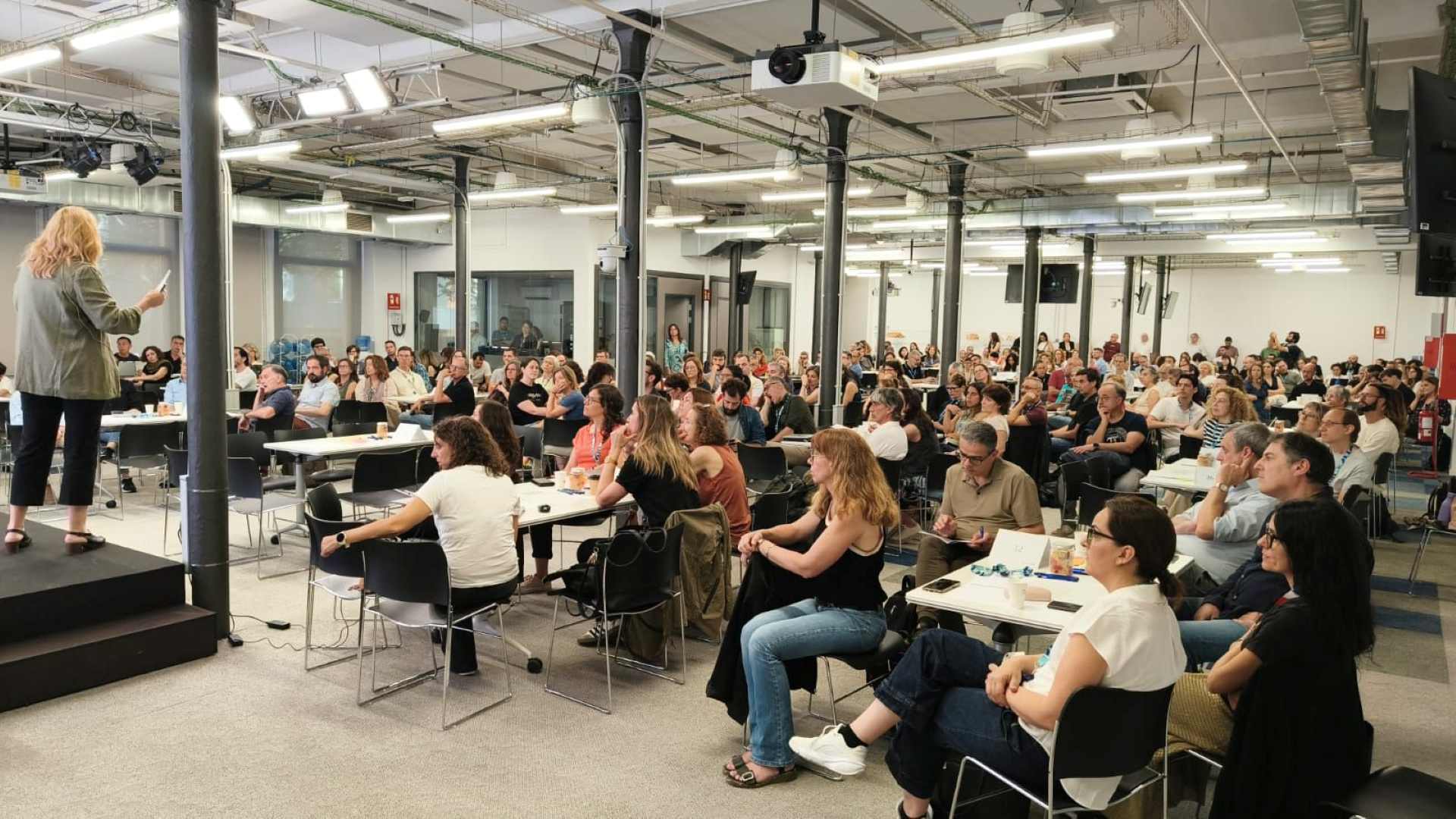
The uoc.Ωmega mission brings together 400 people to imagine the UOC of the future

How should onlineeducation evolve in response to the advent of artificial intelligence? How should tasks be split between humans and machines? How can the new technological landscape help us provide better support to students? What direction should the UOC's educational model take? How can we ensure that AI does not spark a new social, employment and democratic rift?
At a time of critical change, with the rise of AI redefining the ways we teach, learn, generate knowledge and build trust in society, the Universitat Oberta de Catalunya (UOC) has appealed to its community to use its talent, creativity and innovative mindset to imagine the UOC of the future, a fully AI-native university: "The uoc.Ωmega mission is a collective reflection process involving the entire organization. The aim is to redefine the role of universities at a time of sweeping changes due to AI. We must now revisit the role of universities, just like we did 31 years ago," said UOC Rector Àngels Fitó.
"Close to 400 people signed up for the uoc.Ωmega mission, resulting in 55 expeditions with very varied teams. This ability to bring together teaching staff, administrative staff, course instructors, students, graduates and former employees, the fact that everyone wanted to get involved, is a very distinctive feature of our university," said Teresa Guasch, Vice Rector for Teaching and Learning.
Stages of the UOC Ωmega mission
The mission started in mid-May with an appeal to take part and set up expeditions (working groups).
"It's an opportunity to establish the foundations of the equitable, ethical and excellent university we truly want to become," said Azucena Vázquez, course instructor and associate researcher at the UOC-FuturEd research centre. She is one of the people who decided to get involved in this collective creative endeavour.
The projectkicked off in late May with a working session aimed at enabling each group to start outlining their proposed model, with the plan of continuing to refine and work on it during June.
Over the past few weeks, each working group has unleashed its creativity with the support of the eLearning Innovation Center: "We've focused on thinking about how we can help students learn more, and more effectively, and how to remove barriers to learning," said Jordi Conesa, associate professor and researcher at the UOC-FuturEd research centre.
As a result of this process, 45 dossiers were submitted by the expeditions and discussed at a workshop on 15 July. "Coming together with people from different teams and departments has created a new and really enriching setting. In our day-to-day activities, we don't have this chance to work together," said Marta Sintes, tutor for the Bachelor's degree in Humanities.
Imagining the UOC of the future
The UOC was founded more than 30 years ago with the conviction that digitalization had the potential to transform higher education from the ground up. Now, as agentic AI reshapes the present, the university has once again called on that innovative spirit on which it was originally built: the ability to envision a university capable of meeting the needs of science and the new generations in these changing times.
This has led to the launch of the co-ideation process for the UOC's new educational model, drawing on our community's collective intelligence to forge a new UOC directly inspired by the opportunities made possible by this technology.
FAQ
Experts UOC
Press contact
-
Leyre Artiz