
The UOC secures over €1 million for research with socioeconomic stakeholders
UOC's Transformative Social Innovation Lab has received financial backing from ERDF funds as part of the Catalan Government's Regions of Knowledge programmeThe funding programme is part of the RIS3CAT 2030 strategy
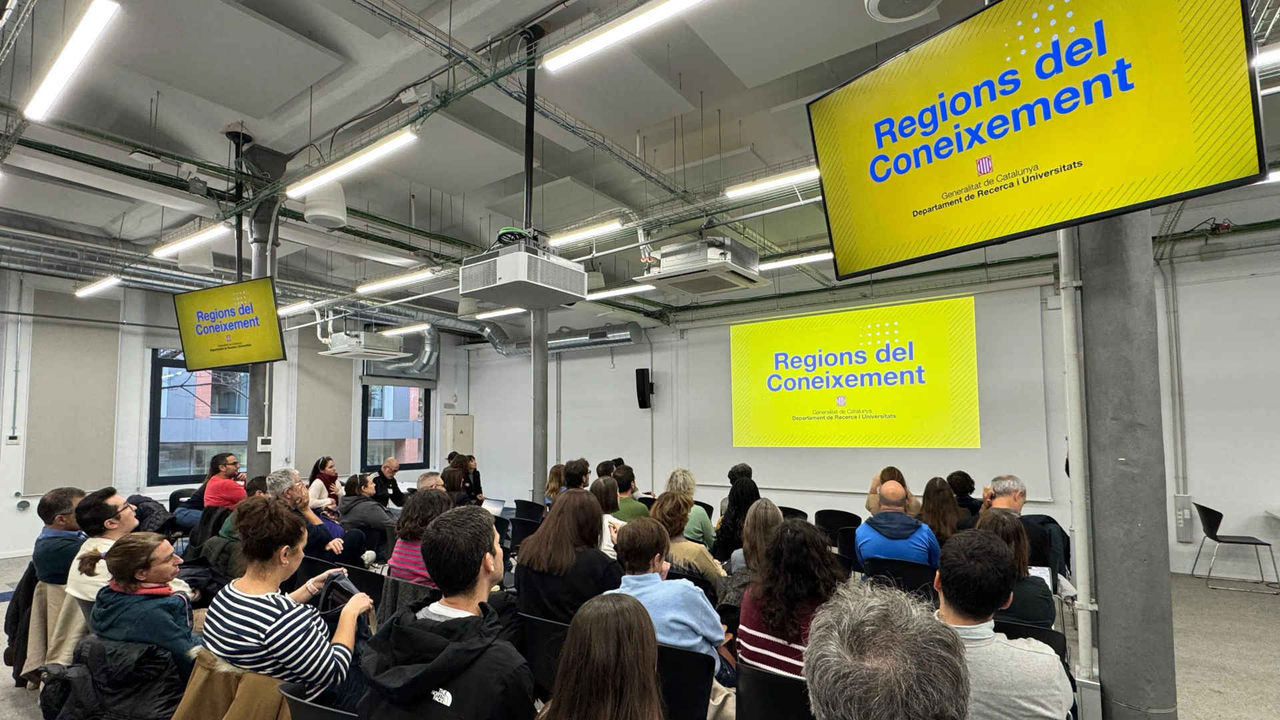
The Universitat Oberta de Catalunya (UOC) has received over €1.3 million in funding for the Transformative Social Innovation Lab (LIST-OpenLab), a project involving applied research and transformative innovation. This final contribution brings the total funding for the project to over €3 million. The financial support has been awarded by the Government of Catalonia as part of the Regions del Coneixement (Regions of Knowledge) programme, which leverages the research ecosystem to ensure that knowledge and innovation address social, environmental and economic challenges throughout Catalonia.
The programme, which is overseen by the Catalan Ministry of Research and Universities and co-funded by the European Regional Development Fund (ERDF), is part of the Strategy for Smart Specialization (RIS3CAT 2030), which aims to promote a greener, fairer, more digital and more resilient socioeconomic approach. The UOC's OpenLab focuses actions in the fields of culture, education and knowledge, industry, community health and the agro-ecological transition. Some 15 research groups and 80 researchers will take part, with 37 actions in collaboration with over 260 local stakeholders.
“OpenLab aims to use the UOC's knowledge to address real-world challenges in collaboration with public authorities, businesses, social organizations, cultural stakeholders and other local actors”
Mireia Riera, director of Knowledge Transfer, Entrepreneurship and Open Science at the UOC, who coordinates the project, highlighted that the funding "recognizes the university's potential role in transforming local communities". Having secured the full amount applied for, OpenLab will now be able to pursue the purposes for which it was created, "as an open, stable and cross-disciplinary platform to use the UOC's knowledge to tackle Catalonia's social, economic, cultural and environmental challenges," she said. Riera sees the support pledged under the Regions of Knowledge programme as confirmation that "far from stopping at the mere generation of knowledge, university research and innovation should help co-create solutions with local stakeholders," as promoted by the RIS3CAT 2030 strategy.
The funding will enable the UOC to establish OpenLab as a platform connecting the university's research with the challenges faced by local communities. "The greatest impact will be seen in three areas in which the UOC can provide unique benefits: education and generation of knowledge; culture as a driving force for cohesion and transformation; and digital, collaborative and sustainable economic models and industries," said Riera. OpenLab has also been designed to help address other challenges in Catalonia, such as community health, the energy transition, sustainable food and the ethical and inclusive use of digital technologies. Riera also pointed out that the impact of the initiative goes far beyond the specific actions carried out: "We hope that this collaboration with public authorities, businesses and social and cultural organizations will result in stronger alliances and new joint projects in the future. This is fully in line with the UOC's alliance policy, which aims to build meaningful relationships with shared value and a tangible impact."
OpenLab's unique features
According to Riera, OpenLab's unique value resides in the fact that it "builds on what makes the UOC different," which is its position as "an interdisciplinary online university with a community spread out across Catalonia". The director of Knowledge Transfer, Entrepreneurship and Open Science added that this "enables us to view local areas not only as geographical areas but as networks of people, communities, organizations and connected knowledge". OpenLab is thus "an infrastructure aimed at identifying challenges, connecting people with different skills and abilities, fostering co-creation and turning knowledge into impact". The lab will also "enable research groups and units from different disciplines to work together in tackling local communities' real-world challenges through participatory methodologies, challenge-based learning, citizen science, impact assessment and working with a diverse range of stakeholders".
Innovation camps
Riera presented a very positive assessment of the initiative's first few months: "We've held various innovation camps, which are precisely one of the key tools for promoting co-creation between the scientific community and local stakeholders." Having started its operations in late 2025, OpenLab has already held four innovation camps so far: Cap a una accessibilitat universal (Towards universal accessibility), held in Barcelona in partnership with the AccessCat Network and the VASS Foundation; Cap a una comunitat professional preparada i resilient davant l’impacte de la IA (Towards an AI-ready and AI-resilient professional community), held in the Barcelona metropolitan area in partnership with the Catalan Small and Medium Enterprise Association (PIMEC) and the Consortium for Continuing Education of Catalonia (CONFORCAT); Revitalització i resiliència en les ruralitats de les Terres de l’Ebre (Revitalization and resilience in the Terres de l’Ebre rural communities), held in the Terres de l’Ebre region in partnership with the Association of Rural and Maritime Initiatives of Catalonia (ARCA) and Ateneu Cooperatiu de les Terres de l’Ebre; and, more recently, Adopció de la IA, cadena de valor i sostenibilitat en les MIPIMES del Camp de Tarragona (AI adoption, value chain and sustainability in micro, small and medium-sized enterprises in the Camp de Tarragona region), held in partnership with Reus Desenvolupament Econòmic (REDESSA) and Reus City Council. These innovation camps have been possible thanks to the work of a number of UOC departments, and the Alliances, Community and Equity department, in particular.
"They're all clear examples of OpenLab's mission: to use the UOC's knowledge to address real-world challenges in collaboration with public authorities, businesses, social and cultural organizations and other local stakeholders," said Riera.
Riera highlighted that, over its first few months, OpenLab has shown its potential as a strategic tool not just for carrying out specific actions under the Regions of Knowledge project but also in terms of building trust with local stakeholders: "These relationships will play a key role in creating closer alliances in line with the policy of driving new joint projects with social, local and economic benefits in the future."

This innovation space falls within the framework of the Call for Knowledge Regions, an instrument of RIS3CAT 2030 (the strategy for the smart specialization of Catalonia), promoted by the Generalitat with the support of the Catalonia ERDF Programme 2021–2027, co-funded by the European Union.
Transformative, impactful research
At the UOC, we see research as a strategic tool to advance towards a future society that is more critical, responsible and nonconformist. With this vision, we conduct applied research that's interdisciplinary and linked to the most important social, technological and educational challenges.
The UOC’s over 500 researchers and more than 50 research groups are working in five research centres focusing on five missions: lifelong learning; ethical and human-centred technology; digital transition and sustainability; culture for a critical society, and digital health and planetary well-being.
The university's Hubbik platform fosters knowledge transfer and entrepreneurship in the UOC community.
More information: www.uoc.edu/en/research
FAQs
Experts UOC
Press contact
-
Anna Torres Garrote