
"The colonial past is not a closed chapter: it continues to shape hierarchies and forms of relationship"
Tania Safura Adam, researcher and promoter of Radio África
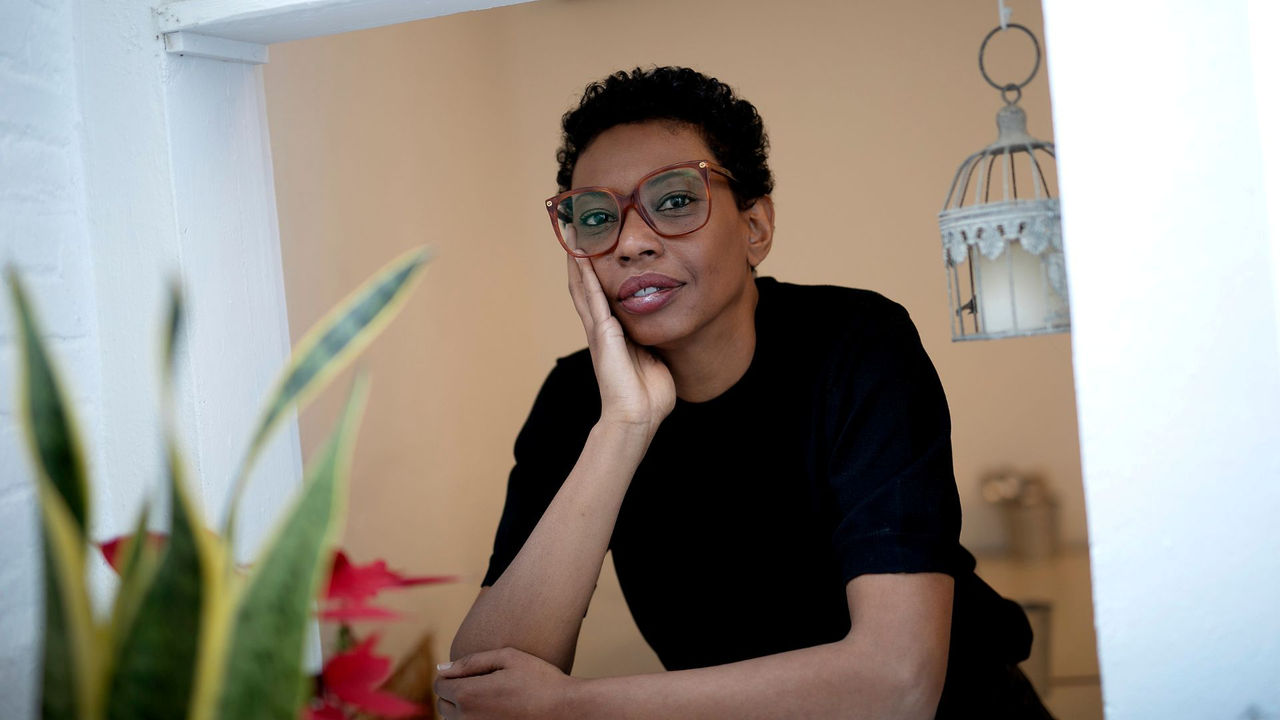
Tania Safura Adam is a researcher and promoter of projects such as Radio África and other spaces for critical thinking and advocacy for Black cultures. Her work focuses on documenting colonial memory and Black forms of resistance, blending academic research and artistic expression.
Lecturer at the Pompeu Fabra University and teacher at the MACBA Independent Studies Programme (PEI), she has participated in the 4th Seminar of Cultural Studies: Imaginaries, Knowledge and Border Identities, organized by the GAME group (UOC-TRÀNSIC) and held at the Universitat Oberta de Catalunya.
“Neighbourhoods like Rocafonda are spaces for cultural production and thought”
Where does your motivation to investigate Black art and culture come from?
I believe it stems from a lack of knowledge; I live in a region that has a profound ignorance of Black culture, among others. My motivation comes from the need to know, to create knowledge, and that is a form of self-knowledge.
What do we mean by forms of Black resistance? Could you give me some examples?
Black communities are relegated to the sidelines. In the face of marginalization you can either give up or resist. Resistance means not accepting the conditions by which you are defined, striving, in various ways, not to succumb to oppression. There are multiple forms of resistance, from the struggle for civil rights to fighting against bureaucratic discrimination or immigration laws.
There are also forms of cultural resistance, such as writing a book like the one we have just published, El color de la piel de toro (Ediciones del Oriente y del Mediterráneo), in which eight writers narrate what it means to be a Black person in Spain. Another action of resistance was the founding of Radio África. Black resistance takes multiple forms and expresses itself through diverse arenas of struggle and creation.
Tell us about Radio África. What is it and why should we listen to it?
Radio África was born as an attempt to promote the music being heard in African cities. It began in 2012 when these expressions were quite unknown, and in Spain, the imaginary of wild and primitive Africa still persisted. This ignorance encouraged me to create Radio África Urban Sounds, and after proposing the initiative to Bruno Sokolovitz, one of the founders of Scanner FM, we launched the podcast on their platform.
Although Radio Áfricas primary motivation was music, it later evolved to explore the African continent through different forms of cultural expression, such as photography or literature. Gradually, it became a space for critical thinking.
Currently, it functions as a laboratory that brings together writing, research and curatorial projects.
Your work explores colonial memory and its traces in todays society, mainly with the España Negra (Black Spain) Project. How does the colonial past continue to influence the culture of contemporary Spain?
Spains colonial relationship with Africa has its own distinct history. Expansion took different forms: military occupation in Morocco and political, cultural and religious colonization in Equatorial Guinea. These are stories that are part of Spain's collective memory.
The colonial past is not a closed chapter: it continues to shape imaginaries, hierarchies and forms of relationship. The representations constructed during imperial expansion are updated in language, institutions and everyday life. I am interested in observing how that past transforms and continues to operate in the present. This imprint appears in monuments and street names, but also in celebrations, businesses and collective narratives. Public space preserves some memories while excluding others.
Do these systems of inequality and discrimination persist?
Yes. Inequalities persist in access to work, housing, representation and cultural life. The experiences and productions of Black people continue to occupy a secondary position. It is a structure that is reproduced in different areas.
Racism is not always explicit. It operates through gestures, stereotypes and institutional practices that may seem normal but lead to exclusion. My experience has allowed me to observe the continuities and the community responses of today.
Throughout your journey as a researcher of Black resistance, what messages have impacted you the most?
I have been struck by the persistence of certain historical depictions of Black people: their association with danger, and their identification with physical, domestic and service work. These are imaginaries with a long genealogy that, although they are changing, continue to condition the forms of representation and social relations. In the case of Black women, this association with domestic and care work remains highly visible. I am interested in reconstructing these genealogies to understand how they have been produced and perpetuated.
Since 2022, you have been leading the España Negra research project which combines academic and artistic approaches and is progressing despite a significant lack of resources and official support.
España Negra seeks to build a field of knowledge about the presence, experience and contribution of Black populations in Spain, from the 16th century to the present. To achieve this, we bring historical research, orality, community archives and artistic practice into dialogue. One of the challenges is that many of these stories have not been preserved or recognized by institutions. This is why we are not only interested in recovering documents and testimonies, but also in generating tools and methodologies that allow us to produce new narratives and establish genealogies between different generations and experiences.
I am also interested in working with the cultural expressions and dynamics of contemporary Black communities. Neighbourhoods like Rocafonda, in Mataró, are spaces for cultural production and thought. Listening to and documenting them allows us to build situated knowledge that is attuned to the present.
Research advances through collaborations, conversations, publications and public projects. Resources are limited, but that does not define the value of the work. The important thing is to consolidate a field of research, to circulate materials and to share them.
What initiatives are you currently working on?
I am working on an installation for the Dakar Biennale that explores the historical and contemporary connections between Africa and Europe through work, displacement and memory. I am interested in observing how people move, but also how sounds, images, money and knowledge circulate. Through a set of archives and testimonies, the project reconstructs genealogies and experiences that allow us to think about migrations beyond conventional narratives.
Finally, what is the main message of your paper "Black Archives: City, Memory and Futures in Dispute", presented within the framework of the 4th Seminar of Cultural Studies: Imaginaries, Knowledge and Border Identities?
Long-term research allows us to recognize continuities and discover what is yet untold. In España Negra I have found that memories of Black presence are scattered across community archives, documents, photographs, publications and oral accounts. That dispersion makes it difficult to build shared genealogies, meaning that every generation has to begin anew. My paper aims to connect these fragments and conceive of the archive not only as a place of conservation but as a tool to produce knowledge and open up futures. I am interested in bringing the struggles and forms of organization from the 1970s into dialogue with the present, recognizing these trajectories and preventing them from being lost, even though digital technologies allow for the documentation and circulation of these materials.
Press contact
-
Editorial department