
Àngels Fitó: "We're placing students at the centre of all the university's work"
The UOC's executive team presented the Strategic Plan for the next five yearsThis new roadmap will help the educational model, the courses and programmes, the research, the organization and the university's social impact evolve
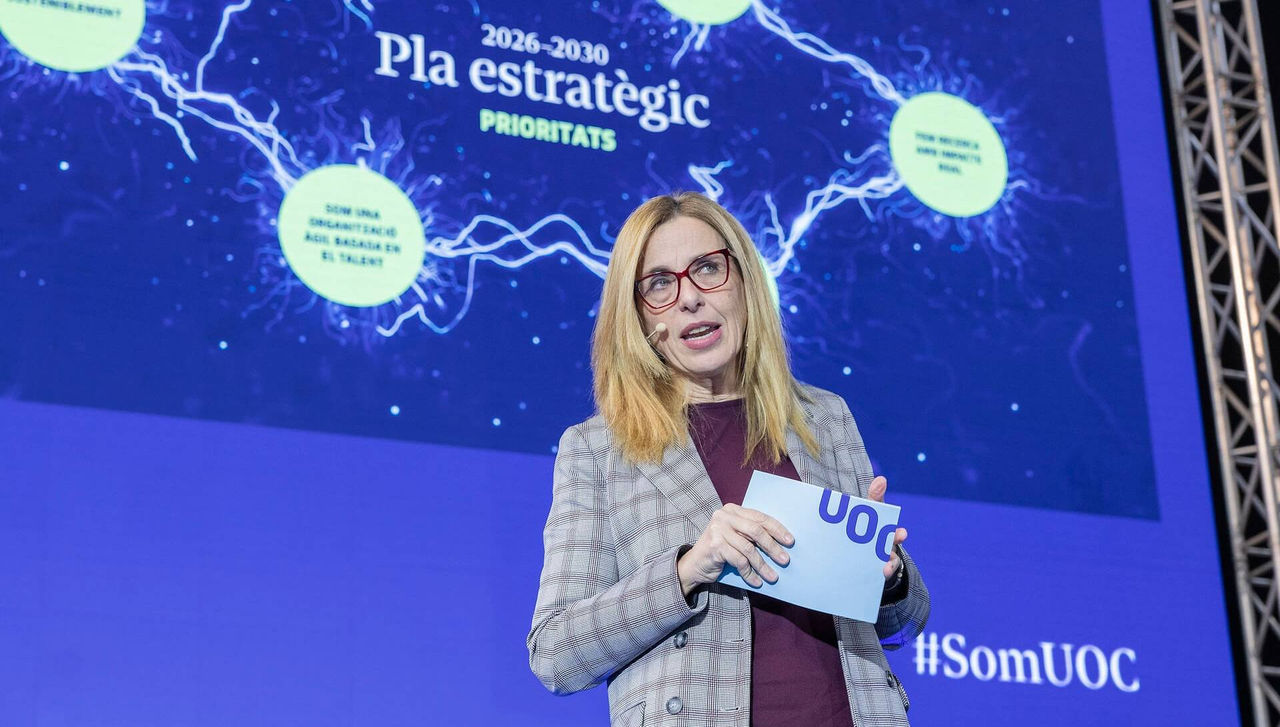
The Universitat Oberta de Catalunya (UOC) presented its Strategic Plan 2026-2030, the roadmap that will set the path for the institution's evolution over the next five years, placing students at the centre of all the decision-making and strengthening the university's role as an agent for social transformation.
The plan sets the priorities to address the current challenges and achieve a UOC that's more people-oriented, more agile and more impactful.
In short, the five priorities that will guide our roadmap until 2030 are:
- Personalizing learning, changing lives: a more personal and flexible educational model.
- Conducting research with a real impact: creating useful knowledge for social transformation.
- Being an agile, talent-based organization: a healthier, more efficient and more technological UOC.
- Growing sustainably: ensuring our role in society and competitive leadership.
- Positioning a transformative UOC: having a political and social impact on a local and global scale.
The university, thanks to its entirely online model, aspires to be more incisive in its mission to improve the lives of people and their communities, and to be a beacon and a benchmark for the education of the future.
Àngels Fitó: "The Strategic Plan is our compass for change"
The plan was unveiled on 29 January to an audience of nearly 1,400 members of the university's staff in an event held at La Farga de L'Hospitalet on the theme of "The UOC we want. The UOC that transforms."
UOC Rector Àngels Fitó stressed that this new Strategic Plan is the result of a process of careful listening that revealed a community that is resilient and passionate. She underlined that "the new plan is not simply a document or an internal guide, but instead a statement of intent aimed at placing students at the centre of all the university's work. […] The Strategic Plan is the result of a shared history and a future that we want to write together."
Finally, she called for the commitment of all members of the UOC staff, and urged everyone to turn the plan into a dynamic project: "Let's make this roadmap our own: let's make it the reason to bring out the best version of ourselves and of the UOC."

Personalization of learning as a key factor in transforming lives and environments
Vice Rector for Teaching and Learning Teresa Guasch reflected on the teaching model: "at the UOC, we are defined not only by placing our students at the centre of our work, but also by how we decide to support them."
Our commitment is embodied in the personalization of learning. "It's not just about adapting content: it means recognizing different backgrounds, different paces and changing goals. Learning is not a single activity, but instead a lifelong process," she said.
Turning to 2026-2027, the vice rector set out the roadmap in four major action plans: enabling students to govern their learning experience, redesigning programmes to make them more flexible and with closer links to their environment, transforming the tutoring model to provide students with comprehensive support, and promoting evidence-based teaching innovation.
Intertwining research and knowledge transfer with social impact
Vice Rector for Research, Knowledge Transfer and Entrepreneurship Xavier Vilajosana talked about the institution's identity: "We must be a research university or we will cease to exist." Against a global backdrop that is sceptical of science and the role of universities, Vilajosana called upon individuals to redouble their efforts in order to adopt a strategic vision that creates tangible value and makes the UOC an essential institution in the system.
Vilajosana pointed out that the current priority is to consolidate structures like the new research centres, to make them useful tools which undertake more diverse and interdisciplinary activities. The new Strategic Plan focuses on attracting talent and increasing self-funding, with elite sources such as COFUND. He also described this year as "the year of knowledge transfer", with a plan to identify assets that can be transferred to business and to society as a whole.
Concluding his speech, Vilajosana called for people, centres and missions to "come together" to produce impactful research.
An agent able to influence public debate and social transformation
For Vice Rector for Alliances, Community and Culture Manel Jiménez-Morales, the university must occupy its own space, position itself strongly and influence public debate. "Being an open university means breaking down the walls of the classroom to connect the knowledge we generate with the real needs of society, businesses and institutions."
In order to make this vision clearer, the vice rector set out a roadmap with four directions. First, strengthening the network of alliances to create a tangible social impact, using tools such as Alumni nodes and the university clinics of the future. Second, making a commitment to a more personal and participatory UOC in which everyone feels they belong to an active community that fosters participation, listening and tolerance. Third, raising the university's profile with a new institutional portal in 2026 and a clearer narrative that explains the unique characteristics of the UOC.
Finally, Jiménez-Morales underlined the objective of having a greater impact on the legislative agenda and public policies by offering our academic expertise.
Empowerment and internal talent
Vice Rector for Governance and Academic Policy Maria Jesús Martínez Argüelles said that the transformation of the UOC must not only be focused outwards, but also begin with the organization itself: how we work, how we coordinate and how we make decisions. Looking towards 2030, she set the university the challenge of becoming a more agile and healthy working environment, of which everyone feels proud to be a part.
This change is based on three key aspects. The first is talent, which the vice rector proposes to foster using a new skills map, continuing education and a culture of empowerment. The second focuses on coordination, and aims to simplify processes and eliminate overlaps that take up unnecessary energy. Finally, the third centres on more fluid decision-making, based on shared data and indicators.
Martínez Argüelles concluded her speech with an encouraging vision of the future: "We want to be an organization in which talent grows, is recognized and has the space to act; to be a university which is somewhere where everyone wants to come and work."
Placing students and support for teaching and research at the centre of organizational transformation
General Manager Jordi Marin issued a call to action to transform the administration of the university. "We are here to answer the question of how to address the urgent need to be more agile, fast, efficient and sustainable."
When setting out this vision, Marin announced that the university is launching a first phase of internal reorganization aimed at moving decisively towards achieving the objectives for the future which have been established collectively. He explained the key areas involved: "This reorganization is a response to a decision that is both strategic and necessary, which places the students' experience at the centre of the organization and reinforces the ecosystems providing support for teaching and research."
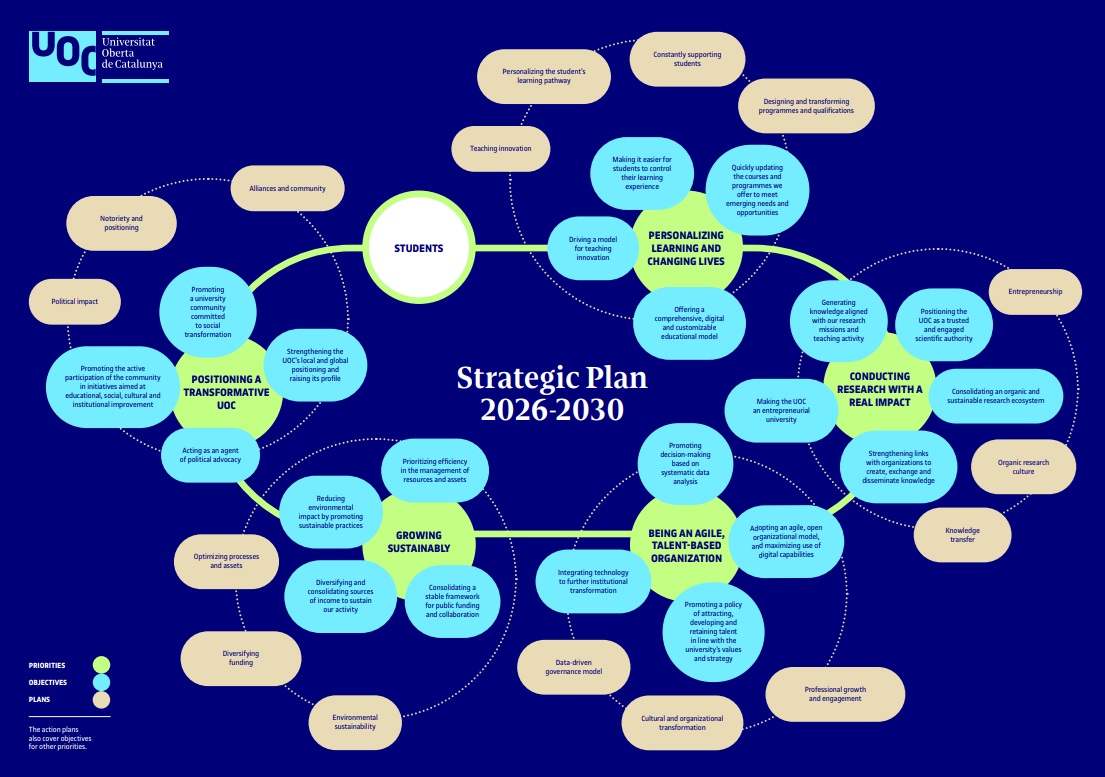
2026-2030 Strategic Plan
Discover our priorities, goals and plans here.
Event photo gallery
Click here to view the images on Flickr.
Press contact
-
Editorial department