
"We must protect children by regulating access to social media"
Daniel Riera, dean of the Faculty of Computer Science, Multimedia and Telecommunications
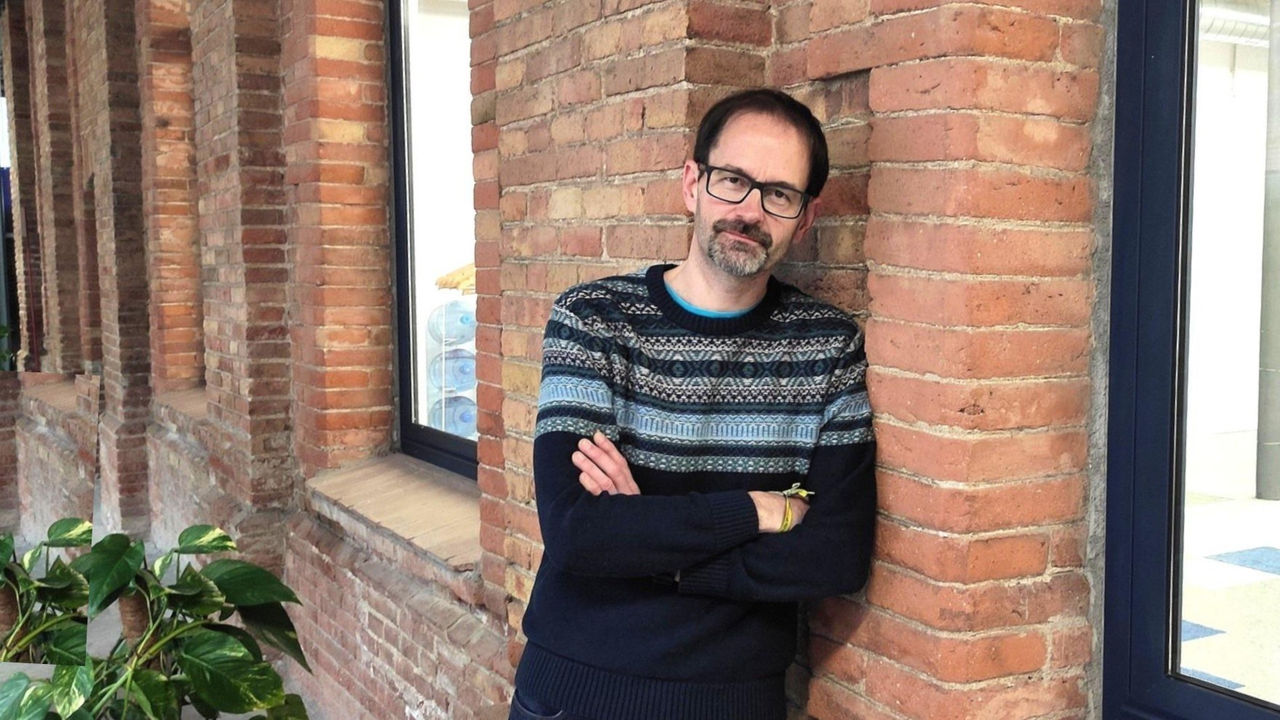
Daniel Riera is the dean of the UOC's Faculty of Computer Science, Multimedia and Telecommunications and also a member of its teaching staff. His work at the UOC-TECH research centre as head of the ICSO group focuses on the development of algorithms and software that can help us to make better decisions in complex situations, such as transport and logistics, production, real-time positioning and smart cities. In this interview he discusses topics such as the use of AI in SMEs, women in technology and whether children should be allowed to access social media, and shares details of his faculty's contribution to training the workforce.
What has the appearance of AI meant for the teaching of technological degrees? And for the Coding School?
The degrees taught in our Faculty remain strongly grounded in mathematics, physics and statistics, etc., because without this knowledge students would have no criteria for judging whether an AI solution is correct or for understanding decisions made by the machine. The arrival of AI is an opportunity to foster students' critical thinking and train them to know how to identify mistakes and propose improvements to solutions.
The UOC's Coding School is designed for people who aren't computer scientists and want to improve their professional prospects through technology. A good example would be journalists who want to learn advanced data handling using tools such as Python. We're planning to introduce modules to teach students how to use AI as a productivity tool, acting as a 'co-pilot' that helps professionals to work better, but always under the control of the human user.
56% of SMEs in Spain already use AI. As a researcher in this field, what mistakes would you advise these companies to avoid, to be more efficient?
One of the most common mistakes is rushing in without researching first. People often buy the first technology that reaches the market without analysing it previously, which in many cases leads to unnecessary investments. You need to take time beforehand to identify exactly how you'll use it. The objective must be for workers to be able to do more things in less time or offer a higher-quality service, without a wasteful start period that doesn't go on to bear fruit.
Teams must also be given time to train. If AI is implemented hastily, staff are often not trained or guided in how to use it correctly, and may perceive new technology as a threat to their jobs, which can lead to internal resistance and reduce efficiency.
You are interested in gamification as a motivational tool in learning. In university degrees, what types of exercise are most beneficial for students?
I'm interested in introducing game dynamics so that students feel more motivated to perform tasks that they could otherwise find tedious. Gamification is not just about having fun, but using techniques typical of games to motivate people to do certain things that can be tiresome. It's a tool that in some cases can help the student to be more productive, for example, by doing more exercises that enable them to better internalize a topic. This can improve their learning and, therefore, their academic performance. It can also be a way to encourage teamwork to undertake common tasks. As an example, one of our faculty members conducted a test in a course on networks and cybersecurity in which he divided the students into groups who had to do different exercises, such as dealing with an attack on a server, allowing then to learn security concepts through practical work.
In an episode of your podcast, Despacho 42, you talk about protecting children online. What do you think about the Spanish government's plans to ban access to social media for children under 16 years of age?
I completely agree. I'm not a psychologist or an expert on the subject, but knowing what's behind the design of social media, it's clear to me that we must protect children by regulating their access. It's similar to the law on tobacco: the responsibility lies with those who sell the product, not with the consumer. Regulation should not be seen as a punishment but as a way of putting limits on companies.
Effective measures to verify age need to be implemented. It's not enough to ask users if they're minors. For people to use social media, you could request a credit card and apply a charge, even if it's simply a token amount, or ask for a digital identifier, issued by an accredited agency, which would allow you to verify the person's age without revealing other personal data, as is being discussed in the EU.
Since 2016 you have been supporting the international Equit@t awards in gender and technology. In the last decade, what social developments have you seen and what aspects need to be improved?
Thanks to our close collaboration with the UOC's Gender and ICT (GenTIC) research group, we can see that girls aged 10 to 14 are continuing to shy away from tech careers, and this is due to various factors, including social stereotypes and a lack of role models. Over the years, engineering has been associated more with men. The Spanish university system used to have a degree in 'Computer Science', and 30% of the students on it were women. When the name was changed to 'Computer Engineering' that figure plummeted to 10%. Today, women are more attracted to technologies with a direct social application, such as biomedical engineering or data analysis focusing on health or education.
In Spain, the employment rate for people with disabilities is 28.5%. How can we improve their employability in the technology sector and boost digital inclusion?
We need to encourage a change of perspective that treats inclusion as a strategic value. When it comes to disabilities, engineers tend towards 'technological solutionism', trying to solve problems without listening to the people affected. Work teams must be diverse, with men, women and people who are racialized or functionally diverse, among others, to avoid bias and ensure that technology responds to real needs.
In fact, the UOC and the VASS Foundation have set up a chair to improve the employability and digital inclusion of people with disabilities. The programme, aimed at people with disabilities, provides training in digital skills that are in high demand professionally, carries out applied research on accessibility and employability, and fosters social and technological transfer.
Is there any emerging technology that you think will change the way we work or relate to each other?
Apart from AI, self-driving vehicles – although it is a technology that already exists – could flourish if there is a political will and improvements are made in the infrastructure for communication between vehicles and with the road. This advance would make it possible to eliminate human errors and traffic jams, and possibly change patterns of ownership towards a more efficient shared vehicle model.
Elsewhere, quantum computing will radically change cybersecurity and message encryption, as well as combinatorial optimization. When quantum computers become a reality, it will be possible to solve combinatorial and optimization problems instantaneously, but they will also pose a risk in terms of computer security. For this reason, research is already being carried out in post-quantum cryptography, to create coding algorithms ready to cope with the arrival of these computers.
How does your Faculty contribute to training for the world of work?
We provide specialized talent and transferable skills in areas that are essential in the labour market today. For example, 59.9% of students in the Spanish university system who study bioinformatics and biostatistics do so at the UOC. The university plays a key role in producing professionals capable of interpreting biomedical data, working with evidence and responding to real challenges in hospitals, research centres and clinical settings.
Interpreting data is also key for decision-making in other sectors, and we must be able to understand the data and explain it. Today we contribute to the training of data science professionals in a broad sense: 21.8% of university students doing a bachelor's degree in applied data science are doing it at the UOC, as do 36.4% of those doing a university master's degree in data science. And, this September, we're launching the new Master's Degree in Data Analysis and Visualization for non-technical profiles (doctors, lawyers, teachers, etc.), who don't need to know advanced algebra, but do need to handle quantitative data.
What kind of research do your teaching staff do? Do your projects have a distinctive feature?
We do research in the digital world, together with other faculties, with a view to influencing the way the society of the future develops and providing solutions to meet global challenges. The researchers are distributed across the UOC's five research centres. For example, at the Ethical Technologies and Connectivity for Humanity Research Centre (UOC-TECH), which is where most of the teaching staff from the Faculty of Computer Science, Multimedia and Telecommunications are, the projects are multidisciplinary: scientific and technical specialists work alongside experts in philosophy, education, art, etc. The projects mainly focus on improving people's lives through technology: smart clothing to monitor blood sugar (without needles), detecting fake news, generating algorithms to optimize the routes of delivery vehicles (as we did during the pandemic with the collection and delivery of PPE to health centres), among others.
Press contact
-
Anna Sánchez-Juárez