Kloosiv: using AI to improve social inclusion and well-being
The cooperative won the rural and best project awards from the SpinUOC programmeBased in Campdevànol, Kloosiv leverages technology to improve the management of social inclusion placements for people with complex support needs

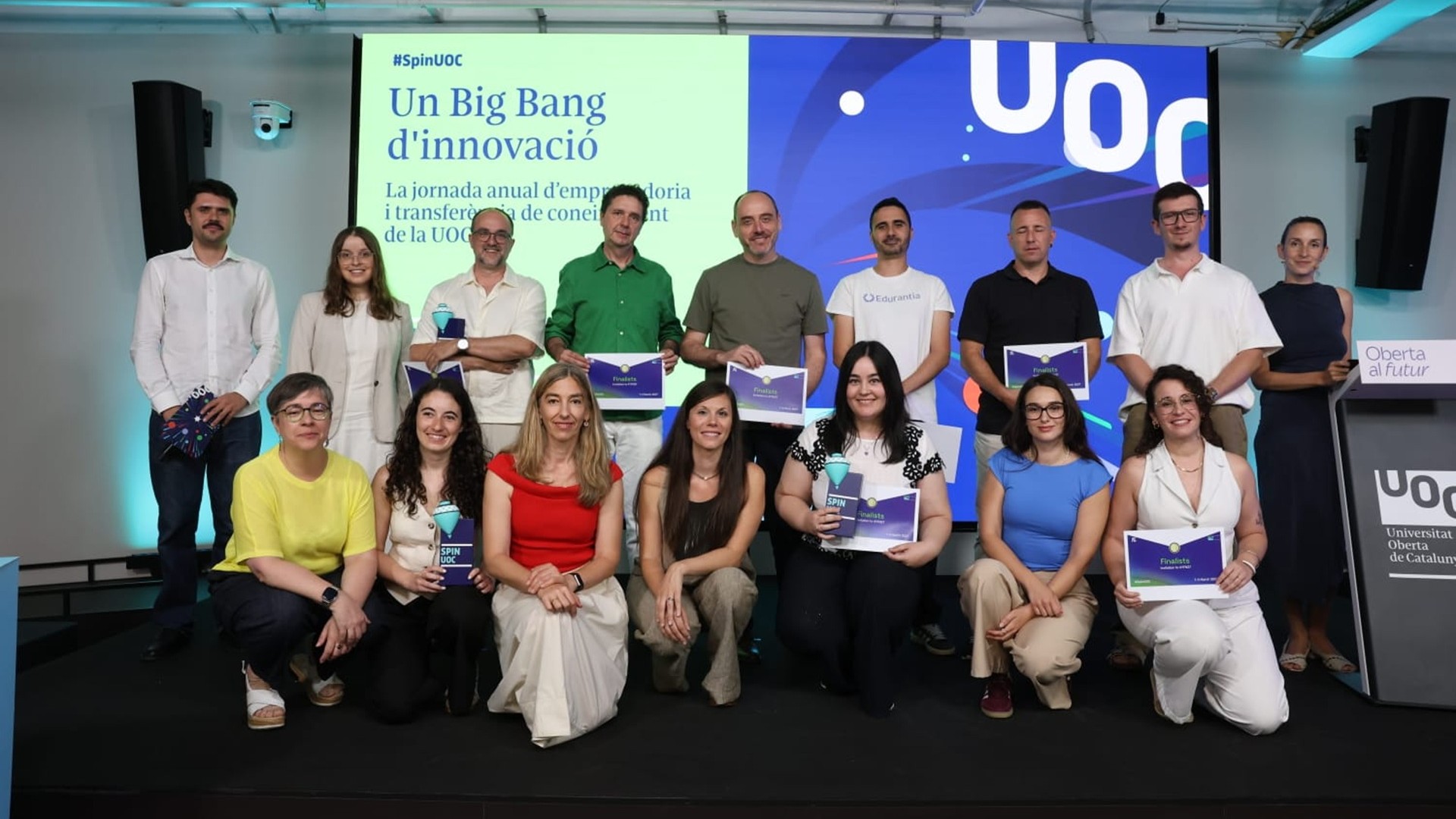
Kloosiv is a non-profit cooperative working to promote social inclusion through housing from its offices in Campdevànol, Catalonia. The cooperative took home both the Jury Award for Best Entrepreneurial Project and the inaugural SpinUOC Rural Award at SpinUOC 2026, organized by the Universitat Oberta de Catalunya (UOC). Although it manages social inclusion placements, its founders are keen to point out that it is much more than a "network of homes or a referral platform".
Kloosiv was launched by two graduates of the UOC Bachelor's Degree in Computer Engineering, Carles Gómez and Gerard Casaus, together with Laura Ayala. The cooperative manages its own placements, working directly with people and groups with complex support needs. According to the founders, these placements serve as a "space for intervention, research and validation", focusing on different support models. "This allows us to better understand what works, what doesn't and what tools need to be developed to improve support," said Ayala, who described the model as a "living lab for social inclusion". The platform then turns this knowledge into tools that can be used by other social organizations and public authorities.
“Universities such as the UOC can help us test the model in other settings, structure the knowledge we generate and share it with professionals already working in the social sector, as well as with the next generation of professionals in training”
Kloosiv currently manages 192 housing placements under its model. Of these, it operates 30 directly, 42 are privately owned placements managed or brokered by the cooperative, and 120 are managed by other organizations and receive methodological and technological support. In addition, the cooperative supports 108 people through non-housing social inclusion programmes, assisting with matters such as documentation, access to rights, language learning, community integration and other social inclusion processes. It also works with two local councils, having assessed nearly 400 homes and 600 people in vulnerable situations. Ayala said: "This work combines direct intervention, support for other organizations and local needs assessment, allowing us to better understand social challenges and housing opportunities across a range of different contexts."
Kloosiv follows a structured process involving needs assessment, interviews, follow-up and evaluation to gather information about the people in its social inclusion placements. According to Ayala, the cooperative uses "official scales and recognized tools such as SSM-CAT to evaluate vulnerability, well-being and support needs against standardized criteria". Technology, and artificial intelligence (AI) in particular, plays a pivotal role by helping to streamline the process. "Interviews can be conducted as spoken conversations, recorded with the person's consent, automatically transcribed and added to their case history," Ayala said. This, she added, "makes it possible to carry out more comprehensive and sustainable assessments that would be very difficult to maintain manually at the same level of depth, while reducing the administrative burden".
The platform tracks indicators across several dimensions, including well-being and autonomy, housing and living arrangements, documentation and access to rights, community integration, language learning, support networks and the opportunities available in the local area. "Technology helps detect changes, identify risks and spot patterns, but all final interpretations are made by a professional", Ayala stressed.
Collaboration with the Barcelona Supercomputing Center
Kloosiv teamed up with the Barcelona Supercomputing Center on the AINA Challenge, harnessing AI to assess social and social healthcare needs in Catalan. "We've worked together on a system to ethically evaluate Catalan-language chatbots that can support interviews, needs assessments and social care follow-up," Ayala said. "The aim is to simplify processes that are extremely time-consuming when carried out manually: collecting spoken information, transcribing it, structuring it, linking it to a person's case history and helping professionals analyse it more effectively." However, Ayala pointed out that "the focus isn't on automating decision-making, but on ensuring that these tools are safe, ethical, useful and suitable for sensitive social care settings".
Kloosiv's team brings together expertise in social support, housing, social inclusion, mediation, technology development, data analysis, AI, project management and regional strategy. Ayala said: "This combination is essential because Kloosiv doesn't develop technology from the outside looking in. Our tools are shaped by our hands-on experience with people, housing providers, social organizations and local authorities." She added that the project also aims to demonstrate that "rigorous, high-impact innovation can be achieved from both the social sector and rural areas".
Kloosiv's current goal is not simply to expand as a housing provider. Instead, the cooperative has identified four areas for growth: increasing its network to around 250 placements across urban, semi-urban and rural areas to validate different housing, co-living and support models; helping other organizations manage their housing, including through partnerships with the Support-Girona Foundation and Habitat3; equipping local authorities, particularly smaller municipalities, with the tools to identify housing opportunities, social vulnerability and available resources; and combining applied research, external validation and knowledge transfer to ensure sustainable growth. Ayala said: "Universities such as the UOC can help us test the model in other settings, structure the knowledge we generate and share it with professionals already working in the social sector, as well as with the next generation of professionals in training."
In addition, Kloosiv believes that specialized public bodies such as TIC Salut Social and Ivàlua can help validate the model, measure its impact and explore how it can be implemented safely, evaluated effectively and coordinated with the public administration.
This entrepreneurial project supports UN Sustainable Development Goals (SDGs): 1, No Poverty; 3, Good Health and Well-being; 4, Quality Education; 8, Decent Work and Economic Growth; 10, Reduced Inequalities; 11, Sustainable Cities and Communities; 16, Peace, Justice and Strong Institutions; and 17, Partnerships for the Goals.






Transformative, impactful research
At the UOC, we see research as a strategic tool to advance towards a future society that is more critical, responsible and nonconformist. With this vision, we conduct applied research that's interdisciplinary and linked to the most important social, technological and educational challenges.
The UOC’s over 500 researchers and more than 50 research groups are working in five research centres focusing on five missions: lifelong learning; ethical and human-centred technology; digital transition and sustainability; culture for a critical society, and digital health and planetary well-being.
The university's Hubbik platform fosters knowledge transfer and entrepreneurship in the UOC community.
More information: www.uoc.edu/en/research
FAQs
Experts UOC
Press contact
-
Anna Sánchez-Juárez