
A study reveals new insights into Europe's last major plague outbreak
A study by the UOC and UAB, published in the scientific journal PNAS, re-examines the biological nature of one of the last major plagues in 19th-century Western Europe: the 1820 plague outbreak in MallorcaThe research helps to better understand how the disease circulated and was transmitted, the evolution of outbreaks, and the importance of lockdowns
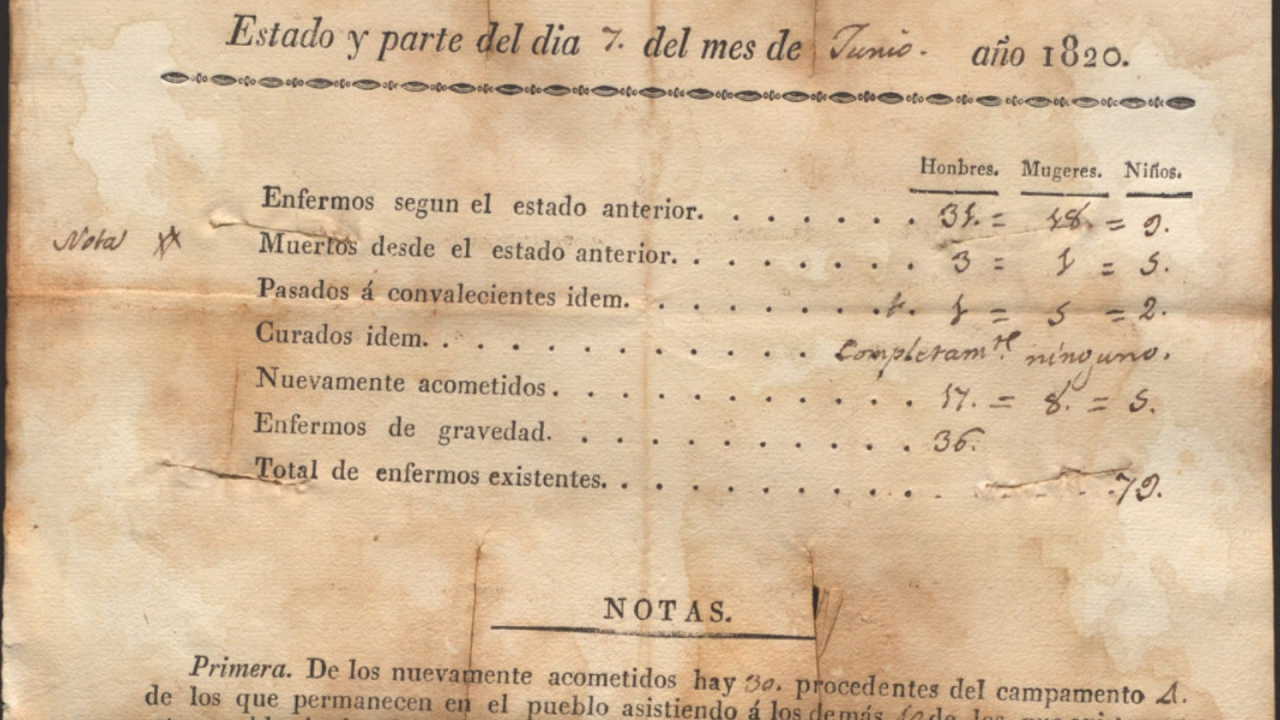
In May 1820, an outbreak of plague began in the eastern part of the island of Mallorca, traditionally classified as a late episode of bubonic plague. Now, a study published in the prestigious scientific journal PNAS, conducted by Joana Maria Pujadas-Mora of the Open University of Catalonia (UOC) and ICREA Academia researcher, and Pere Puig of the Autonomous University of Barcelona (UAB) and the Centre for Mathematical Research (CRM), re-examines how the plague was transmitted in a context prior to the development of bacteriology.
The research reveals that, according to historical documents, the sick deteriorated very rapidly. These characteristics contrast with previous interpretations, which attributed the episode primarily to bubonic plague transmitted by flea bites associated with rodents. In this regard, researcher Joana Maria Pujadas-Mora, from the SEC-History Society, State and Culture group (UOC-TRÀNSIC) and professor at the Arts and Humanities Department, emphasizes: “Our analysis provides new evidence about the 1820 plague outbreak in Mallorca and suggests that the pneumonic and septicemic forms could help explain the high mortality rate, which reached 78%.” Furthermore, historical data rules out rats as a reservoir for the disease and points to human ectoparasites, such as fleas and lice, or direct person-to-person transmission as the most likely routes of spread in the 1820 outbreak.
According to the research, the 1820 outbreak in Mallorca likely arrived from Tangier via infected crew members who disembarked clandestinely in the Son Servera area, in the east of the island. The town lacked a port, and goods were unloaded using small rowboats, making it unlikely that infected rats reached the ground. According to the study, the most likely scenario is that infected fleas from the ship bit residents of Son Servera, who subsequently became ill. Another possibility is that the disease arrived through close contact with infected crew members. From this initial outbreak, the plague could have spread rapidly via human ectoparasites, such as fleas or lice, and also through direct person-to-person transmission of the septicemic and pneumonic forms.
The importance of Lockdown
However, the epidemic did not spread massively thanks to the strict isolation measures implemented once the outbreak was confirmed. The towns of Artà, Son Servera, and Capdepera were cordoned off, and later, Manacor as well. These measures, which involved a strong military presence and reduced trade and movement between towns, demonstrate the authorities' awareness that the disease was contagious.
“Research questions traditional interpretations of the disappearance of the plague in Western Europe and highlights the role of human behavior”
In total, more than 2,400 of the area's 7,500 inhabitants died during this episode, known as the last major plague outbreak in 19th-century Europe.
This research challenges traditional interpretations of the plague's disappearance in Western Europe and highlights the role of human behavior, mobility, and ectoparasites in the evolution of epidemics.
The study is based on a previously unexamined daily historical record that systematically collected the number of cases, deaths, convalescents, and recovered patients throughout the outbreak. Given the recent experience with the global pandemic, Pujadas-Mora emphasizes the value of this historical information for the present: “It is important to highlight the significance of having data that allows us to measure and reconstruct the temporal dynamics of an epidemic. In our case, the data from 1820 allows us to analyze its evolution and is entirely exceptional. This issue remains fully relevant today. The availability of reliable and timely data is essential both for understanding the trajectory of an epidemic and for informing its monitoring and decision-making.”
By combining this historical documentation with advanced quantitative methods, the research provides new information about the nature of the outbreak and allows for a better understanding of how plague epidemics developed before the responsible bacteria were known. This work demonstrates the value of connecting archival evidence with mathematical and statistical modeling to reconstruct the ecology of past diseases and improve our understanding of pathogen transmission in historical populations.
Reference article: Puig, P., & Pujadas-Mora, J. M. (2026). The 1820 Mallorca plague was not a classic bubonic outbreak. Proceedings of the National Academy of Sciences https://doi.org/10.1073/pnas.2536892123
This UOC research is part of the project PID2021 -1280100B-I00. Epidemias, estado y desigualdades socioeconómicas: predictibilidad y perdurabilidad, siglos XIX y XX (EPI-DESIGUAL), funded by the Ministry of Science, Innovation and Universities. It also contributes to the UN 2030 Agenda's Sustainable Development Goals (SDGs), including SDGs 3 on Good Health and Well-being, and 9 on Industry, Innovation and Infrastructure. It is also aligned with the UOC's research missions, Culture for a critical society and Planetary health and well-being.

Transformative, impactful research
At the UOC, we see research as a strategic tool to advance towards a future society that is more critical, responsible and nonconformist. With this vision, we conduct applied research that's interdisciplinary and linked to the most important social, technological and educational challenges.
The UOC’s over 500 researchers and more than 50 research groups are working in five research units focusing on five missions: lifelong learning; ethical and human-centred technology; digital transition and sustainability; culture for a critical society, and digital health and planetary well-being.
The university's Hubbik platform fosters knowledge transfer and entrepreneurship in the UOC community.
More information: www.uoc.edu/en/research
Notícia relacionada

Experts UOC
Press contact
-
Anna Sánchez-Juárez