
Authory.tech, a tool helping teachers detect students’ misuse of AI
The platform, shortlisted for the SpinUOC entrepreneurship awards, helps teachers verify the authorship of pupils’ work based on an analysis of their writing processesAuthory.tech is a plugin integrated into educational platforms such as Moodle and Canvas

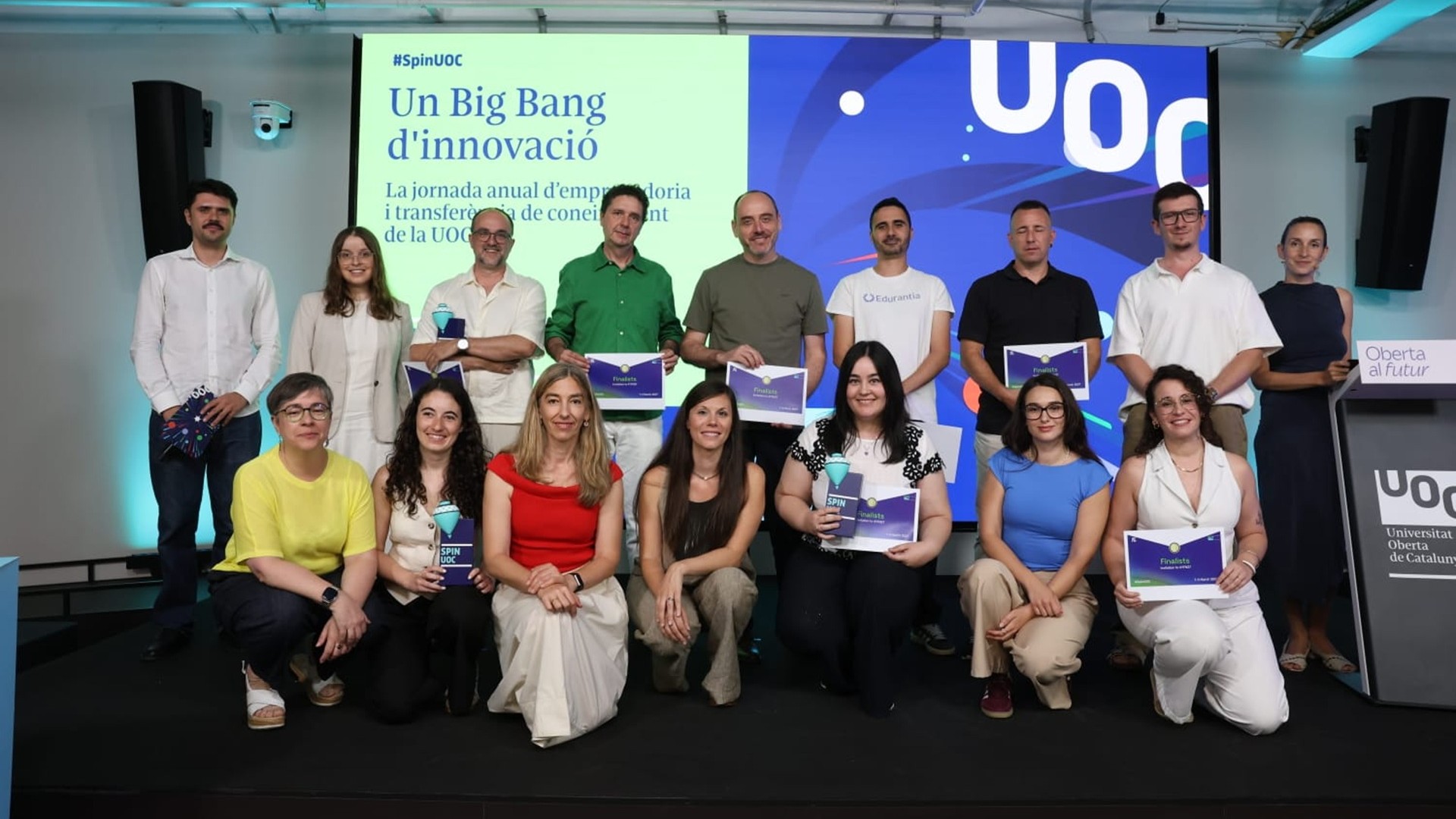
Artificial intelligence (AI) is already part of everyday life in the education world, and could become even more widespread over time. Ensuring that learning in these settings continues to be a process based on effort and knowledge building is one of the main goals of Authory.tech. This tool co-created by Nil Gallego, who is pursuing a Bachelor’s Degree in Computer Engineering at the Universitat Oberta de Catalunya (UOC), was selected as a finalist project in the SpinUOC 2026 entrepreneurship programme.
Its creators describe it as a platform that can be easily integrated into LMSs (Learning Management Systems), such as Moodle and Canvas, helping teachers verify the authorship of academic assignments based on an analysis of students' writing processes. However, they stress that their goal "is not to replace teachers' criteria, but rather to back them up with objective data. Our main concern isn't just the automation of writing, but also the risk that students will no longer develop key skills such as critical thinking, the ability to argue a point or the crafting of their own unique voices."
The developers of Authory.tech explain that the platform emerged from an "intuition" when they saw that generative AI was transforming the way students tackled assignments but that grading tools "weren't equipped for the new context". This imbalance prompted them to conduct research and speak with teachers from different schools, who acknowledged that, although they could tell when an assignment hadn't been completed by one of their students, they lacked the tools to prove it. “This led to uncertainty, conflicts and a gradual loss of trust in the grading process,” they explain.
“Our goal is not to replace teachers’ judgement, but rather to support it with objective data”
The data reflect this emerging phenomenon. According to a study recently cited by The Economist, 15% of high-school students in the US admitted to using AI to complete an entire assignment in 2025, compared to 11% the previous year. At the same time, over half of high-school students believe that AI can harm their critical thinking skills. In addition to this phenomenon, the creators of Authory.tech also observed that current tools had a clear limitation: “Most of them only analyse the final text, provide opaque percentages, and result in false positives.” They believe that the future requires understanding the process of completing the assignment, not just the result.
How does Authory.tech work?
Authory.tech is a plugin integrated into educational platforms such as Moodle and Canvas. The system records various metrics reflecting writing patterns, such as writing speed, the time the student takes to complete the assignment, the insertion of copied passages and the use of vocabulary considered unusual for their academic level. Furthermore, it contextualizes these patterns by comparing them among different students in the same group. This information is then transformed into graphics and metrics helping teachers better understand the work that went into a given assignment.
In some cases, interpreting these metrics is straightforward because “there are very obvious patterns associated with assignments completed using AI or copied content”, the creators of Authory.tech say. For example, some students finish the assignment too quickly or have clearly copied and pasted the text. “However, in the pilot tests we’ve also come across cases of students who are very good at covering up their use of AI. That’s why we've developed support documents for teachers, explaining which metrics to watch out for and how to cross-reference different indicators to accurately identify suspicious cases.” That’s why the creators of Authory.tech don’t see it as a tool that delivers automated judgements or opaque percentages of “AI-generated text”. Rather, it “provides contextualized, transparent evidence to help teachers make the final decision”.
But besides looking at how texts are produced, does Authory.tech also detect whether a person or an AI came up with the ideas expressed in the assignment? It “doesn’t automatically determine whether an idea is human or AI-generated”, the tool’s creators say. “Our proposal is based on analysing the writing process to provide evidence about the work that went into completing an academic assignment: we look at patterns in writing, editing, text insertion and speed that help to contextualize the assignment.”
They suggest that this approach can also be expanded to other educational applications: “Since Authory.tech analyses the writing process, it can detect other situations besides the potential use of AI. For example, it can show if a student needed much more time than their classmates to complete an assignment, or is exhibiting different writing patterns. This information can help teachers identify learning difficulties and offer additional support.”
The UOC’s role in the project
Gallego explains that the UOC has played a key role in the development of Authory.tech since its inception: “When we started in the Edutech Emprèn programme, it was just an idea that we thought could be useful for teaching staff. As the programme went on, we fine-tuned the various facets of the project.” Participating in this programme gave them the opportunity to have a stand at 4YFN, “which was a true turning point for the project. We were able to publish our first press releases encouraging schools to try out the tool, which in turn led to the first pilot tests.” All of this support empowered them to go from an initial intuition-based idea to a solution that they plan to launch on the market just in time for the start of the academic year in September.
The tool’s developers feel that they’re ready to start marketing it through various channels: LMS application markets, direct sales and an education supplies company interested in offering the tool to its clients. At the same time, they’re looking for universities to start pilot tests in higher education. In the medium term, their goal is to scale up and secure approval from the regional authorities to integrate Authory.tech in state-school Moodles. However, they also have a broader goal: “We want to help restore trust and transparency to grading in the age of AI. We believe that technology must help preserve the foundations of learning: effort, critical thinking and students’ ability to develop their own voices.”
Outlook on AI: pro-responsibility, anti-prohibition
The creators of Authory shy away from a “prohibitionist approach to AI”. On the contrary, they believe that “used properly, it can be an incredibly powerful educational tool because it can help students structure information, practise skills, receive feedback or explore content.” The key, they argue, “is for AI to complement the learning process without replacing it. We feel that responsible use means transparency, sound judgement and educational purposes. The goal is for students to continue thinking about, deciding on, editing and crafting their own text. We want education to continue serving as a tool for social mobility, where effort and critical thinking make the difference. Technology must support this process, not replace it.”
Authory.tech was one of the winning projects of the Santander X Award | University Entrepreneurial Projects 2026, promoted by Banco Santander and the UOC through its entrepreneurship platform, Santander X.
This award, obtained in the UOC call, recognizes the disruptive and innovative nature of the technology developed by the startup. This achievement provided the team with a financial boost—endowed with 2,000 euros—and granted them a direct pass to compete in the national phase of the Santander X Spain Awards.
The Authory project is aligned with one of the UN’s sustainable development goals (SDGs): Quality Education, 4.

Transformative, impactful research
At the UOC, we see research as a strategic tool to advance towards a future society that is more critical, responsible and nonconformist. With this vision, we conduct applied research that's interdisciplinary and linked to the most important social, technological and educational challenges.
The UOC’s over 500 researchers and more than 50 research groups are working in five research units focusing on five missions: lifelong learning; ethical and human-centred technology; digital transition and sustainability; culture for a critical society, and digital health and planetary well-being.
The university's Hubbik platform fosters knowledge transfer and entrepreneurship in the UOC community.
More information: www.uoc.edu/en/research
Frequently asked questions
Experts UOC
Press contact
-
Anna Sánchez-Juárez