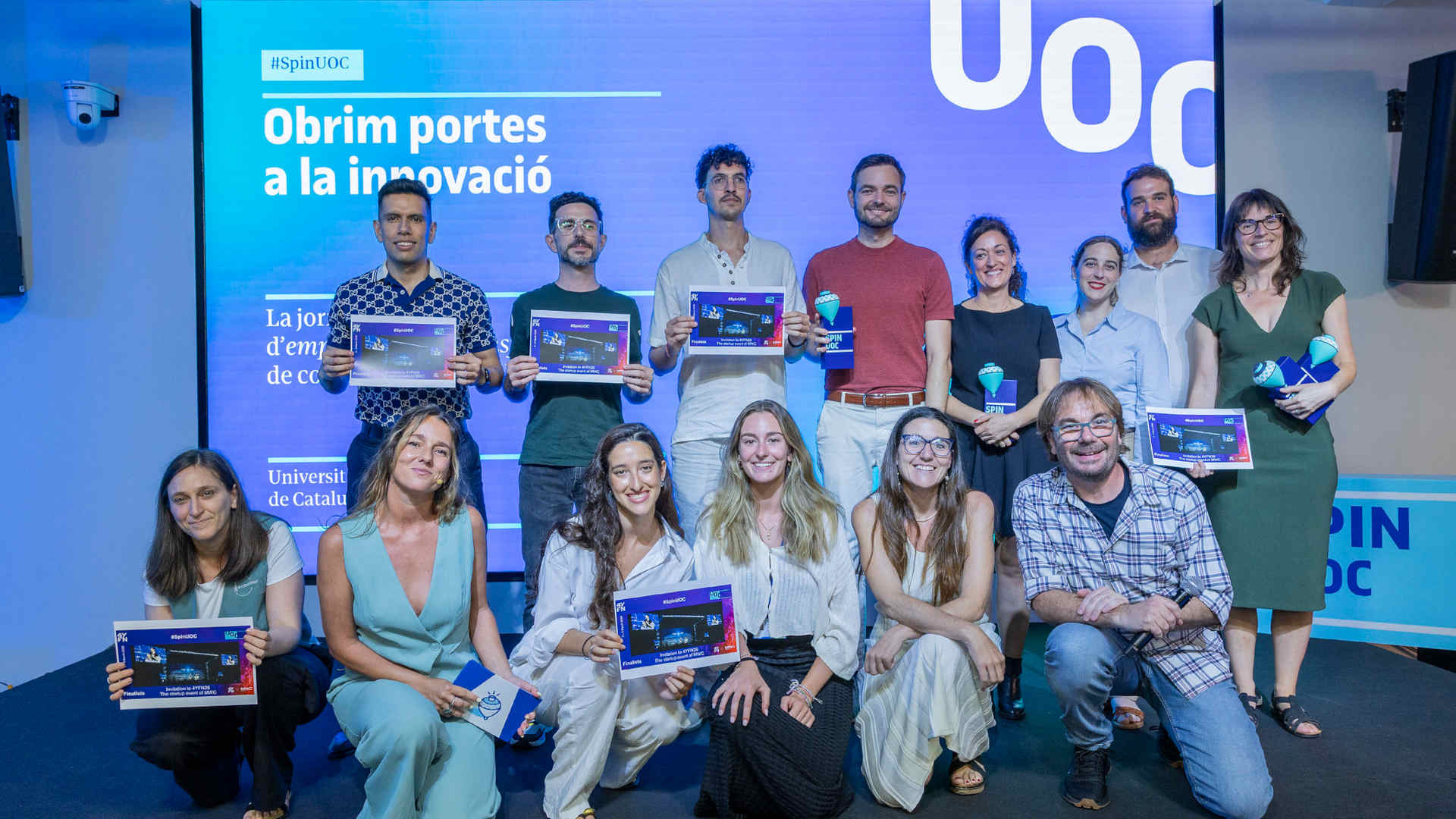
The SpinUOC programme is being held for the 14th time, rewarding entrepreneurship and rural talent
The event will be held on 18 June at the UOC centre in BarcelonaThe event will include 11 presentations of innovative proposals, four of them related to the rural environment
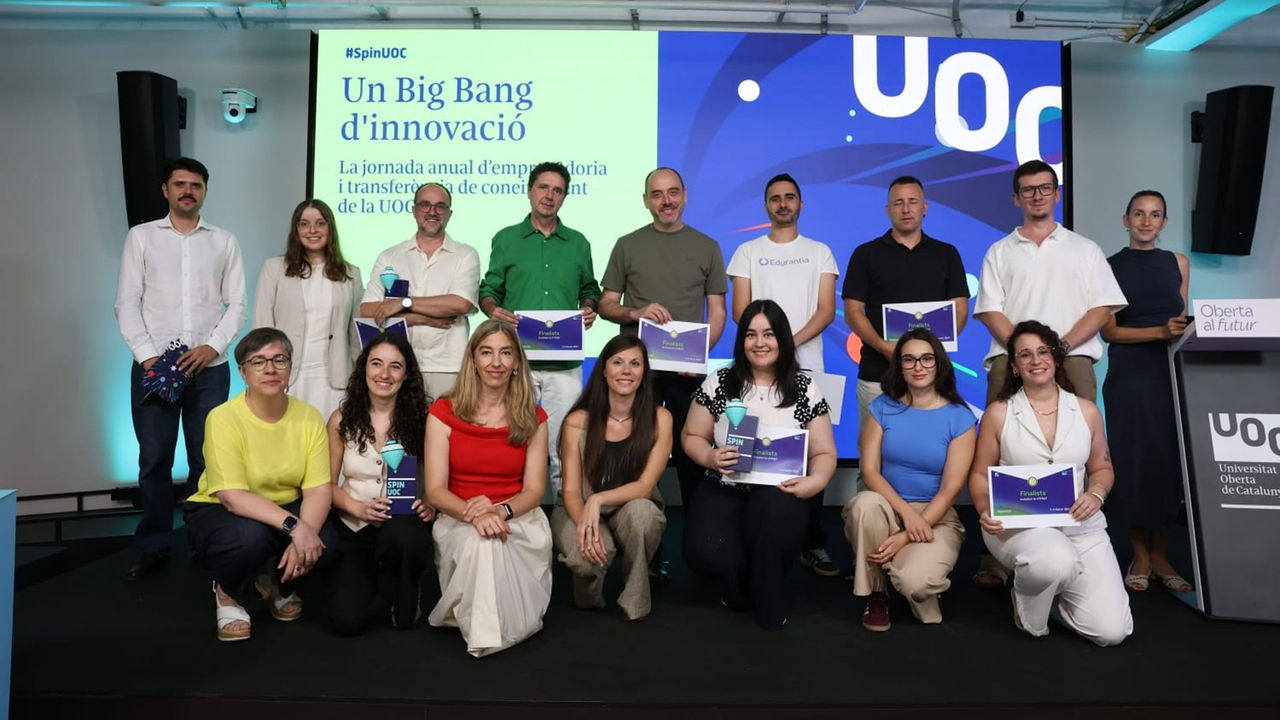
[June 19 update]
SpinUOC 2026 winning projects
‘Best Entrepreneurial Project Award’, endowed with a cash prize of 10,000 euros: Kloosiv - Laura Ayala.
‘Ramon Molinas Foundation Award’, endowed with a cash prize of 10,000 euros: Plastikóre - Marcel Bassachs.
‘Audience Award for Best Presentation’, endowed with 3,000 euros in cash: Plastikóre - Marcel Bassachs.
‘SpinUOC Dona Award’
· First prize endowed with a cash prize of 10,000 euros: Phycocares - Eloisa Toledo.
· Second prize endowed with a support program for the development, validation, and implementation of the business model and the financing plan (valued at 2,500 euros) offered by Hubbik: SenIA - Sheila Canudas.
‘SpinUOC Rural Award’ endowed with a cash prize of 10,000 euros: Kloosiv - Laura Ayala.
“We value entrepreneurial projects that look ahead and have a vision and a spirit of service to the community”
The annual SpinUOC programme, through which the Hubbik platform promotes entrepreneurial and technological initiatives from across the Universitat Oberta de Catalunya (UOC) community (students, alumni, faculty, research staff and administrative staff), will hold the final event of its 14th edition on 18 June at the UOC campus in Barcelona (Carrer del Perú, 52). To attend as a member of the audience, you must register via this link.
The main novelty this year is the launch of the SpinUOC Rural category, designed to reward projects with an impact on the rural world, whether or not they belong to the UOC community. In a pre-event competition, four projects will compete for a prize of €10,000, and the winner will also be entered directly as a finalist in the main event.
The winner of SpinUOC Rural will join the other seven finalists of the general programme to compete for a total of €23,000 in prizes. This amount comprises €10,000 for the best project, decided by the panel of judges, another €10,000 from the Ramon Molinas Foundation for the initiative with the greatest social impact, and €3,000 for the project receiving most votes from the audience. The event will conclude with the announcement of the winner of the SpinUOC Dona award, contested by four projects headed by female entrepreneurs from the Hubbik community.
The event will be divided into two parts. It will start at 5.45 p.m. with the SpinUOC Rural session, lasting approximately 45 minutes, and after a short break, the main SpinUOC session will start at 7 p.m.
The Rector of the UOC, Àngels Fitó, emphasized the significance of the SpinUOC programme and the importance of entrepreneurial projects which are developed "within the big family that is the UOC." She praised the work done by hundreds of people who apply each year and highlighted the value of initiatives "that look ahead and have a vision and spirit of service to the community," adding that the awards presented during the event are intended to "recognize determination to succeed in a challenging environment" and that "reaching the final is a merit in itself" in view of the large number of entries received.
Regarding the university's commitment to the rural environment, Manel Jiménez-Morales, Vice Rector for Alliances, Community and Culture at the UOC, said that "we are convinced of the crucial importance of people's knowledge and talent to foster strong regions that are connected both economically and from a social and cultural point of view."
The seven projects that have already been selected as finalists for SpinUOC 2026 are described below.
Detecting if a student has misused AI
Nil Gallego, who is studying for a Bachelor's Degree in Computer Engineering, is one of the developers of Authory.tech, a platform that offers a text authorship verification system for teaching staff. The tool analyses writing to provide teaching staff with objective metrics about students' writing patterns. The platform has been created to address the current situation of more and more teachers suspecting the use of artificial intelligence in academic tasks, but not having clear evidence to prove it. Authory.tech uses objective data to detect whether a student has misused AI to do academic work.
A gamified virtual city that motivates students
Edurantia is a project by Óscar Herrero, a graduate of the Bachelor's Degree in International Relations programme. It consists of a gamified application that motivates students with the management of a virtual city. The app improves academic performance by applying knowledge to real-world problems and develops transferable skills. The application can be used in any educational centre in groups of students from 11 to 15 years old, and can be adapted to the needs of the classroom and the diversity of the pupils. The platform integrates four key competencies – entrepreneurship, STEM, linguistic communication and learning to learn – with automated tracking to minimize the workload for teachers.
AI and personal support to combat sedentary lifestyles and chronic diseases
Beth Iriarte, who was a course instructor for the Bachelor's Degree in Communication, is co-founder of Fitter, a digital health app that combines AI supervised by healthcare professionals with coaching, nutrition, and physiotherapy to deliver highly personalized health programmes.
Focusing initially on the prevention and management of type 2 diabetes in adults, Fitter addresses one of the major public health challenges: low adherence to sustainable healthy habits. Its model combines technology and human support to improve results, encourage user autonomy and help reduce pressure on the healthcare system.
Through a hybrid scalable approach, the app redefines how people access health solutions, promoting active ageing and combating sedentary lifestyles and the pathologies associated with them.
A platform for tourism and events without greenwashing
Julio Fernández de la Iglesia, a graduate of the University Master's Degree in Digital Innovation and Transformation programme, is the developer of Mintnature, a digital platform that allows event organizers, companies and organizations in the tourism sector to offset CO₂ emissions, avoiding greenwashing. The platform also makes it easier for organizations to meet sustainability reporting requirements in a simple, verifiable and traceable way. Through blockchain technology, tokenization and AI, the platform transforms climate compensation, traditionally opaque and complex, into verifiable data and reports ready for regulators, investors and customers. The platform also generates digital assets that are shared with event attendees in the form of EcoSeals, making the climate action taken visible, participatory and easy to understand.
Improving teaching practice with classroom evidence
Gerard Ferrer Esteban, researcher at the UOC, coordinator of the Laboratory of Social Education (LES), attached to the UOC-FuturEd research centre and a member of teaching staff in the Faculty of Psychology and Education Sciences, is one of the founders of Observa, a teacher assessment and improvement platform designed for primary and secondary schools, based on evidence collected in the classroom. The tool transforms the observation of real-world practice into professional learning using classroom videos that blend peer observation and AI support to deliver training feedback. The system transforms qualitative assessments into personalized reports for teachers and schools, with a map of strengths and needs. The platform facilitates decision-making for management teams and teachers in less time and using fewer resources than in traditional processes.
Eliminating micro-pollutants from wastewater
Marcel Bassachs, a graduate of the University Master's Degree in Cultural Management, is one of the developers of Plastikóre, an innovative project in the field of wastewater treatment to efficiently eliminate microfibres without the use of chemical reagents. The initiative helps reduce the release of micro-pollutants into rivers and the sea by between 85% and 95%, according to its creators. It follows the principles of the circular economy and is based on deep-tech technology that is scalable, modular and sustainable, and could be of interest to wastewater treatment plants, textile industries and engineering consultancies that must comply with environmental regulations.
AI used to improve practical training in physiotherapy
Iker Villanueva, a graduate of the University Master's Degree in E-Health programme presents SynaptIA, an edtech platform for AI-based e-learning that enhances practical training in physiotherapy through clinical simulation with synthetic patients and automated assessment. The platform provides continuous skills training and overcomes the limitations of cost, infrastructure and scalability of traditional simulation.
Students interact with realistic synthetic patients through natural language. The platform offers an attractive technological solution for universities and professional physiotherapy colleges, both for regulated training and for professional refresher courses.
The following projects are also vying for the SpinUOC Rural award to become the eighth finalist in the event.
Using AI to detect illegal waste dumping
Elohawk is a platform based on AI and geospatial analysis that detects illegal dumping across large areas of land. The platform, created by Eduardo López, who is studying for a University Master's Degree in Data Science, increases public inspection capacity through the use of existing data. The application combines aerial orthophotography, LiDAR (light detection and ranging) data and administrative sources to identify sites at risk, generate visual evidence and prioritize inspections by determining the area occupied by the waste and estimating its volume.
AI for social and residential inclusion in rural settings
Two computer engineering graduates, Carles Gómez and Gerard Casaus, along with Laura Ayala, are co-founders of Kloosiv, an AI platform that predictively identifies risks such as residential insecurity, unwanted loneliness, social fragility or the lack of a community support network. The tool combines AI models and advanced data analysis to collect, cross-reference, and analyse social, residential, socio-health and community information at regional level. The intelligent mapping of rural municipalities shows key indicators for government bodies and social organizations. The data make it possible to prioritize intervention, design personalized support itineraries and coordinate the work of local agents, optimizing resources and facilitating preventive, scalable and reproducible intervention models in different areas.
Seaweed as a natural alternative to fungicides for oranges
Phycocares, a project created by Eloísa Toledo, a graduate of the University Master's Degree in Bioinformatics and Biostatistics programme and currently a researcher at the Politécnico de Leiria (Portugal), is a sustainable solution derived from invasive red algae found in the Iberian Peninsula to control green mould, the main cause of post-harvest losses in oranges, accounting for approximately one million tonnes annually. By combining biotechnological innovation with the principles of the circular economy, this initiative offers an accessible solution for distributors of agricultural supplies for the citrus sector.
The solution is aimed at fruit and vegetable processing plants, cooperatives and rural producers. reducing losses in the orange production chain. Its formulation reduces fungal infection during storage and transport, improves fruit preservation and prolongs shelf life. Given the increasing EU restrictions on synthetic fungicides and the shortage of effective alternatives, the project provides a response to the rural citrus sector's urgent need for affordable, natural and industry-compatible alternatives.
Electric bike rental for rural areas
Mariana Boadella is one of the driving forces behind Turicleta, the first autonomous electric bike rental network designed specifically for the rural environment. The project combines unstaffed smart stations, electric bicycles, and an app to offer a sustainable mobility and active tourism solution. The goal is to enable municipalities and those providing accommodation to easily activate tourist experiences, generating economic, social and environmental benefits for the region. It uses a plug and play system and does not, therefore, require on-site personnel. The project relies on a network of local partners for maintenance and support, rooting it in the local economy.
SpinUOC is a UOC entrepreneurship promotion programme coordinated by the Hubbik platform and supported by the Ramon Molinas Foundation.
SpinUOC may be co-funded by the EU's European Regional Development Fund (ERDF) as part of the Catalonia ERDF Operational Programme 2021-2027.
Transformative, impactful research
At the UOC, we see research as a strategic tool to advance towards a future society that is more critical, responsible and nonconformist. With this vision, we conduct applied research that's interdisciplinary and linked to the most important social, technological and educational challenges.
The UOC’s over 500 researchers and more than 50 research groups are working in five research units focusing on five missions: lifelong learning; ethical and human-centred technology; digital transition and sustainability; culture for a critical society, and digital health and planetary well-being.
The university's Hubbik platform fosters knowledge transfer and entrepreneurship in the UOC community.
More information: www.uoc.edu/en/research
Experts UOC
Press contact
-
Anna Torres Garrote