
UOC launches two bachelor's degrees and two university master's degrees
Biomedical Engineering, Software Development, Educational Psychology and Applied Data added to the official range of courses for the 2026/2027 academic yearThe university will also offer a new MBA

The two new bachelor's degrees that the UOC will be offering next academic year are the Bachelor's Degree in Biomedical Engineering, taught by the Faculty of Computer Science, Multimedia and Telecommunications, and the Joint Bachelor's Degree in Software Development and Testing, which will be taught entirely in English with the Open University of the Netherlands (OUNL) and Spain's National University of Distance Education (UNED), as part of the European OpenEU alliance. There will also be two new official master's degrees: the University Master's Degree in Applied Data Analysis and Visualization and the new University Master's Degree in Educational Psychology. These and more new developments will be presented on the UOC's new stand at the Saló de l'Ensenyament education fair, which is open to visitors at the Fira de Barcelona from 16 to 18 March.
Bachelor's Degree in Biomedical Engineering
The UOC's Bachelor's Degree in Biomedical Engineering provides online interdisciplinary education in the fields of engineering, computer science and health sciences. The programme places particular emphasis on emerging fields, including artificial intelligence applied to health, medical imaging and bioinformatics, and trains students to design innovative medical technologies and contribute to the development of personalized medicine. It incorporates innovation and ethics to prepare students for the demands of a growing labour market, especially in digital health and biotechnology sectors or the development of medical devices.
Biomedical engineering is a discipline with multiple applications, including the development of new drugs, the design of prostheses and biomechanical systems, the creation of applications for monitoring health using wearables, and the management and analysis of clinical data.
The new bachelor's degree programme has been designed by faculty members Francesc Saigí and David Merino. "The demand for biomedical engineers has increased significantly in recent years, especially in the pharmaceutical and biotech sectors, or in the development of biomedical sensors and digital health, where digital technologies are transforming how diseases are prevented, diagnosed and treated," said Merino.
Meanwhile, Saigí highlighted the potential of this field in areas such as "nanomedicine and robot-assisted surgery, where we can improve the precision of treatments and develop new types of therapeutic interventions."
Joint Bachelor's Degree in Software Development and Testing
This is the UOC's first official international programme. It will be taught in partnership with the Open University of the Netherlands (OUNL) and Spain's National University of Distance Education (UNED) as part of the OpenEU alliance. This alliance is coordinated by the UOC, and consists of ten member universities and seventeen associated partners, including academic, business, rural, municipal and civil associations from all over Europe. It aims to create a pan-European open university and transform digital education on the continent. This bachelor's degree will only be taught in English and will have a total study load of 180 credits, as is the case with the standard structure of European bachelor's degree programmes.
Students will master software development, from conceptualization to implementation, testing and maintenance. The programme is a response to the growing demand for experts in software development and testing, and provides a path to a profession with excellent prospects and competitive salaries.
The academic director of this new bachelor's degree course is Javier Cánovas, associate professor in the UOC's Faculty of Computer Science, Multimedia and Telecommunications. He said that "the launch of this new programme within the OpenEU alliance provides a unique opportunity in an innovative international environment to learn a key profession in our knowledge society – a society that relies on software development and testing competencies to sustain its technological foundations".
University Master's Degree in Applied Data Analysis and Visualization
The UOC is responding to the demand for interdisciplinary analytical profiles by launching this new university master's degree: an official programme designed to bridge the digital divide for professionals from the social sciences and humanities, with a modular structure and three specialization pathways. Students on the programme can focus on business intelligence in organizations, and study customer, operations and human resources analytics for corporate decision-making. It also offers a specialization in Data Strategy and Policy, which focuses on governance, analytical culture and designing economic and social indicators for institutions. Finally, the pathway in Data Science Applied to Social Sciences trains students in advanced research techniques, covering text analysis, studying social networks and communities, and modelling and prediction through machine learning.
The director of this new official master's degree will be Josep Cobarsí, associate professor in the Faculty of Computer Science, Multimedia and Telecommunications.
University Master's Degree in Educational Psychology
With a clearly profession-focused and practice-oriented approach, this new master's degree programme emphasizes the development of competencies for advising and supporting educational improvement and innovation. It is aimed above all at eliminating barriers to learning and participation, and building inclusive educational environments in diverse educational and community contexts.
The aim is to prepare students to work in educational psychology and act as agents for change and educational transformation. This new programme also trains educational psychologists to act as advisors in the use of artificial intelligence in educational ecosystems, promoting its integration in order to enhance inclusion and personalized learning, while remaining subject to ethical and regulatory criteria.
The director of this new official master's degree will be Rosa Maria Mayordomo, a member of the Faculty of Psychology and Education Sciences.
University Master's Degree in Business Administration and Management (MBA)
Traditional leadership roles have become obsolete in an age when AI and ESG (environmental, social, and governance) regulations are redefining the economy. The new executive profile that companies are seeking calls for a hybrid combination: a command of emerging technologies and soft skills in order to manage diverse teams. The new MBA provides training for agents of change: professionals who are ready to lead and transform organizations – both existing institutions and new initiatives, incorporating sustainability as a strategic driving force, rather than a mere obligation. Executive leadership for the here and now.
The director of this upgraded programme is Laura Lamolla, associate professor in the Faculty of Economics and Business.
Short courses
The university will be complementing the new range of programmes with four expert diplomas in:
● Digital Health, which will provide specific training related to the advanced use of AI in the assessment, prevention, diagnosis, treatment and management of patients in clinical settings.
● Strategic Management and Logistics in International Development Cooperation and Humanitarian Action (UOC-Red Cross), providing a comprehensive and professional approach to the management of operations in complex environments, with a strategic emphasis on team management.
● Internal Communication Management (UOC-DIRCI), to acquire the competencies and knowledge needed in the corporate communication sector.
● Transmedia Communication.
New microcredentials
Microcredentials are the UOC's bold move to boost employability. They offer people a way to certify their professional skills through short courses. Around a thousand people have taken one of the more than 100 microcredentials offered by the UOC this year. The range of courses will be expanded next academic year to include 23 new courses in the following areas:
● Artificial Intelligence: Generative Artificial Intelligence Applications and Tools for Scientific Research, AI for Decision-making (a new soft skill from the UOC Skills Lab).
● Programming and Data Analysis: Qualitative Tools for Data Analysis and Presentation, Analytical Questions, Data and Knowledge Extraction, and new levels of Python, JavaScript and R at the Coding School.
● Education and Equality: Educating for Equality; Who Designs the Future? Gender, Technology and the Challenge of Equality; Multilingualism in the Pre-school Classroom; Asynchronous Teaching: Pedagogical Design and Training for Pre-school Teachers.
● Political Science: Geopolitics of Conflicts, Data Management Applied to Political Science.
● Food and Sport: Biology and Physiology Applied to Sport; Food and Physical Activity at Different Stages of Life; Food, Cooking and Sport; Comprehensive Athlete Assessment; New Trends in Food.
● Legal Review: Current Challenges in the Termination of Employment Contracts: Beyond the Legislation.
● Sustainability: ESG Guidelines and Sustainability Communication
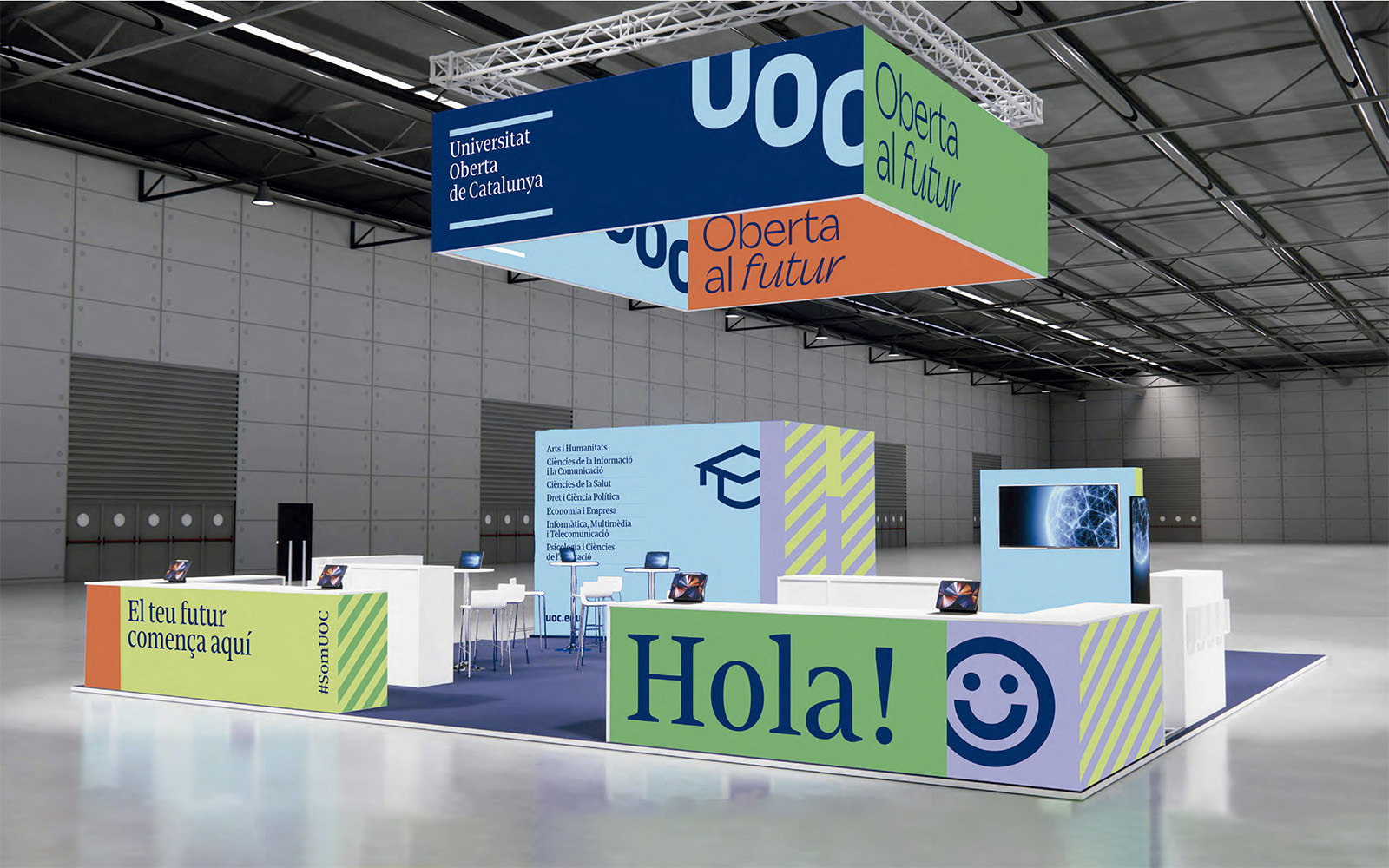
New stand at the Saló de l'Ensenyament education fair.
New stand at the Saló de l'Ensenyament education fair
After an overhaul of its web portal, the UOC is also enhancing its presence at the Saló de l'Ensenyament education fair. This year more than ever, the stand aims to reflect the university's spirit: open, flexible and with close ties to the community.
The UOC's corporate visual identity has been refreshed with a new range of colours that are brighter, clearer and more consistent. The university's new slogan – Open to the future – serves as the cornerstone for communications and features prominently.
The stand will be a meeting point where visitors can discuss issues. It will feature daily information sessions so that students can learn about the UOC's innovative learning methodology, and an academic guidance team will be providing tailored advice.
In short, students will be able to explore the programmes offered at the university, clear up any doubts and design their own training pathways.
Press contact
-
Anna Torres Garrote